Ajit Singh Kullar - Orvador

Grants for Nonprofits: Where to Find Funding in 2026 (Foundation, Corporate & Government)

TL;DR: Looking for grants for nonprofits in 2026? Funding now comes from three main channels – foundations, corporations, and government agencies- and each has its own databases, timelines, and paperwork. Unrestricted grants for nonprofits are harder to win but far more valuable than restricted, program-specific funding because you decide how to spend them. Government grants for nonprofits typically require SAM.gov and Grants.gov registration months before a deadline, so early setup matters. This guide walks through where to search for grants for nonprofit organizations, how to build a 12-month grant calendar, and a readiness checklist to run before you apply. If you want a funding source you can activate this week with zero application backlog, the Google Ad Grant gives eligible nonprofits $10,000 a month in free search advertising. We cover how it fits into your broader funding mix, and how Orvador can set it up for you, at the end of this guide.

Nonprofits chasing grants for nonprofits in 2026 are working in a noticeably different funding environment than they were even two or three years ago. Federal budgets have tightened in some categories and expanded in others, more foundations are experimenting with rolling and rapid-response applications, and corporate giving programs increasingly bundle cash with in-kind software credits. If your organization is still applying the way it did in 2022, you are likely missing funding sources that didn’t exist a few years back, and possibly wasting hours on databases that have gone stale.

This guide breaks down exactly where to look for grants for nonprofits in 2026, how foundation, corporate, and government funding differ in process and risk, and how to build a repeatable system so grant seeking stops being a once-a-year scramble.

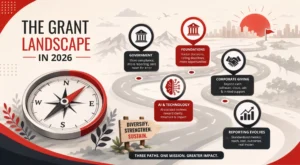
1. The Grant Landscape in 2026: What’s Changed
Grant Landscape in 2026

A few shifts are shaping how nonprofits should approach grants for nonprofit organizations this year.

Government funding has become more compliance-heavy. Agencies are asking for more detailed outcome reporting and cybersecurity attestations than they did a few years ago, particularly for federal pass-through grants administered at the state level. Organizations that haven’t updated their SAM.gov registration or their Unique Entity ID (UEI) in the last twelve months are finding applications rejected on technicalities before reviewers even read the narrative.

Foundations are moving faster. More private and community foundations have adopted rolling deadlines, letter-of-inquiry (LOI) triage, and shorter application windows modeled on participatory grantmaking. This is good news for smaller nonprofits without large development teams, but it also means funding pages need to be checked more frequently rather than bookmarked once a year.

Corporate giving has diversified beyond cash. Tech companies in particular have leaned into in-kind grants – software licenses, cloud credits, and advertising grants- as a lower-cost way to support the sector at scale. For a lean nonprofit, one of these in-kind grants can free up thousands of dollars a year in expenses that would otherwise compete with program funding.

AI-assisted proposal review has entered mainstream grantmaking. Some funders now use AI tools internally to pre-screen or summarize incoming applications, which puts a premium on proposals that are clearly structured, plainly written, and easy to parse, a shift that rewards well-organized applications over dense academic prose.

Reporting expectations have also become more standardized across channels. Where foundations, corporations, and government agencies once asked for wildly different formats, many now converge on similar outcome metrics – reach, cost per outcome, and demographic breakdowns of who a program served. Nonprofits that build one strong internal reporting system, rather than customizing from scratch for every funder, save significant staff time across an entire grant portfolio.

The practical upshot: nonprofits chasing grants for nonprofits now need a funding strategy that spans all three channels (foundation, corporate, and government) rather than leaning on just one. Organizations that diversify across all three tend to weather funding cuts in any single channel far better than those concentrated in one source, which is itself one of the strongest arguments for treating grants for non profits as a portfolio strategy rather than a single annual campaign.

2. Foundation Grants: Databases & How to Search Them
Foundation Grants

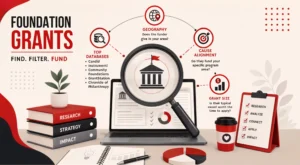
Foundation funding remains the most flexible and often the fastest-moving of the three channels, but it also requires the most active searching, since there is no single central database the way there is for federal grants.

Candid (formerly Foundation Center / GuideStar) is still the most comprehensive paid database for private and community foundation search, letting you filter by cause area, geography, and grant size, and cross-reference a foundation’s 990-PF filings to see who they’ve funded historically and at what dollar amounts. This history check matters. Many foundations only fund organizations working in specific regions or specific program areas, and a quick look at past grantees saves hours of writing proposals to funders who were never going to say yes.

Instrumentl is a subscription tool built specifically to match nonprofits to funders based on mission and past grant history, and it’s become popular with development teams that want automated deadline tracking layered on top of search.

Community foundations – there are hundreds across the US and UK covering specific cities or counties which are worth checking directly, since many maintain their own funding portals separate from Candid and specifically prioritize local or regional nonprofits, often with lighter application requirements than national funders.

GrantStation and the Chronicle of Philanthropy’s funding pages are useful lower-cost or free supplements, particularly for smaller organizations not ready to pay for a full Candid subscription.

When searching foundation databases for grants for nonprofits, three filters matter more than any keyword: geography (does the funder give in your state or country), cause alignment (do they fund your specific program area, not just your broad sector), and grant size (is their typical award in a range worth the hours it will take to apply). Skipping any of these three checks is the single biggest reason development teams waste time on foundation research that goes nowhere.

3. Corporate Grants & CSR Programs (Incl. In-Kind: Google, Canva, Microsoft)
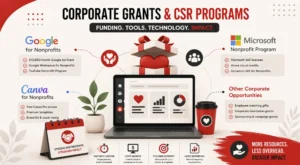
Corporate Grants & CSR Programs

Corporate social responsibility (CSR) programs have become one of the more accessible funding channels for grants for nonprofit organizations, particularly for younger or smaller nonprofits that don’t yet have the grant history foundations look for.

Google for Nonprofits is the anchor of most tech-sector CSR strategies for the nonprofit space. Beyond the well-known $10,000/month Google Ad Grant (which we cover in detail in section 8), eligible organizations also get access to Google Workspace for Nonprofits at no cost, and YouTube Nonprofit Program features for storytelling and fundraising campaigns.

Canva for Nonprofits provides free access to Canva Pro, which includes premium design templates, brand kit tools, and stock media – a meaningful saving for organizations that would otherwise pay for design software or outsource basic graphics work.

Microsoft’s nonprofit program bundles free and discounted Microsoft 365 licenses, Azure cloud credits, and Dynamics 365 nonprofit-specific tools, aimed at organizations that need enterprise-grade software infrastructure without the enterprise price tag.

Other corporate grant programs worth tracking include employee-matching gift programs (which many companies operate quietly and nonprofits underuse), corporate foundation grant cycles tied to specific verticals (retailers funding food security, banks funding financial literacy, and so on), and sponsorship-style grants tied to specific campaigns or events.

The advantage of corporate and in-kind grants for non profits is speed. Many of these programs have simple online applications with fast turnaround, no LOI stage, and minimal reporting burden compared to government funding. The tradeoff is that most are restricted to a specific use (software, advertising, a named program) rather than general operating support, which is why they work best layered alongside, not instead of, foundation and government funding.

4. Government Grants: Where to Look & Register
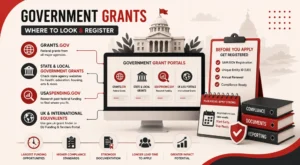
Government Grants

Government grants for nonprofits carry the largest dollar amounts available in the sector, but they also come with the heaviest compliance and reporting requirements, and the longest lead time before you can even submit an application.

Grants.gov is the single portal for federal discretionary grants in the US, covering everything from HHS and Department of Education funding to smaller agency-specific programs. Before you can apply for anything listed here, your organization needs an active SAM.gov registration and a Unique Entity ID (UEI). A process that can take several weeks the first time and needs annual renewal, so it should never be left until a deadline is close.

State and local government grants are frequently underused because they’re scattered across individual state agency websites rather than centralized in one database. Checking your state’s department pages for health, education, housing, or arts funding (depending on your program area) regularly surfaces smaller, less competitive grants that national nonprofits overlook.

USAspending.gov is a useful research tool even though it isn’t an application portal. It lets you see which federal agencies have funded organizations similar to yours in the past, which is a strong signal of where to focus limited grant-writing capacity.

UK and international equivalents. UK nonprofits should check gov.uk’s grant finder tool and individual local authority funding pages, while EU-based organizations can search the EU Funding & Tenders Portal for cross-border and country-specific programs.

Because government grants for nonprofits require the most upfront administrative setup (registration, compliance certifications, sometimes an audited financial statement). This is the channel where starting early pays off the most. An organization that registers with SAM.gov and Search federal grants on Grants.gov in January, well before any specific deadline, is in a far stronger position by application season than one starting registration the week a deadline opens.

5. Unrestricted vs Restricted Funding: Strategy

Unrestricted vs Restricted Funding

Not all grants for nonprofits carry the same strategic value, even when the dollar amounts look similar on paper. Understanding the difference between restricted and unrestricted funding should shape which grants your team prioritizes.

Restricted grants are tied to a specific program, project, or expense category – a foundation funding only your after-school tutoring program, for instance, or a corporate grant that can only be spent on advertising. These are usually easier to win because the funder’s intent is narrow and specific, and they’re valuable for growing a named program. But they can also create a “restricted funding trap,” where an organization’s overhead, staff salaries, and general operations remain underfunded even as program-specific grants pile up.

Unrestricted grants for nonprofits – sometimes called general operating support- let the organization decide how the money is spent, whether that’s covering rent, paying staff, investing in fundraising infrastructure, or filling a budget gap a restricted grant can’t touch. These grants are harder to win because funders are trusting the organization’s judgment rather than funding a specific, easily measured outcome, and they typically require a stronger track record and clearer impact reporting to secure.

A workable strategy is to treat restricted grants as the majority of an application pipeline, since they’re more numerous and more accessible, while actively cultivating relationships with a smaller number of funders capable of offering unrestricted support. Often, the same foundations that started with a restricted grant and increased trust (and flexibility) over multiple funding cycles. Multi-year unrestricted commitments, when they can be secured, are typically the single most valuable outcome a development team can achieve, since they reduce the year-to-year scramble that restricted, single-cycle funding creates.

6. Building a 12-Month Grant Calendar
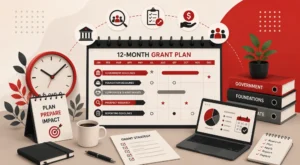
uilding a 12-Month Grant Calendar

Because grants for nonprofit organizations come from three different channels with three different timelines, a single shared calendar is the only way to avoid missed deadlines and duplicated effort.

Start with government deadlines, since they’re the most fixed and the least forgiving. Federal agencies publish annual or multi-year funding cycles well in advance, so these should anchor the calendar first. Mark not just the submission deadline but the SAM.gov/Grants.gov registration renewal date, ideally 60–90 days before any major federal application.

Layer in foundation deadlines next, distinguishing between fixed annual deadlines and rolling/LOI-based funders. For rolling funders, set an internal quarterly check-in rather than a single date, since these opportunities can open and close with little notice.

Add corporate and in-kind grant cycles, many of which (like the Google Ad Grants for nonprofits) don’t have a fixed annual deadline at all and can be applied for as soon as eligibility requirements are met. These should be treated as “apply now” items rather than calendar deadlines.

Build in prospect research time, not just application-writing time. A common mistake is filling the calendar only with deadlines for grants already identified, leaving no dedicated time to search for new grants for non profits opportunities that open mid-year.

Schedule reporting deadlines with the same weight as application deadlines. Missed or late grant reports are one of the most common, and most avoidable, reasons a funder declines to renew, and they deserve calendar space just as much as the original application.

A well-built 12-month calendar turns grant seeking from a reactive scramble into a predictable operating rhythm, which is ultimately what separates nonprofits that grow their grant revenue year over year from those that plateau.

Assign ownership for each calendar item, not just a date. A deadline without a named owner tends to slip, especially in small development teams juggling multiple roles. Even a simple shared spreadsheet with a deadline column, an owner column, and a status column outperforms a calendar that lists dates alone. Reviewing the calendar monthly, not just at the start of the year, also catches new grant opportunities for nonprofit organizations that open outside the original planning cycle – new corporate CSR programs, emergency response funds, and mid-year foundation initiatives all tend to appear with little advance notice.

7. Grant Readiness Checklist Before You Apply

Grant Readiness Checklist Before You Apply

Before submitting any application for grants for nonprofits, run through this readiness checklist. Funders reject a surprising number of otherwise strong applications over items on this list rather than the quality of the program itself.

  • Current 501(c)(3) determination letter (or country equivalent) on file and easy to attach
  • Audited financials or a recent Form 990 ready to share, since most funders request at least one
  • A clear, concise case for support – mission, program description, and target outcomes in plain language, not internal jargon
  • Board list and key staff bios, since funders evaluate organizational capacity as much as the program itself
  • A logic model or theory of change connecting activities to outcomes, which most foundation and government funders now expect as standard
  • SAM.gov registration and UEI current (required for any federal government grants for nonprofits application)
  • A realistic budget that matches the request amount and shows other committed or pending funding sources
  • Data infrastructure – a donor/grants database or CRM that can produce the outcome metrics funders will ask for in reporting, not just at application time

If your organization is also actively working on proposal quality itself, our guide on using AI to write stronger grant proposals covers how to speed up drafting without losing the voice and specificity funders respond to.

Start With the Free $10K/Month Google Ad Grant – We’ll Set It Up

Before you spend weeks chasing foundation LOIs or building out a government compliance file, there’s a funding source most nonprofits qualify for right now: the Google Ad Grant, worth up to $10,000 a month in free Google Search advertising. Unlike most grants for nonprofits, it doesn’t have an annual deadline, doesn’t require a written proposal, and can be reinvested every month into donor acquisition, volunteer recruitment, and awareness campaigns that support the rest of your funding strategy.

Orvador handles the entire process – eligibility review, application, account setup, and ongoing compliance management- so your team can focus on foundation and government applications while your Ad Grant account runs in the background. Read our full breakdown of Google Ad Grants eligibility and management, or reach out and we’ll assess your nonprofit’s eligibility for free.
Talk to Orvador about setting up your Google Ad Grant →

ChatGPT & AI for Nonprofits: 25 Practical Use Cases (With Prompts)

TL;DR: AI for nonprofits has moved from experiment to everyday tool. Most nonprofits now use it in some form, though few have formal policies around it. This guide covers ChatGPT nonprofit discounts (and what other AI tools for nonprofits offer), 25 practical use cases with copy-paste prompts across fundraising, marketing, and operations, plus the data privacy guardrails and AI policy basics every organisation needs before donor information touches a chatbot.

1. The State of AI Adoption in the Nonprofit Sector

The nonprofit sector’s relationship with AI has shifted fast. A 2026 survey of nonprofit leaders found that nonprofits report a real opportunity gap between interest and actual use. 78% of funders and 77% of nonprofits believe their organisation would benefit from using more AI, especially in mission-related work, yet actual adoption lags at 14% for traditional AI and 22% for generative AI. Put simply: everyone agrees AI for nonprofits matters, but most teams are still figuring out where to start.

Where AI has landed, it’s landed hard on communications and data work. A 2024 survey found that 58% of nonprofits had already incorporated AI into their communications strategies, and 68% were using it to analyse data. Both figures ahead of comparable adoption in the for-profit B2C sector. More recent reporting pushes that number higher still: one 2026 industry report puts overall AI usage among nonprofits at roughly 92%, though the same report notes that the vast majority are using it informally, without documentation, training budgets, or a governance policy in place.

That gap between usage and structure is exactly where most nonprofits get into trouble – not because ChatGPT for nonprofits is risky by design, but because nobody wrote down what it should and shouldn’t touch. We’ll fix that in section 7. First, the practical stuff: what AI tools for nonprofits actually cost, and where the discounts are.

2. Nonprofit Discounts: ChatGPT, Claude & Other AI Tools

Nonprofit Discounts: ChatGPT, Claude & Other AI Tools

If your organisation is paying full retail for AI software, you’re probably leaving money on the table. Here’s what’s currently on offer.

ChatGPT nonprofit discount (OpenAI for Nonprofits). Through OpenAI for Nonprofits, eligible nonprofits can access ChatGPT Business for $8 per user per month billed annually, or $10 per month billed monthly –  a steep discount off the standard rate. Larger organisations ready for large-scale rollout can contact OpenAI’s sales team directly for a discount of up to 75% on ChatGPT Enterprise. Eligibility is verified through Goodstack, OpenAI’s nonprofit verification partner, and typically requires a registered 501(c)(3) or an equivalent international designation; academic, government, and (in most cases) healthcare institutions are generally excluded, though Federally Qualified Health Centers and rural hospitals operating as 501(c)(3)s are a documented exception. The free tier of ChatGPT remains open to any nonprofit at no cost, but it skips the admin controls and no-training data guarantees that make the paid nonprofit tier worth the small monthly spend once donor or beneficiary information is involved.

Claude and other assistants. Anthropic, the company behind Claude, does not currently run a dedicated nonprofit or student discount programme, so nonprofits evaluating Claude should budget at standard pricing, though many teams still choose it for long-document work like grant narratives and policy drafts, where its longer context window is a genuine advantage over a general chatbot.

Microsoft and Google. Microsoft offers nonprofit pricing on its 365 Copilot add-on, and Google for Nonprofits gives eligible organisations free access to Google Workspace (with Gemini built in) for a generous user cap – often the single best deal available if your team already lives in Gmail and Docs.

Free AI tools for nonprofits. Beyond the paid discounts, TechSoup (the nonprofit tech marketplace) bundles several AI-adjacent perks, including a discount on Grammarly’s AI-powered editing tools, alongside free consultation services to help your organisation figure out which tools actually fit your workflow. Canva’s free tier, Google’s free Gemini access through Workspace for Nonprofits, and ChatGPT’s free consumer tier round out a genuinely usable starter stack for teams with no software budget at all.

The takeaway: don’t assume “we can’t afford AI.” Between OpenAI’s nonprofit pricing, Google’s free Workspace tier, and TechSoup’s catalogue, most organisations can build a credible AI for nonprofits toolkit for well under $100 a month – sometimes for nothing.

3. Use Cases: Fundraising (Prompts Included)

  1. Draft a donor appeal letter. Prompt: “Write a 300-word year-end appeal letter for [mission], highlighting [specific program outcome]. Tone: warm, direct, no jargon.”
  2. Segment your donor messaging. Prompt: “Suggest three donor personas for a [cause area] nonprofit and a distinct email angle for each.”
  3. Summarise a grant’s eligibility criteria. Prompt: “Summarise the eligibility requirements in this funder guideline document in five bullet points.” (Attach the PDF.)
  4. Generate a GivingTuesday campaign outline. Prompt: “Create a six-week GivingTuesday campaign timeline for a small nonprofit with one part-time comms staffer.”
  5. Turn a case study into a fundraising email. Prompt: “Rewrite this beneficiary case study as a 150-word donor email with a clear call to action.”
  6. Draft thank-you messages at scale. Prompt: “Write three variations of a donor thank-you email for gifts under $100, $100–$999, and $1,000+.”
  7. Brainstorm matching-gift campaign angles. Prompt: “Suggest five subject lines for a matching-gift email campaign for [cause].”
  8. Draft board-ready fundraising summaries. Prompt: “Summarise this quarter’s fundraising results into a one-page board update, highlighting trends, not just totals.”

4. Use Cases: Marketing & Content (Prompts Included)

  1. Repurpose a blog post into social captions. Prompt: “Turn this blog post into five Instagram captions, each under 150 characters, with a relevant hashtag set.”
  2. Draft a newsletter from program updates. Prompt: “Combine these three program updates into a single monthly newsletter with a 40-word intro.”
  3. Write SEO-friendly page copy. Prompt: “Write 200 words of website copy for our [program] page targeting the keyword ‘[keyword]’, written for a general public audience.”
  4. Generate FAQ content for AI search visibility. Prompt: “Write five frequently asked questions and concise answers about [program/topic] for our website’s FAQ section.”
  5. Draft volunteer recruitment posts. Prompt: “Write a volunteer recruitment post for [role], listing time commitment, skills needed, and impact in under 120 words.”
  6. Translate content for multilingual audiences. Prompt: “Translate this donor email into [language], keeping the tone warm and informal rather than formal.”
  7. Create a content calendar. Prompt: “Build a one-month social media content calendar for [cause], mixing impact stories, event promotion, and donor recognition.”
  8. Draft press release copy. Prompt: “Write a press release announcing [program milestone], following standard AP style, under 400 words.”

5. Use Cases: Operations, Reporting & Grants

  1. Summarise long funder reports. Prompt: “Summarise this 20-page impact report into a one-page executive summary for our board.”
  2. Draft grant proposal sections. Prompt: “Using this program data, draft a 250-word ‘statement of need’ section for a grant proposal aimed at a [funder type].” For a deeper walkthrough of using generative AI across the full proposal, not just single sections, see our guide to writing winning grant proposals with AI.
  3. Draft meeting agendas and minutes. Prompt: “Turn these rough meeting notes into a structured set of minutes with action items and owners.”
  4. Build internal SOPs. Prompt: “Draft a standard operating procedure for [process], written for a new staff member with no prior context.”
  5. Analyse survey feedback. Prompt: “Summarise the themes in these open-ended survey responses and group them into three to five categories.”
  6. Draft job descriptions. Prompt: “Write a job description for a [role] at a nonprofit focused on [mission], including responsibilities and required qualifications.”
  7. Prepare donor database cleanup rules. Prompt: “Suggest a checklist for identifying duplicate or outdated records in a donor database before an annual data audit.”
  8. Draft annual report narrative sections. Prompt: “Using these program metrics, draft a 300-word ‘year in review’ section for our annual report.”
  9. Build training materials for staff or volunteers. Prompt: “Create a one-page onboarding guide covering [topic] for new volunteers, written in plain language.”

For a broader comparison of which platforms handle which of these tasks best, our best AI tools for nonprofits guide breaks down the wider toolkit beyond ChatGPT.

6. Guardrails: Data Privacy & Donor Trust

None of the above use cases require you to hand over donor records. That distinction matters, because it’s exactly where nonprofits get into trouble with AI tools.

The free and personal-Plus tiers of most chatbots, including ChatGPT, may use your conversations to help train future models unless you actively opt out. The paid nonprofit tiers (ChatGPT Business/Enterprise, Claude’s business plans, Copilot, and Gemini through Google Workspace) generally do not train on your inputs by default, which is precisely what the nonprofit discount is buying you, not just the extra features.

A few working rules for any AI for nonprofits deployment:

  • Never paste full donor exports, giving histories, or contact lists into a consumer-tier chatbot. Use anonymised or aggregated summaries instead.
  • Treat health, immigration status, and safety-related beneficiary data as off-limits for any general-purpose AI tool, regardless of tier, unless you have a specific data processing agreement in place.
  • Default to business or enterprise tiers for any account that touches organisational data, not personal free accounts.
  • Communicate AI use transparently to donors and beneficiaries where relevant. Trust, not just compliance, is the real currency here.
  • Fact-check everything AI drafts. Generative tools are fluent, not always accurate, and a wrong statistic in a grant proposal or annual report can cost more credibility than the time it saved.

7. Building an AI Policy for Your Organisation

You don’t need a 20-page document to get started. You need answers to five questions, written down and shared with your team:

  1. Which tools are approved, and at what tier (free vs. business/enterprise)?
  2. What data can and can’t be entered into an AI tool. Be explicit about donor PII, financials, and beneficiary information.
  3. Who reviews AI-generated content before it goes external – a named person, not “someone will check it.”
  4. How is AI use disclosed, if at all, to funders, donors, or the board?
  5. How will the policy be revisited, quarterly is reasonable, given how fast the tools change.

A one-page policy answering these five questions, signed off by your ED or board, closes most of the gap between “92% of nonprofits use AI” and “4% have a documented approach to it.” It’s a small investment that protects the trust your organisation has spent years building.

Curious how AI actually shows up inside a real NGO marketing campaign, not just a use-case list? 

Ask us how we use AI in NGO campaigns – our team works AI into everyday content, fundraising, and reporting workflows for nonprofit and social-impact clients, and we’re happy to walk through what that looks like for your organisation.

Sources

Donor Databases & Donor Management for Nonprofits: The Complete Guide

TL;DR: A donor database is the single system of record that tracks every gift, contact, and interaction your nonprofit has with a supporter. Once you cross roughly 150-200 donors, spreadsheets start costing you more in errors and missed follow-ups than a proper platform would cost in fees. This guide covers when to graduate from spreadsheets; the exact fields and segments your nonprofit donor database needs; how the top donor management software options compare for small versus large organizations; the data hygiene rules that keep your records usable; and how to turn a clean database into segmented, higher-converting campaigns.

Ask any development director where their fundraising actually breaks down, and the answer rarely traces back to a bad campaign idea. It traces back to the data behind it. A donor who got asked for a fifth gift because no one flagged they’d already given, a lapsed supporter who never received a win-back email because their record sat in the wrong tab, a major donor whose giving history was split across two duplicate profiles. These aren’t software problems so much as donor database problems, and they compound quietly until a nonprofit realizes its growth ceiling isn’t fundraising strategy; it’s data structure.

This guide walks through how to know when it’s time to move off spreadsheets, what a proper marketing for a donor database for nonprofits needs to track, how the major nonprofit donor management software options stack up depending on your organization’s size, and the hygiene and integration habits that keep a database useful instead of just full. Whether you’re a five-person team weighing donor management software for small nonprofits or a growing org trying to identify the best donor management software for nonprofits at your scale, the fundamentals below apply either way.

1. Spreadsheet vs Database: When to Graduate

Spreadsheet vs Database

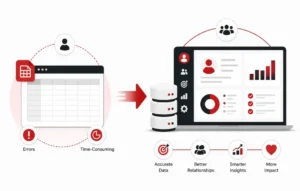
Every nonprofit starts somewhere, and for many that somewhere is a shared Google Sheet with donor names, amounts, and dates in neat columns. It works, until it doesn’t.

A spreadsheet is fine when you have a small, static list and one person managing it. The trouble starts when any of the following becomes true:

  • You have more than roughly 150–200 active donors and can no longer scan the sheet to remember who gave what, when.
  • More than one staff member edits donor records, and version conflicts or overwritten rows start appearing.
  • You want to send different messages to different donor groups (first-time givers, lapsed donors, monthly sustainers) instead of one blast to everyone.
  • You need to report retention rate, average gift size, or lifetime value, and you’re manually building pivot tables every quarter.
  • Your board or funders ask for a donor pipeline view, and a flat spreadsheet simply can’t show relationship stages.

This is the point where nonprofit donor management stops being a filing exercise and becomes a growth function. A real donor database for nonprofits automates what a spreadsheet forces you to do by hand: dedup checks, gift history rollups, tax receipt generation, and segmentation. The switch typically pays for itself within two or three campaigns, because staff time saved on manual list-building gets redirected into donor communication and cultivation.

That said, graduating too early can also be a mistake. A five-person nonprofit with 40 donors doesn’t need an enterprise CRM with a six-figure implementation timeline. The right moment to move is when data errors, duplicate entries, or missed stewardship touches are visibly costing you gifts, not simply when a vendor’s sales team suggests it’s time.

2. What a Donor Database Must Track (Fields & Segments)


Donor Database Must Track

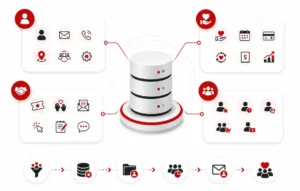
Whatever platform you choose, the database itself only works if it’s structured around the right fields. At minimum, nonprofit donor management should capture:

Core contact fields

  • Full name, preferred name, pronouns
  • Mailing address, email, phone
  • Household or organizational relationships (spouses, family foundations, matched employers)
  • Communication preferences and opt-in/opt-out status

Giving history fields

  • Every gift: amount, date, campaign, fund designation, payment method
  • Recurring gift status and next expected payment date
  • Soft credits (gifts made in someone’s honor or influenced by a volunteer ask)
  • Pledges and pledge fulfillment status
  • Lifetime giving total and largest single gift

Engagement fields

  • Event attendance
  • Volunteer hours or roles
  • Email opens, clicks, and website donation-page visits where the platform integrates with your email tool
  • Notes from calls, meetings, or handwritten thank-yous

Segments every organization should be able to build

  • First-time donors (for welcome sequences)
  • Lapsed donors (no gift in 12-18 months, for win-back campaigns)
  • Monthly/recurring sustainers (for retention-focused stewardship)
  • Major donors (typically top 10-20% by lifetime giving, for personal outreach)
  • Event-only donors who haven’t converted to general giving

If your current system can’t filter and export these segments in a few clicks, the database isn’t doing its job, regardless of how many fields it technically stores. The goal isn’t data for its own sake; it’s the ability to send the right message to the right group without manually sorting a spreadsheet each time.

3. Top Donor Management Tools Compared (Small vs Large Orgs)

There’s no single best donor management software for nonprofits, because “best” depends heavily on organization size, budget, and technical capacity. Here’s a practical way to think about the landscape.

For small nonprofits (under roughly 500 donors, lean or volunteer-run teams):

Donor management software for small nonprofits generally prioritizes simplicity and price over advanced customization. Look for platforms with a low or no monthly minimum, built-in online donation forms, and automated tax receipts. Some of the top tools for nonprofits typically bundle CRM, email, and basic reporting into one plan, which matters when you don’t have a dedicated database administrator. Expect to spend anywhere from free (with transaction fees) up to a few hundred dollars a month.

What to prioritize at this stage: ease of setup, a clean donor-facing giving page, and automatic gift acknowledgment. Advanced features like predictive analytics or AI-driven donor scoring are usually unnecessary overhead for a small team and add training time you don’t have to spare.

For mid-size nonprofits (500-5,000 donors, dedicated development staff):

At this stage, nonprofit donor management software needs to do more: multi-channel campaign tracking, moves-management pipelines for major gift officers, integration with direct mail vendors, and more granular reporting. Pricing usually scales with donor record count or active user seats, often landing in the low-to-mid four figures annually.

For large nonprofits (5,000+ donors, multiple program areas or chapters):

Larger organizations typically need enterprise-grade donor databases for nonprofits with role-based permissions, API access, wealth-screening add-ons, and dedicated account support to handle complex org structures and compliance requirements across regions.

Across all three tiers, the checklist stays the same: Can it dedupe records automatically? Does it integrate with email and accounting tools without a developer? Can non-technical staff build a segment and export a mailing list in under five minutes? If not, the sticker price doesn’t matter. Staff will quietly revert to spreadsheets within a few months.

4. Data Hygiene: Deduplication, Consent & Retention Rules

Data Hygiene: Deduplication, Consent & Retention Rules

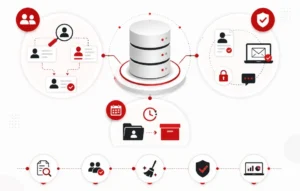
A donor database is only as trustworthy as the data inside it. Poor hygiene is the single biggest reason nonprofits abandon a platform and blame the software instead of the process.

Deduplication

Duplicate records happen constantly: a donor gives online under “Bob Smith” and by mail under “Robert Smith,” or a spouse’s gift gets logged as a separate household. Run a dedup pass at minimum quarterly, and set up your platform’s automatic matching rules (usually based on email and address) so new duplicates don’t accumulate between cleanups. Merging records isn’t just tidiness; unmerged duplicates split a donor’s lifetime giving total in half, which understates who your major donors actually are.

Consent and communication preferences

Every contact record should store how and whether a person consented to be contacted, and through which channel. This matters for compliance with regional data protection rules and for simple donor respect. If someone unsubscribes from email, that preference needs to sync everywhere, including any connected email platform, or you risk mailing someone who explicitly opted out.

Retention rules

Decide, in writing, how long you keep inactive records before archiving them, and document a policy for deceased donor notifications and information requests. Most organizations keep full giving history indefinitely for tax and audit purposes but archive contact records for donors with no engagement in three-plus years, moving them out of active mailing segments while preserving historical data.

A simple hygiene calendar works well for most teams: monthly quick-scan for obvious duplicates, quarterly full dedup and consent audit, and an annual data retention review tied to your fiscal year-end reporting.

5. Using Your Database for Segmented Campaigns

The entire point of clean, structured nonprofit donor management is that it lets you stop sending one message to everyone. Segmentation is where the database earns its keep.

Start with the segments outlined in Section 2 and build a communication plan around each:

  • First-time donors get a short welcome series that thanks them, shows early impact, and invites a second, smaller ask before a large one.
  • Lapsed donors get a distinct “we miss you” or impact-recap campaign rather than the standard newsletter, since a generic appeal rarely re-engages someone who’s already stopped responding.
  • Monthly sustainers get stewardship-focused content, not repeat asks, since they’re already giving consistently and over-soliciting them increases churn.
  • Major donors get personal outreach, phone calls, or handwritten notes pulled directly from the database rather than an automated email, since the relationship value justifies the manual touch.

If you want a deeper breakdown of how to build the actual email sequences behind each segment, our donor retention email guide covers lifecycle automation in detail. The database is what makes that kind of segmentation possible in the first place. 

The practical workflow is: filter the database by segment, export or sync the list to your email or direct mail tool, run the campaign, then log responses back into the database so the segment definitions stay accurate for next time. Skipping that last step is the most common reason segmented campaigns quietly degrade into blasts again within a year.

6. Integrations: Email, Forms, Accounting

A donor database that sits in isolation creates more manual work than it saves. The tools worth paying for connect cleanly to the rest of your stack.

Email platforms: Your donor database should sync donor records, segments, and unsubscribe status with your email provider automatically, not through manual CSV exports. This is what allows the lifecycle campaigns described in Section 5 to run without someone rebuilding lists every send.

Online giving forms: Every donation form on your website should write directly into the database in real time, capturing amount, campaign, and any custom fields (like tribute gifts or event registration) without a staff member re-keying entries.

Accounting software: Gift data should flow into your accounting system (or at minimum export cleanly), so finance can reconcile deposits against donor records without a separate manual process. This is especially important around fiscal year-end and audit season, when mismatches between development and finance records create real headaches.

If your current system requires manual exports and imports between any of these three, that’s hidden labor cost that should factor into any donor management software for small nonprofits comparison, not just the subscription price. For a broader look at how these platforms stack up on features and pricing across budget tiers, see our full fundraising software comparison.

Not sure if your current setup is holding you back?

Whether you’re still running donor records in spreadsheets or evaluating a switch between platforms, a second set of eyes on your data and martech stack can save months of costly cleanup later.

Get a Free Donor-Data & Martech Stack Review from Orvador →

Related reading: 50+ Fundraising Ideas for Nonprofits

50+ Fundraising Ideas for Nonprofits That Actually Raise Money

TL;DR: Looking for fundraising ideas for nonprofits that go beyond the usual bake sale? This guide breaks down 50+ nonprofit fundraising ideas across four categories – digital-first campaigns, events, low-budget/small-team options, and corporate & CSR partnerships, plus a quarter-by-quarter seasonal calendar and a promotion playbook for getting each idea in front of donors. Whether you’re a five-person grassroots team or a national organization, you’ll find fundraising ideas for nonprofit organizations sized to your budget, staff capacity, and cause. Jump to any section, or read start to finish for a complete annual fundraising strategy.

Every nonprofit reaches a point where the usual playbook stops working. The email list has plateaued. The annual gala costs more to run than it raises. Donors are asking for more transparency and better ways to give. At that point, most teams start Googling fundraising ideas for nonprofits, and land on a listicle of 10 generic suggestions that don’t account for team size, cause type, or donor maturity.

This guide is different. It’s built around 50+ nonprofit fundraising ideas, organized so you can filter by what actually applies to you: your digital capacity, your event bandwidth, your budget, and your corporate relationships. We’ve also added a seasonal calendar and a promotion playbook, because an idea without a distribution plan rarely raises real money.

Nonprofit fundraising has also changed shape in the last few years. Donors expect transparency about where their money goes, younger supporters give in smaller, more frequent amounts rather than one large annual gift, and corporates increasingly want structured, reportable partnerships instead of a one-time cheque. Any list of fundraising ideas for nonprofit organizations that doesn’t account for these shifts will underperform, no matter how creative the individual idea is. That’s why every category below is written with execution in mind, not just the concept, but who it’s for and what it takes to run.

You’ll also notice this guide leans on real formats nonprofits are already using successfully across digital campaigns, community events, grassroots drives, and CSR partnerships, because the goal isn’t novelty, it’s a fundraising idea you can actually staff, promote, and repeat next year. Whether your team searches for this as “non profit fundraising ideas” or “nonprofit fundraising ideas,” the underlying question is the same: what will realistically move donors to give, and can we run it well with the team and budget we actually have?

How to Pick the Right Fundraising Idea for Your Size & Cause

Before you scroll to the list, it’s worth spending five minutes on fit. The most successful fundraising ideas for nonprofits aren’t the flashiest ones. They’re the ones that match three things: team capacity, donor relationship stage, and cause type.

Team size and capacity. A two-person team running a marathon-style fundraising event will burn out before race day. If you’re small, lean toward digital-first and low-budget ideas that scale without headcount – recurring giving, peer-to-peer campaigns, and matching gift drives typically need less hands-on coordination than a physical event.

Donor relationship stage. Cold audiences respond better to low-commitment asks: a social media challenge, a small-dollar crowdfunding page, a shareable matching gift moment. Warm, engaged donors, people already on your list or who’ve given before, are the right audience for higher-touch asks like galas, major-donor dinners, or monthly giving upgrades.

Cause type. Cause-driven urgency (disaster relief, health emergencies) performs well with time-boxed digital campaigns and matching gifts. Community-based causes (education, local shelters, arts) tend to do better with in-person events and community days that build local visibility. Environmental and animal welfare causes often see strong results from challenge-based social campaigns that are naturally shareable.

Budget reality. Every idea below is tagged by category so you can filter for what’s realistic. If your budget is thin, start in the Low-Budget & Small-Team section and the Digital-First section. Most require no upfront spend beyond staff time.

A good rule for any nonprofit organization: pick two or three ideas per quarter, run them well, and measure results before adding a fourth. Successful fundraising ideas for nonprofits are rarely about doing more. They’re about doing fewer things with better follow-through and promotion.

A quick self-check before you commit to any idea:

  • Can we staff it without pulling people off program delivery for more than a few hours a week? If not, look at the low-budget or digital-first sections first.
  • Does it match how our existing donors already engage with us? An audience that responds well to email appeals may not show up for a golf tournament, and vice versa.
  • Can we repeat it next year? One-off ideas are fine occasionally, but the highest-performing non profit fundraising ideas over time are the ones that become annual traditions donors look forward to.
  • Do we have a way to promote it beyond our existing list? An idea with no promotion plan, covered in one of our section, will underperform even if the concept is strong.

Once you’ve filtered by these four questions, the right mix of ideas usually becomes obvious.

Digital-First Ideas: Crowdfunding, P2P, Matching, Social Challenges

Digital fundraising ideas for nonprofit organizations are the fastest to launch and the easiest to track. They also compound. A well-built donation page or recurring-giving flow keeps generating revenue long after the campaign ends.

  1. Crowdfunding campaign with a specific project ask. Instead of “support our mission,” fund one concrete outcome, 50 school kits, one water well, one month of shelter meals. Specific asks convert better than general ones.
  2. Peer-to-peer (P2P) fundraising. Equip supporters with personal fundraising pages tied to a shared goal. This turns your existing donor base into a distributed fundraising team and extends your reach into networks you don’t have.
  3. Matching gift campaigns. Partner with a major donor or corporate sponsor to match every dollar raised during a set window. The urgency and doubled-impact framing reliably lifts conversion rates.
  4. Social media giving challenges. Time-boxed, shareable formats (a 30-day challenge, a step count goal, a “nominate a friend” chain) work especially well for younger donor segments and cause-driven audiences.
  5. Text-to-donate campaigns. Lower the friction to a single text message during live events, community gatherings, or emergency appeals.
  6. Recurring/monthly giving program. Convert one-time donors into sustainers with a modest monthly ask ($10–25). Recurring revenue is the most predictable line in any nonprofit fundraising strategy.
  7. Birthday and celebration fundraisers. Many platforms let supporters turn their birthday into a fundraiser for your cause automatically – a nearly zero-effort acquisition channel.
  8. Giving Tuesday campaign. Build a dedicated landing page, matching gift, and multi-channel push around the global giving day in late November.
  9. Livestream fundraising events. Pair a virtual event. A Q&A, a performance, a behind-the-scenes tour, with a live donation tracker.
  10. Email fundraising series. A three- to five-email sequence with a clear story arc (problem, solution, urgency, gratitude) consistently outperforms a single blast appeal.
  11. Year-end giving campaign. The final two weeks of December account for a disproportionate share of annual nonprofit fundraising. Build a dedicated sequence well before the last week.
  12. Donor-advised fund (DAF) outreach. Add DAF giving instructions to your donation page; DAF donors tend to give larger average gifts.
  13. Cryptocurrency and stock donations. Offer a simple pathway for appreciated-asset gifts, which can be tax-advantageous for donors and larger in size than cash gifts.
  14. Google Ad Grants–powered donation campaigns. Nonprofits can access up to $10,000/month in free Google Ads to drive traffic to time-sensitive digital appeals.
  15. Subscription-box or micro-membership model. Offer a small recurring perk (a newsletter, impact report, or physical token) in exchange for a monthly gift. This is useful for building a donor community with a tangible sense of belonging.

Event Ideas: Galas, Runs, Auctions, Community Days

Fundraising events for nonprofit organizations remain some of the highest-grossing single-day activities available, but they also carry the highest cost and staff time per dollar raised, so pick carefully based on your team’s bandwidth. Well-run fundraising events for nonprofit organizations also do double duty as donor cultivation and community visibility moments, which is why many of the ideas below are worth repeating annually rather than treating as one-off experiments.

  1. Annual gala or dinner. The classic major-donor event; works best when paired with a live auction and a clear ask moment.
  2. Charity run, walk, or cycling event. Combines fundraising with community visibility and works well as a recurring, branded annual event.
  3. Silent auction. Pair with any other event or run as a standalone online auction. Low overhead once items are secured.
  4. Live auction. Higher-energy, higher-yield version of the silent auction, usually reserved for galas with an experienced auctioneer.
  5. Trivia or bingo night. Low-cost, easy to promote locally, and repeatable multiple times a year without donor fatigue.
  6. Community fun fair or fete. Family-friendly, good for local visibility and volunteer recruitment alongside fundraising.
  7. Golf tournament. A reliable format for reaching corporate sponsors and major donors with disposable income.
  8. Wine or beer tasting event. Pairs naturally with local business sponsorships and in-kind donations.
  9. Concert or performance fundraiser. Especially effective if a local artist or performer will donate their time for the cause.
  10. Cook-off or bake sale (scaled up). A community cook-off with ticketed tasting and a judged competition raises more than a traditional bake sale while keeping costs low.
  11. Fashion show or style event. Works well for causes with retail or lifestyle partners willing to donate product or runway talent.
  12. Themed dinner or supper club. A ticketed, intimate dinner with a guest speaker or storytelling component – good for mid-level donor cultivation.
  13. Film screening. Pair a documentary relevant to your cause with a panel discussion; low production cost, high engagement.
  14. Community day / open house. Invite the public to see your programs firsthand, paired with a suggested-donation entry or on-site giving stations.
  15. Endurance or challenge event (obstacle race, hike, swim). Popular with younger, fitness-oriented donor bases and highly shareable on social media.

Low-Budget & Small-Team Ideas

For nonprofits running on a skeleton crew, these fundraising ideas for nonprofits require minimal upfront spend and can often be executed by one or two staff members.

  1. Dollar-a-day challenge. Ask supporters to commit a small daily amount for a month, framed around a specific outcome their gift funds.
  2. Restaurant or business “give-back” night. Partner with a local restaurant that donates a percentage of a night’s sales. No cost to your organization beyond promotion.
  3. Garage or rummage sale. A reliable, near-zero-cost way to raise funds using donated goods and volunteer labor.
  4. Online merchandise drop. A small run of branded T-shirts, tote bags, or stickers sold through a print-on-demand service with no inventory risk.
  5. Skill-share or workshop fundraiser. Volunteers or staff teach a paid class (cooking, a craft, a language) with proceeds going to the cause.
  6. Raffle. Secure a handful of donated prizes and sell tickets digitally. Check local regulations before launching.
  7. “Change jar” or round-up campaign. Partner with local businesses to round up transactions to the nearest dollar for your cause.
  8. Letter-writing or handwritten appeal campaign. A small, personal, handwritten mail push to your most engaged donors often outperforms a mass email in dollars raised per contact.
  9. Volunteer-run car wash or bake sale. Still effective for hyper-local, youth-driven, or grassroots fundraising with almost no overhead.
  10. Community sponsorship board. Sell small, low-cost sponsorship slots (a name on a wall, a shout-out in a newsletter) to local businesses that can’t afford a full event sponsorship.

Corporate & CSR Partnership Ideas

Corporate partners increasingly look for non profit fundraising ideas that align with their CSR mandates, giving nonprofits an opening to build multi-year, higher-value relationships rather than one-off donations.

  1. Employee giving and payroll deduction programs. Partner with an HR or CSR team to offer payroll-based giving to their staff.
  2. Corporate matching gift programs. Encourage donors to check if their employer matches gifts. This alone can double a company’s aggregate impact with no extra ask.
  3. Cause marketing partnerships. A company donates a percentage of sales from a specific product line to your cause over a defined period.
  4. Employee volunteer days (Dollars for Doers). Many corporations donate a fixed amount for every hour employees volunteer with a nonprofit.
  5. In-kind product or service donations. Secure donated goods, software, or professional services (legal, design, printing) in place of cash to reduce operating costs.
  6. Sponsorship packages for events. Offer tiered sponsorship (logo placement, speaking slots, employee tickets) for your existing event calendar.
  7. CSR grant applications. Many corporations run structured CSR grant cycles. Align your ask to their published focus areas and reporting requirements under India’s Schedule VII CSR mandate where applicable.
  8. Supplier or vendor giving programs. Ask your own vendors and service providers to contribute a percentage of their invoice as a standing partnership.
  9. Co-branded fundraising campaigns. Run a joint digital campaign with a corporate partner’s marketing team to reach their customer base directly.
  10. Board-member company matches. Ask board members whose employers offer corporate giving programs to activate that match specifically for your organization.

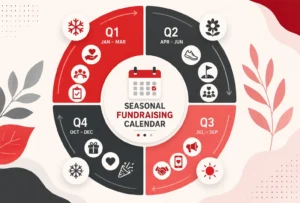
Seasonal Calendar: What to Run Each Quarter

Spreading fundraising ideas for nonprofits across the calendar avoids donor fatigue and takes advantage of natural giving moments.

Seasonal Calendar

Q1 (Jan–Mar): Thank last year’s donors, launch a monthly-giving upgrade campaign, and start planning your flagship annual event. This is also the right window for CSR grant applications tied to corporate fiscal-year planning.

Q2 (Apr–Jun): Run your charity run/walk, golf tournament, or community day. Outdoor and in-person fundraising events for nonprofit organizations perform well in spring weather. Launch a spring peer-to-peer campaign.

Q3 (Jul–Sep): Focus on mid-year digital campaigns, social media challenges, and corporate partnership renewals. This is a good quiet window to build content, refresh your donation page, and prep year-end assets.

Q4 (Oct–Dec): Your highest-yield quarter. Run Giving Tuesday, a matching gift campaign, and a year-end email series. Close the year with a gala or major-donor dinner if your team has the bandwidth.

Mapping fundraising ideas for nonprofits to a calendar like this also solves a problem most teams don’t notice until it’s too late: donor fatigue. Asking the same list for money every few weeks with no seasonal logic tends to depress open rates and unsubscribe donors over time. A quarterly rhythm, with one clear “hero” campaign per quarter and smaller supporting asks in between, keeps your audience engaged without feeling over-solicited, and it gives your team predictable planning windows instead of constant reactive fundraising.

Promotion Playbook: SEO, Email & Ads for Each Idea

Even the best fundraising ideas for nonprofits underperform without a distribution plan. Here’s how to promote each category effectively.

SEO. Build a dedicated landing page for every recurring campaign (your run, your Giving Tuesday page, your monthly giving program) so it can rank independently in search and in AI-powered answer engines. Use donor-intent keywords in your page titles and FAQs, keep page load times fast, and interlink your campaign pages back to your cause pages. If your nonprofit hasn’t audited its digital presence yet, our guide to NGO digital marketing breaks down the SEO, Google Ad Grants, and content foundations nonprofits need before launching any campaign.

Email. Segment by donor stage. First-time donors, recurring donors, lapsed donors, and tailor the ask accordingly. A three-email sequence (story, urgency, gratitude) consistently outperforms a single appeal for time-boxed campaigns like Giving Tuesday or a matching gift drive.

Paid and Google Ad Grants. Nonprofits eligible for Google Ad Grants can run up to $10,000/month in search ads at no media cost. This is ideal for driving traffic to a live crowdfunding page or event registration form during a campaign window.

Social proof and case studies. Donors give more readily when they can see proof of impact. Our Educate Girls case study shows how a data-driven content and SEO strategy helped one nonprofit multiply organic traffic and strengthen its digital fundraising funnel, a useful reference point for what “successful” looks like when SEO and fundraising promotion work together.

Timing. Promote each idea on a countdown cadence. Announce three to four weeks out, remind weekly, and push hardest in the final 48 hours, when urgency-driven giving typically spikes.

Fifty-plus fundraising ideas for nonprofits is a lot to take in at once, and that’s the point. Not every idea on this list is right for your organization this year. The nonprofit fundraising ideas that actually raise money are the ones matched carefully to your team’s size, your donors’ habits, and your cause’s natural giving moments, then promoted with the same discipline as any other marketing campaign. Start with two or three from the sections above, build the promotion plan alongside the idea itself, and treat this list as a menu to revisit every planning cycle – not a one-time checklist.

Want a fundraising campaign built around your specific cause and calendar?

Get a Free Fundraising Campaign Marketing Plan – Orvador’s team will map the right mix of digital, event, and CSR fundraising ideas for nonprofits to your organization’s size, cause, and donor base.

Nonprofit Website Design: Fix These Issues Before You Lose More Donors

TL;DR: Nonprofit website design has to do what business sites don’t – build donor trust, serve multiple audiences at once, and convert visitors through a frictionless donation flow. This guide covers the 9 essential pages every nonprofit site needs, trust and accessibility principles, donation UX best practices, Core Web Vitals and AI-search fundamentals, a DIY vs. agency budget breakdown, and a redesign checklist to migrate without losing rankings.

A nonprofit website has one job that a typical business site doesn’t: it has to turn strangers into believers, and believers into donors, in a single visit. Get the nonprofit website design wrong, and you lose supporters who would have given, volunteered, or shared your cause. Get it right, and your website becomes your best-performing fundraiser – one that works 24/7, never takes a day off, and gets cheaper to run every year.

This guide is a practical, end-to-end walkthrough of nonprofit web design, from the pages you actually need, to the psychology of donation UX, to the technical SEO fundamentals that get you found on Google (and now, on AI search tools like ChatGPT and Perplexity). Whether you’re planning a from-scratch build, evaluating web design for nonprofits agencies, or auditing an existing site before a redesign, you’ll find a checklist-driven framework here.

What a Nonprofit Website Must Do (That a Business Site Doesn’t)

Most web design advice is written for e-commerce stores or SaaS companies, and it doesn’t map cleanly onto the nonprofit sector. A nonprofit website carries a different kind of weight. It has to build trust with someone who isn’t buying a product, but giving away money with no tangible return. That single distinction changes almost every design decision.

Here’s what separates effective nonprofit website design from standard commercial web design:

  • It sells belief, not benefits. A retail site convinces someone a product will improve their life. A nonprofit site has to convince someone that their money, in the hands of strangers, will create real change they’ll never personally witness. That requires proof (data, stories, and transparency), not persuasion copy.
  • It serves multiple, competing audiences at once. Donors, volunteers, beneficiaries, corporate partners, grant officers, and journalists may all land on the same homepage, each looking for something different. Commercial sites usually optimize for one buyer persona; nonprofit sites have to route several audiences to different destinations without confusing any of them.
  • Trust has to be established, not assumed. Shoppers already trust that Amazon or a known retailer will deliver. Donors are inherently more skeptical. They’ve heard about nonprofit overhead scandals, and they want proof their money isn’t disappearing into administrative costs before they’ll click “Donate.”
  • Emotional and rational decision-making both have to be satisfied. People give because a story moves them, but they also want to see the impact numbers, the ratings, and the accountability data before they commit. A good nonprofit web design balances both in the same user journey.
  • The donation flow is the entire business model. For a retailer, checkout is one of many revenue paths. For most nonprofits, the donation button is the single conversion event the entire site exists to support, which means friction here costs more than anywhere else on the site.

Every principle in this guide flows from those five differences. Keep them in mind as you plan your nonprofit website redesign or new build.

The 9 Essential Pages Every Nonprofit Website Needs

Before touching layout or color palettes, map out your site architecture. Most nonprofit websites either try to do too much (bloated navigation, buried donate buttons) or too little (a homepage and a donate page, with no supporting proof). These nine pages form the backbone of solid website design for nonprofits:

01
Homepage

Communicate the mission in five seconds, then route every visitor toward donating, learning more, or getting involved.

02
Donate Page

Turn intent into a completed transaction with as little friction as possible.

03
About / Mission

Establish credibility, leadership, history, and legal legitimacy.

04
Programs / Impact

Show exactly what the money funds, with concrete, specific detail.

05
Stories / Case Studies

Provide emotional proof through real beneficiary and donor narratives.

06
Financials / Transparency

Prove responsible use of funds via annual reports, ratings, and audited statements.

07
Get Involved / Volunteer

Capture non-monetary support and build a future donor pipeline.

08
Blog / Resources

Drive organic search traffic and demonstrate ongoing activity.

09
Contact / Press

Support media inquiries, partnerships, and general trust signals.

A few notes on the pages that get underbuilt most often:

The Financials/Transparency page is frequently missing entirely, yet it’s one of the highest-trust pages you can build. Link your Charity Navigator, GuideStar/Candid, or regional equivalent rating directly, and publish your most recent Form 990 or annual report as a downloadable PDF. Donors who reach this page are pre-qualified. They’re doing due diligence before giving, and an incomplete answer here can lose a major gift.

The Programs/Impact page should avoid vague mission language (“we empower communities”) in favor of specifics: number of people served, geography, cost-per-outcome, and a named theory of change. This is also prime territory for the kind of data-backed storytelling that performs well in both classic SEO and generative engine optimization (GEO). AI answer engines increasingly pull directly from pages with clear, citable statistics.

Stories/Case Studies deserve their own template, separate from the blog. A structured “beneficiary story” format (problem, intervention, outcome, quote, photo) is easier for visitors to scan and easier for you to produce consistently as your organization grows.

Design Principles: Trust Signals, Accessibility & Mobile-First

Good nonprofit website design isn’t about decoration; it’s about removing every reason a visitor might have to doubt you, hesitate, or bounce. Three principles do most of the heavy lifting.

Trust signals belong above the fold

Trust isn’t built on the About page alone; it should be visible from the first screen a visitor sees. Effective placements include:

  • Charity rating badges (Charity Navigator, GuideStar Platinum, GreatNonprofits) in the header or footer
  • A one-line “X% of every donation goes directly to programs” statement near the donate button
  • Recognizable partner or funder logos (foundations, corporate sponsors, government grants)
  • A real photo of your team or field staff, not stock imagery
  • Recent press mentions or awards

Accessibility is not optional

A meaningful share of your audience, donors, volunteers, and the communities you serve, will interact with your site using assistive technology, and in many countries, accessibility is now a legal requirement, not a best practice. At minimum, aim for WCAG 2.1 AA compliance:

  • Color contrast ratios of at least 4.5:1 for body text
  • Full keyboard navigability (no mouse-only interactions)
  • Descriptive alt text on all images, especially in the donation flow
  • Proper heading hierarchy (H1 → H2 → H3) so screen readers can navigate logically
  • Captioned video content
  • Form labels that are programmatically associated with their fields, not just placeholder text

Accessibility also has a direct SEO payoff: clean heading structure, descriptive alt text, and semantic HTML are exactly what search engines and AI crawlers use to understand and rank your content.

Design mobile-first, not mobile-friendly

Across most nonprofit sites, more than half of traffic, and an increasing share of donations, now arrives on mobile, often from a social media link or a peer-to-peer fundraising share. “Mobile-friendly” (a desktop design that shrinks acceptably) is no longer enough. Nonprofit web design in 2026 has to be planned mobile-first:

  • Donate buttons should be thumb-reachable, not tucked in a hamburger menu three taps deep
  • Forms should use mobile-native input types (numeric keypads for amounts, autofill for address fields)
  • Hero sections should load a compressed, mobile-optimized image, not a scaled-down desktop hero
  • Sticky donate buttons that follow scroll perform consistently better than static, buried ones

Looking to grow your nonprofit online? Read our complete guide to Nonprofit Marketing in 2026 and discover proven strategies to attract more donors, volunteers, and supporters.

Donation UX: Reducing Friction From Homepage to Payment

This is the section that determines whether your redesign pays for itself. Every additional click, every unclear label, and every slow-loading step between “I want to give” and “payment confirmed” costs you completed donations. Donation UX design should be treated with the same rigor an e-commerce brand applies to checkout.

Map the full donor journey, not just the donate page. The path usually starts on a social post, an email, or a Google search result, long before the donate button. Each entry point should lead logically to giving, without forcing the visitor to hunt for the next step.

Minimize form fields. Every non-essential field on a donation form reduces completion rates. Name, email, amount, and payment details are usually sufficient for a first-time donor; save granular preference capture (newsletter opt-in, tribute gifts, employer matching) for after the transaction, or make it clearly optional.

Default to recurring giving, without hiding the one-time option. Presenting a monthly amount as the pre-selected default, while still allowing an easy toggle to one-time, is one of the most reliably effective changes in nonprofit donation UX, because it reframes the ask from “give once” to “become a sustaining member.”

Offer suggested amounts anchored to impact. Instead of a blank number field, use preset tiers tied to a tangible outcome (“$25 provides a week of school meals”). This does double duty: it increases average gift size and reinforces the impact story at the exact moment of decision.

Keep the donor on your domain. Every redirect to a third-party payment processor introduces doubt and a visual break in trust. If your platform allows an embedded or on-page checkout rather than an external redirect, use it. Completion rates drop noticeably every time a visitor has to leave your branded environment.

Build a real thank-you experience. The confirmation page and receipt email are the first moment of your relationship with a new donor. A generic “Thank you for your submission” wastes it. Confirm the impact of their specific gift, set expectations for what’s next, and invite a low-friction next action, following your social channels, sharing the page, or signing up for updates.

Test for payment friction on mobile specifically. Autofill, digital wallets (Apple Pay, Google Pay), and numeric keyboards for amount fields all measurably reduce mobile drop-off. If your current donation form doesn’t support at least one digital wallet option, that’s a quick, high-leverage fix.

Donation UX is where web design for nonprofits stops being about aesthetics and starts being a direct revenue lever, small, unglamorous changes here typically outperform a full visual redesign in terms of dollars raised per visitor.

SEO & Site Speed Fundamentals (Core Web Vitals for Nonprofits)

A beautifully designed nonprofit website that no one finds is a wasted investment. SEO and site speed aren’t separate from design in 2026, they’re inseparable from it, because Google (and AI search tools) treat page experience as a ranking input.

Core Web Vitals, explained simply

Google measures three technical performance metrics as part of its ranking signals:

1

LCP

Largest
Contentful Paint

How long the main content takes to load

Under 2.5s
2

INP

Interaction to
Next Paint

How responsive the page feels when tapped or clicked

Under 200ms
3

CLS

Cumulative
Layout Shift

How much elements jump around as the page loads

Under 0.1

For most nonprofit sites, the biggest offenders are unoptimized hero images, autoplaying video backgrounds, and embedded donation widgets or social plugins loaded before the rest of the page. Compress and lazy-load images, host video rather than autoplaying it, and defer non-critical scripts.

On-page fundamentals that still matter

  • One clear, keyword-relevant H1 per page (avoid stuffing multiple keyword variants into a single heading)
  • Descriptive, unique meta titles and descriptions for every page, not templated duplicates
  • A logical URL structure that mirrors your site’s information architecture
  • Internal linking from high-authority pages (like your homepage) to key conversion pages (like your donate page and programs page)
  • Structured data (schema markup) for your organization, especially NonprofitOrganization and Donation schema, which helps both traditional search and AI answer engines understand your site

Designing for AI search, not just Google

Generative platforms like ChatGPT, Perplexity, and Google’s AI Overviews are increasingly providing direct answers without requiring users to click through to a website. Effective AI SEO services help nonprofit websites improve their visibility across these AI-driven search experiences by creating clear, factual, and well-structured content. Using specific statistics, dated reports, and direct answers to common questions makes your content easier for AI engines to understand, extract, and cite as a trusted source. This is why well-optimized FAQ and Impact pages are essential for both GEO visibility and delivering valuable information to human visitors.

Budgeting: DIY Builder vs Agency vs Pro Bono

There’s no single right answer to how much a nonprofit should spend on its website. It depends on organizational size, in-house skill, and how central the site is to your fundraising strategy. Here’s how the three common paths compare.

DIY Builder (Squarespace, Wix, WordPress + theme)
Typical cost
$0 – $3,000/year
Relative cost vs. other approaches
Best for

Small nonprofits and early-stage organizations working with a limited budget.

Watch out forLimited donation UX customization, generic design, weaker SEO control, and an ongoing time cost on staff.
Pro Bono / Volunteer Build
Typical cost
$0 – $1,000 (mostly in-kind)
Relative cost vs. other approaches
Best for

Grassroots organizations with a design-savvy volunteer or board member.

Watch out forInconsistent quality and no accountability for post-launch support — a common cause of abandoned or half-finished sites.
Agency / Professional Build
Typical cost
$8,000 – $60,000+ (project)
Plus ongoing retainer
Best for

Established nonprofits where the website is a core fundraising channel.

Watch out forRequires clear scope and vendor vetting; cost varies widely by agency experience with the sector.

When teams search for website design nonprofits can rely on long-term, the real comparison isn’t just sticker price. It’s cost per dollar raised over the life of the site. A few honest notes on making this decision:

DIY builders are a legitimate starting point, not a compromise to be ashamed of. Many nonprofits successfully raise significant funds on a well-configured Squarespace or WordPress site. The ceiling is real, though most builders limit how deeply you can customize donation flows, page speed, and technical SEO, which becomes a growth constraint once your organic traffic and donor volume increase.

Pro bono work is valuable but needs structure. The most common failure mode isn’t the quality of the initial build. Volunteer designers are often talented. It’s the lack of an ongoing maintenance plan once that volunteer moves on. If you go this route, get the CMS credentials, documentation, and a written maintenance handoff before launch, not after.

Agencies earn their fee through specialization, not just execution. A generalist web design agency can build you an attractive site. A nonprofit web design agency that has actually worked in the sector understands donor psychology, Google Ad Grants compliance, GuideStar/Charity Navigator integration, and the specific compliance and accessibility requirements nonprofits face, which usually shows up as a meaningfully higher conversion rate on the same traffic, not just a nicer-looking homepage.

Whichever path you choose, budget for ongoing costs, not just the launch: hosting, an SSL certificate, plugin/CMS updates, and at minimum a quarterly content and SEO review. Good web design for nonprofits is infrastructure, not a one-time purchase.

Redesign Checklist: How to Migrate Without Losing Rankings

A redesign is one of the highest-risk moments in a nonprofit’s digital presence. It’s entirely possible to launch a more beautiful site that quietly tanks your organic traffic for months because of an unmanaged migration. Work through this checklist before, during, and after launch.

Before migration:

  • Export a full list of your current site’s indexed URLs (Google Search Console → Pages report)
  • Record current rankings, organic traffic, and top-performing pages as a baseline
  • Audit existing backlinks so you know which URLs need to be preserved or redirected
  • Map every old URL to its new equivalent. This becomes your redirect plan
  • Confirm your new site’s information architecture doesn’t accidentally delete or merge pages that currently rank well

During migration:

  • Implement 301 redirects for every changed URL. Never leave old, ranking pages returning a 404
  • Carry over all metadata (titles, descriptions) or improve it deliberately, not accidentally
  • Preserve or upgrade structured data/schema markup
  • Re-submit an updated XML sitemap to Google Search Console immediately at launch
  • Test Core Web Vitals on the new site before it goes live, not after

After migration:

  • Monitor Google Search Console daily for the first two weeks for crawl errors and indexing drops
  • Check that all redirects resolve correctly (no redirect chains or loops)
  • Compare organic traffic and keyword rankings weekly against your pre-migration baseline for at least 8–12 weeks
  • Update all external references to old URLs where possible (social bios, email signatures, partner sites, directories)
  • Re-verify Google Ad Grants tracking and conversion goals, which frequently break silently during a rebuild

The single most common cause of post-redesign traffic loss is a missing or incomplete redirect map. Treat it as non-negotiable, not a nice-to-have.

For a closer look at how this plays out with real numbers, our Educate Girls case study shows how a structured, SEO-informed content and website strategy delivered measurable year-on-year growth in one-time and monthly donors alongside stronger organic visibility.

Ready to see where your website stands?

Whether you’re weighing a full rebuild, evaluating website design nonprofits partners, or just want to know why your current site isn’t converting, a second set of eyes usually surfaces the highest-leverage fixes fastest.

Request a Free Website & SEO Audit – we’ll review your site’s donation UX, Core Web Vitals, and search visibility, and send back a prioritized list of what to fix first, at no cost.

Nonprofit Marketing in 2026: Don’t Miss These Essential Growth Strategies

TL;DR: Nonprofit marketing in 2026 is about building trust, increasing visibility through SEO, AI search, email, and Google Ad Grants, and turning supporters into long-term donors. This guide explains the complete nonprofit marketing funnel, the best-performing channels, essential KPIs, common mistakes to avoid, and a practical 12-month roadmap for sustainable growth.

Nonprofit marketing is the practice of promoting a cause, building an audience, and converting that audience into donors, volunteers, and advocates, using many of the same channels as for-profit marketing but built around trust, story, and mission rather than product sales. In 2026, nonprofit marketing has shifted decisively toward owned channels: organic search, AI search assistants, email, and Google Ad Grants, as third-party donor lists and paid social costs have made traditional acquisition harder to justify on tight budgets.

This guide covers everything a nonprofit marketing team needs to build a working strategy: how nonprofit marketing differs from for-profit marketing, the donor funnel, a channel-by-channel breakdown, budgeting on limited resources, the KPIs that actually matter, real examples from organizations like Educate Girls and GiveIndia, and a 12-month roadmap you can adapt to your own organization.

What Makes Nonprofit Marketing Different from For-Profit Marketing?

Marketing for nonprofits sells belief in a mission, not a product, which changes the buyer’s journey, the metrics that matter, and the tools available to reach an audience.

A few structural differences shape every decision a nonprofit marketer makes:

The transaction is emotional, not transactional. A donor isn’t buying a good or service in the traditional sense. They’re buying into an outcome they’ll likely never see firsthand, which means trust, transparency, and storytelling carry more weight than product features or price comparisons.

The “customer” and the “beneficiary” are different people. A for-profit marketer sells to the person who uses the product. A nonprofit marketer sells to a donor, but the impact is delivered to a beneficiary. This double audience means messaging has to work on two levels: proving impact to the person paying, while staying respectful and accurate about the person being served.

Budgets are a fraction of commercial marketing spend. Most digital marketing for nonprofits on a budget that would barely cover a mid-sized company’s paid social spend for a month. This is exactly why channels with a low or zero cost per acquisition, such as SEO, Google Ad Grants, and email, tend to outperform paid acquisition for nonprofits over time.

Nonprofits have access to marketing tools for-profits don’t. Google Ad Grants provides up to $10,000 a month in free search advertising to eligible nonprofits. Canva, Mailchimp, and dozens of other platforms offer free or heavily discounted nonprofit plans. Few commercial marketing budgets have an equivalent.

Regulatory and donor-trust standards are stricter. Claims about impact need to be accurate and often need to tie back to reportable outcomes, since donors and watchdog organizations (like Charity Navigator or GuideStar) scrutinize nonprofit communications in ways that don’t apply to typical product marketing.

Trust has to be earned before an ask is made. For-profit marketing can lead with a product benefit and close quickly. Nonprofit digital marketing usually needs to establish credibility first, through transparency about how funds are used, evidence of past outcomes, and third-party validation (press coverage, ratings from watchdog groups, testimonials from beneficiaries), before a donor is ready to give.

Understanding these differences early prevents a common and costly mistake: importing a for-profit playbook wholesale, when marketing nonprofit organizations needs its own funnel, its own KPIs, and its own channel priorities. A marketing plan built for a nonprofit should start from the donor’s search behavior and trust threshold, not from a generic acquisition funnel borrowed from ecommerce or SaaS.

The Nonprofit Marketing Funnel: Awareness → Engagement → Donation → Retention

The nonprofit marketing funnel has four stages: awareness, engagement, donation, and retention, and each stage requires a different type of content and a different channel mix.

Awareness. This is the stage where someone first encounters your organization, usually through organic search, social media, an AI search result, a shared article, or word of mouth. Content here should answer the questions your future donors are already asking, whether that’s “how do I start a nonprofit” or “best charities for girls’ education in India.” SEO and social content do the heaviest lifting at this stage.

Engagement. Once someone knows you exist, they need a reason to keep paying attention. Email newsletters, blog content, video storytelling, and social proof (case studies, testimonials, third-party press mentions) move a prospect from passive awareness to active interest. This is also where a website’s design and clarity matter most, since a confusing or dated site will lose engaged visitors before they convert.

Donation. This is the conversion moment, whether that’s a one-time gift, a recurring donation, a volunteer sign-up, or a petition signature. Donation forms, landing pages, and calls to action need to be frictionless. Every extra form field or unclear button reduces conversion.

Retention. Retention is the stage most nonprofits underinvest in, despite it being the cheapest way to grow revenue. A donor who has already given once is far more likely to give again than a new prospect is to give for the first time. Retention marketing includes thank-you sequences, impact updates, donor recognition, and re-engagement campaigns for lapsed donors.

Most nonprofit marketing plans focus almost entirely on the top of the funnel (awareness) and the moment of donation, while skipping engagement and retention. A funnel that’s balanced across all four stages consistently outperforms one that’s front-loaded on awareness alone, because donor retention rates in the sector average well below 50%, meaning the majority of new donors never give a second time unless they’re actively nurtured.

Channel-by-Channel Breakdown: SEO, Google Ad Grants, Email, Social, Paid

Each nonprofit marketing channel plays a distinct role in the funnel. Here’s how to think about the major ones.

SEO (Search Engine Optimization)

SEO is the foundation of nonprofit marketing because it captures people who are already searching for the problem your organization solves, at effectively zero cost per visitor once content is published. Nonprofit-specific SEO opportunities include:

  • Ranking for donor-intent keywords (“best nonprofits for [cause],” “how to donate to [cause]”)
  • Ranking for beneficiary-intent keywords (people searching for the help you provide)
  • Building topic clusters around your core programs, similar to the pillar-and-subtopic structure used across this content plan
  • Optimizing for AI search and generative engines (see the GEO note below)

Generative Engine Optimization (GEO)

GEO is the practice of structuring content so AI tools like ChatGPT, Google’s AI Overviews, and Perplexity cite or recommend your organization directly in their answers. This matters increasingly in 2026, since a growing share of donor research now happens inside an AI chat interface rather than a traditional search results page. GEO overlaps heavily with strong SEO but adds a few extra requirements: clear, quotable answers near the top of a page, well-structured headers, original data or examples, and consistent factual accuracy that AI systems can verify against other sources.

Google Ad Grants

Google Ad Grants gives qualifying 501(c)(3) organizations up to $10,000 per month in free Google Search advertising. It’s one of the highest-leverage channels available to nonprofits because the acquisition cost is entirely absorbed by Google, but it comes with strict account management rules (minimum click-through rate, geo-targeting requirements, ongoing keyword relevance) that cause many nonprofits to lose their grant within the first year of use.

Email Marketing

Email remains the highest-ROI retention channel for nonprofits because it’s a direct, owned relationship that isn’t subject to a platform’s algorithm. A well-run nonprofit email program typically includes a welcome series for new subscribers, monthly or quarterly impact updates, seasonal campaigns (GivingTuesday, year-end appeals), and a dedicated recurring-donor communication track.

Social Media

Social media is best used for top-of-funnel awareness and community-building rather than direct conversion, since donation rates from social traffic tend to run lower than from search or email. Platform choice should follow the audience: Instagram and TikTok for younger donor bases and visual storytelling, LinkedIn for corporate partnerships and major donor relationships, and Facebook for older demographics and community groups.

Paid Advertising (Beyond Ad Grants)

Paid social and display advertising can extend reach beyond what Ad Grants and organic content cover, particularly for time-bound campaigns like GivingTuesday or disaster response appeals. Because budgets are limited, paid spend works best when it’s tightly targeted (retargeting website visitors, lookalike audiences built from existing donors) rather than broad awareness campaigns.

Content Marketing

Content marketing is the connective tissue between SEO, GEO, email, and social, since a single well-researched piece (a guide, a data-backed report, a case study) can be repurposed into blog content, email sends, and social posts rather than creating separate assets for each channel. Nonprofits that treat content as a shared asset library, rather than a one-off blog post that’s published and forgotten, get significantly more return from the same production effort. Priority content types include cornerstone guides on core program topics, annual or quarterly impact reports, and case studies built around individual outcomes that can be cited across every other channel.

PR and Earned Media

Earned media, meaning coverage in outlets a nonprofit doesn’t pay for or control, still carries more third-party credibility than owned content alone. A single mention or backlink from a recognized publication can lift both search rankings and donor trust simultaneously, since search engines and AI tools increasingly treat citations from reputable outlets as a trust signal. Building relationships with journalists who cover a specific cause area, and pitching data or stories tied to relevant news moments, remains one of the more underused channels in nonprofit marketing.

Budgeting for Marketing on a Nonprofit Budget (Including Free Tools & Grants)

A workable nonprofit marketing budget prioritizes free and discounted tools first, then allocates paid spend only to the channels with the clearest return, since most nonprofits are marketing on a fraction of a comparable for-profit budget.

Start with what’s free or discounted:

  • Google Ad Grants – up to $10,000/month in free search ads for eligible 501(c)(3) organizations
  • Canva for Nonprofits – a free Canva Pro upgrade for eligible organizations, covering design for social graphics, reports, and print materials
  • Google Workspace for Nonprofits – free or discounted email, docs, and collaboration tools
  • Mailchimp, HubSpot, and similar CRMs – nonprofit-specific discounts, often 30–50% off
  • TechSoup – a marketplace of donated and discounted software for registered nonprofits

Then allocate a realistic paid budget. A reasonable starting split for organizations without an existing marketing budget is roughly 40% toward content and SEO (freelance writers, an SEO tool subscription), 30% toward email and CRM tools, 20% toward design and video, and 10% held back for testing paid social or display campaigns around key fundraising moments.

Treat Ad Grants as free budget, not zero effort. Because Ad Grants funds are unlocked, not cash, the real cost is staff or freelancer time to manage the account well enough to keep it compliant. Budget for that management time explicitly, since a poorly managed grant account is the single most common reason nonprofits lose access to this channel.

Consider what stage of growth your organization is in before allocating spend. A newly formed nonprofit with little existing content should weight its budget heavily toward foundational SEO and website work, since there’s no existing traffic or audience to retarget yet. A more established organization with a working website and an existing donor list will typically see faster returns by shifting more budget toward email segmentation, retention campaigns, and paid retargeting, since the foundational assets are already in place.

Don’t skip a marketing tools stack review once a year. Nonprofit-specific discounts and grant programs change, and many organizations continue paying full commercial rates for software long after a nonprofit tier became available. A short annual audit of current subscriptions against available nonprofit pricing (through TechSoup or directly with each vendor) often frees up budget that can be redirected into content or paid campaigns.

Measuring What Matters: KPIs & Attribution for Nonprofits

The KPIs that matter most in nonprofit marketing map to the same four funnel stages: awareness, engagement, donation, and retention, rather than to vanity metrics like follower counts or raw traffic.

Awareness metrics: organic search traffic, keyword rankings for priority terms, referral traffic from press or backlinks, and impressions from AI search citations where trackable.

Engagement metrics: email open and click-through rates, average session duration and pages per visit on the website, and social engagement rate (not follower count alone).

Donation metrics: conversion rate on donation pages, average gift size, cost per acquisition by channel (critical for knowing whether paid spend is worth it), and donation form abandonment rate.

Retention metrics: donor retention rate (the percentage of donors who give again within 12 months), recurring donor growth rate, and lifetime donor value.

Attribution for nonprofits is imperfect by design, since a donor might discover an organization through a social post, return three times via organic search, then finally convert after opening an email. Rather than chasing perfect last-click attribution, most nonprofit marketing teams get more value from tracking multi-touch patterns at a high level (which channels appear most often across a donor’s path) and pairing that with simple source tagging on donation forms and UTM parameters on every outbound link.

Set a baseline before setting a target. A common mistake is adopting an industry benchmark (a specific email open rate, a specific donor retention percentage) without first measuring where the organization currently stands. Pull three to six months of historical data across each funnel stage before setting new KPI targets, so progress is measured against the organization’s own starting point rather than an external average that may not reflect its size, cause area, or donor base.

Review KPIs on a cadence that matches the funnel stage. Awareness and engagement metrics are useful to review monthly, since they shift quickly with content output and seasonality. Donation and retention metrics are more meaningful reviewed quarterly, since gift patterns and renewal behavior take longer to shift and can be misread as noise if checked too frequently.

7 Real Nonprofit Marketing Examples That Worked

Concrete examples show these principles in practice better than theory alone. Below are marketing approaches from organizations working across education, gender equity, and broader social impact in India and beyond.

  1. Educate Girls’ data-driven storytelling. Educate Girls has built its content and donor communications around specific, sourced statistics on out-of-school girls and program outcomes across its work in India, rather than general appeals. Pairing verifiable data with individual student stories gives donors both an emotional and a rational reason to give, and it’s a pattern worth replicating across your own impact reporting. (See the Educate Girls case study linked below.)
  2. GiveIndia’s platform-first fundraising model. GiveIndia built a marketing and product model around removing friction from the donation process itself, functioning as an aggregator platform that verifies and lists causes so individual donors can give confidently in a few clicks. This illustrates a broader principle: reducing steps between intent and donation consistently lifts conversion more than almost any messaging change. (See the GiveIndia case study linked below.)
  3. Charity: Water’s transparent-cost model. Charity: Water built donor trust by publicly separating administrative costs from program funding and showing donors exactly where their money goes, a model widely credited with helping the organization scale its individual donor base significantly.
  4. The ALS Association’s Ice Bucket Challenge. While not repeatable as a tactic, the campaign’s design principles are: it made giving social, visible, and easy to participate in without a large ask, generating both awareness and direct donations simultaneously.
  5. DonorsChoose’s specific, closeable asks. By letting donors fund a single, specific classroom project rather than a general fund, DonorsChoose consistently drives higher completion rates on individual campaigns, since donors respond more strongly to a concrete, finishable goal than an open-ended appeal.
  6. WWF’s recurring-gift positioning. WWF markets recurring monthly giving as membership rather than a donation, complete with tiered recognition, which has become a widely adopted retention tactic across the sector because it reframes an ongoing expense as an ongoing relationship.
  7. Smaller, local nonprofits using Google Ad Grants for high-intent local search. Community-level nonprofits (food banks, shelters, local education programs) have used well-managed Ad Grants accounts to consistently rank above competitors for “[cause] near me” and “how to help [cause] in [city]” searches, proving that Ad Grants isn’t only useful for large national organizations.

Building Your 12-Month Marketing Roadmap

A 12-month nonprofit marketing roadmap works best when it’s front-loaded with foundational work in the first quarter, then builds toward campaign-specific pushes around key fundraising moments later in the year.

Months 1–3: Foundation. Audit your current website, SEO performance, and existing content. Apply for or clean up your Google Ad Grants account. Set up (or fix) donation tracking and UTM tagging. Publish your first pillar content pieces around core program areas.

Months 4–6: Build momentum. Launch or refresh your email welcome series and donor journey emails. Begin publishing supporting content around each pillar topic. Start testing paid social for retargeting website visitors.

Months 7–9: Mid-year push. Review KPIs against your Q1 baseline and adjust channel spend toward what’s converting. Build out video and social storytelling content ahead of year-end. Begin planning your GivingTuesday and year-end campaign.

Months 10–12: Campaign season. Run your GivingTuesday campaign with dedicated landing pages and a multi-touch email sequence. Launch your year-end giving appeal, typically your highest-revenue campaign of the year. Close the year with a donor impact report and retention-focused thank-you campaign, setting up stronger renewal rates for the following year.

Treat this roadmap as a starting structure, not a fixed template. Organizations with existing content or a mature Ad Grants account should compress the foundation phase and move faster into campaign-specific work.

Common Nonprofit Marketing Mistakes to Avoid

Most underperforming nonprofit marketing programs share a small set of recurring mistakes.

Treating the website as a brochure instead of a conversion tool. A nonprofit site with no clear donation path, slow load times, or an outdated design will lose visitors that SEO and social work spent effort earning.

Ignoring retention in favor of constant new-donor acquisition. Since retaining an existing donor costs far less than acquiring a new one, an all-acquisition strategy leaves significant revenue on the table.

Losing the Google Ad Grants account through poor management. Google suspends accounts that fall below required click-through rates or use broad, low-relevance keywords, and this is one of the most common and preventable losses in nonprofit marketing.

Publishing content without a keyword or search-intent strategy. Blog posts written from an internal, organizational point of view (announcements, general updates) rarely rank or convert compared to content built around what donors and beneficiaries are actually searching for.

Under-investing in email. Many nonprofits treat email as an afterthought newsletter rather than a structured, funnel-aligned communication channel, missing what is consistently one of the highest-ROI channels available.

No consistent measurement. Without baseline KPIs tracked across the funnel, it’s impossible to know which channels are actually driving donations versus which ones simply feel active.

Writing for AI search the same way as traditional SEO. Content optimized only for keyword rankings, without clear, quotable, well-structured answers, is increasingly likely to be skipped by AI Overviews and chat-based search tools in favor of sources that answer a question directly and cite specific data.

Spreading effort thin across too many channels at once. A small marketing team trying to actively run SEO, five social platforms, paid ads, and a full email program simultaneously typically executes all of them poorly, whereas concentrating effort on two or three channels with the clearest return produces stronger results with the same headcount.

Ready to build a marketing strategy that actually grows your mission?

Book a free nonprofit marketing consultation with Orvador’s team and get a custom plan built around your organization’s goals, budget, and audience.

Related reading: E-Commerce Digital Marketing Services · Educate Girls case study · GiveIndia case study

10 Must-Have AI Tools for Nonprofits in 2026: Tested, Ranked & Reviewed

TL;DR: Nonprofits are adopting AI faster than ever, but most teams don’t know which tools are actually worth their limited budget. We tested 10 of the most popular AI tools for nonprofits and ranked them by impact, ease of use, and value for mission-driven teams, from free options to premium platforms. Get set, go.

Why Do Nonprofits Need AI Tools in 2026?

Most nonprofit teams run lean. One communications manager wears five hats: donor emails, social posts, grant reports, and a website that hasn’t been updated since 2023. AI tools for nonprofits exist to close exactly this gap. The right nonprofit AI tools don’t replace your mission-driven team. They give back hours that were previously lost to repetitive admin work. Hours that can go straight into donor relationships, program delivery, and the actual cause you exist for. We tested dozens of platforms marketed toward the social sector and narrowed it down to 10 tools for nonprofits that consistently delivered real value, whether you’re working with zero budget or a modest annual tech spend.

How Did We Test and Rank These Tools?

Before ranking anything, Orvador evaluated each platform against five criteria that matter specifically to nonprofits:
  • Cost-to-value ratio – does the free or discounted tier actually do useful work?
  • Ease of use – can a non-technical team member use it without training?
  • Nonprofit-specific features – donor segmentation, grant writing, volunteer coordination, etc.
  • Data privacy – is donor and beneficiary data handled responsibly?
  • Integration – does it work with tools nonprofits already use, like CRMs and email platforms?

The 10 Best AI Tools for Nonprofits, Ranked

Quick Comparison Table

Rank Tool Best For Free Plan? Starting Price
1 Claude (Anthropic)  Content drafting, research & grant writing  Yes  Free–$20/mo 
2 Donorbox + AI Insights Donor management & predictions Yes Free-$99/mo
3 Canva for Nonprofits Design & social content Yes (free for eligible NGOs) Free
4 ChatGPT (Nonprofit use) Content drafting & strategy Yes Free-$20/mo
5 HubSpot for Nonprofits CRM & marketing automation Discounted plans 40% nonprofit discount
6 Otter.ai Meeting notes & transcription Yes Free-$16.99/mo
7 Jasper Long-form content & campaigns No $39/mo
8 Fundraise Up AI-optimized donation pages Yes (revenue share) Free to start
9 Zapier (AI workflows) Automating repetitive tasks Yes Free-$19.99/mo
10 Google Gemini for Nonprofits Research & drafting Yes (via Google for Nonprofits) Free
Claude logo
★ Top Pick

Claude

Best All-Purpose AI Assistant for Nonprofits

Claude has quickly become a go-to tool for nonprofit teams that need one assistant capable of handling several jobs well: drafting grant proposals, summarising board documents, writing donor emails, and researching programme data — all while maintaining a careful, accurate tone that matters when you're representing a cause.

What sets it apart for nonprofit use is its handling of longer documents. Teams can upload an entire grant-guideline PDF or a board report and get a clear, accurate summary or first draft back, rather than working in disconnected snippets.

Why it ranks #1

Most nonprofit teams don't have the bandwidth to learn five specialised tools. Claude covers grant writing, content drafting, research, and document summarisation in one place — with a free tier that's genuinely usable for small teams.

Best forNonprofits of any size that want one reliable AI assistant for writing and research tasks, rather than juggling multiple subscriptions.

Google Gemini logo

02Google Gemini for NonprofitsBest Free Research Assistant

Available through the Google for Nonprofits programme, Gemini helps with research, first drafts, and data summarisation — integrated directly with Google Workspace, which many nonprofits already use.

Best forNonprofits already on Google Workspace who want AI without adding another subscription.

Donorbox logo

03Donorbox + AI InsightsBest for Donor Prediction

Donorbox has become a default donation platform for many nonprofits, and its AI-powered insights layer now helps predict which donors are likely to lapse — and which are ready for a larger ask.

Best forOrganisations already using Donorbox who want smarter segmentation without switching platforms.

Canva logo

04Canva for NonprofitsBest Free AI Tool for Nonprofits

Canva's nonprofit programme gives eligible organisations free access to its Pro plan, including AI-powered design features like Magic Design and background removal. It's one of the most genuinely useful free marketing tools for nonprofits available today.

Best forAny nonprofit producing social graphics, flyers, or annual reports without a designer on staff.

ChatGPT logo

05ChatGPTBest All-Purpose Online Tool for Nonprofits

ChatGPT remains one of the most versatile options on this list. Teams use it for drafting donor emails, summarising board-meeting notes, brainstorming campaign angles, and editing grant copy.

Best forTeams that need one flexible tool rather than five specialised ones.

HubSpot logo

06HubSpot for NonprofitsBest for CRM + Marketing Automation

HubSpot offers a steep nonprofit discount, and its AI features now assist with email subject lines, content generation, and lead (donor) scoring inside the same CRM your team already lives in.

Best forNonprofits managing both donor and volunteer pipelines who want everything in one system.

Otter.ai logo

07Otter.aiBest for Meeting Notes

Board meetings, donor calls, and programme check-ins generate a lot of unrecorded knowledge. Otter.ai transcribes and summarises these automatically, with action items pulled out for you.

Best forTeams that want a written record of every donor or partner call without manual note-taking.

Jasper logo

08JasperBest for Campaign Content at Scale

Jasper is a paid-only tool, but it earns its place for nonprofits running multi-channel campaigns that need consistent messaging across email, social, and web copy.

Best forLarger nonprofits with dedicated marketing budgets running seasonal campaigns like Giving Tuesday.

Fundraise Up logo

09Fundraise UpBest AI-Optimised Donation Page

Fundraise Up uses AI to optimise donation-page design, suggested gift amounts, and payment options in real time, based on donor behaviour. Several nonprofits report a meaningful lift in average gift size after switching.

Best forOrganisations looking to convert more website traffic into actual donations.

Zapier logo

10Zapier (AI Workflows)Best for Automating the Busywork

Zapier's AI-enhanced workflows connect your existing tools so that, for example, a new donor is automatically added to your CRM, your thank-you email sequence, and your spreadsheet — without anyone touching three different platforms.

Best forTeams juggling too many disconnected tools and no IT support.

Free vs. Paid: Which AI Tools for Nonprofits Actually Need a Budget?

Not every nonprofit needs to spend money to get value from AI. Here’s how to think about it:
Situation Recommended Approach
Small team, no tech budget Start with Canva, ChatGPT free tier, and Google Gemini
Applying for grants regularly Invest in Grantable. The time saved pays for itself
Running donation campaigns Try Fundraise Up’s free-to-start model
Managing donor relationships at scale Budget for HubSpot’s nonprofit discount or Donorbox’s paid tier
A good rule: start free, prove the value internally, then make the case for a paid tool using the hours saved as your justification.

Common Mistakes Nonprofits Make When Adopting AI Tools

  • Choosing a tool before defining the problem. Map out where your team loses the most time before picking software.
  • Ignoring data privacy policies. Donor and beneficiary data deserves the same scrutiny you’d apply to any vendor contract.
  • Treating AI tools as a content shortcut, not a content strategy. Tools can draft faster, but they can’t replace a real SEO, GEO, and content strategy that gets that content found in the first place.
  • Forgetting the human review step. AI-drafted donor communications still need a human eye for tone and accuracy.

AI Tools Are Only Half the Equation

Even the best nonprofit tools can’t fix a website that doesn’t rank, or content that AI engines and Google don’t surface to donors searching for your cause. That’s where a dedicated nonprofit SEO strategy becomes the other half of the equation; the part that makes sure all the content your team produces with these tools is actually found. This is increasingly about more than traditional search too. With AI tools influencing how people find and choose causes to support, Generative Engine Optimization is now part of that same picture, alongside the more familiar SEO services for nonprofits Orvador already provides.

Ready to Turn That Content Into Traffic? 

AI tools can help your nonprofit move faster, but moving faster only matters if the right people are finding your content in the first place. If your team is producing great content but not seeing it translate into traffic, donations, or volunteer sign-ups, that’s usually an SEO gap, not a content gap. Talk to Orvador about nonprofit SEO and let’s figure out where your biggest visibility gaps are.

Frequently Asked Questions

What are the best free AI tools for nonprofits?

Canva for Nonprofits, ChatGPT’s free tier, and Google Gemini (via Google for Nonprofits) are the strongest free options, covering design, content drafting, and research.

Many tools offer genuine free tiers or nonprofit-specific discounts, but usage limits, watermarks, or feature caps are common. Always check the nonprofit eligibility program directly rather than the standard pricing page.

Grantable is purpose-built for grant writing, using a response library to speed up proposal drafting. ChatGPT and Gemini can also help draft and edit grant copy.

Yes. Canva, ChatGPT, and Google Gemini all offer free tiers that cover most small-team needs: design, content, and research, without any subscription cost.

AI content tools can help draft blog posts and web copy faster, but they don’t fix technical SEO issues or build the search visibility needed to actually rank. That requires a dedicated SEO strategy alongside the content.

It depends on the platform. Always review a tool’s data privacy policy before connecting donor or beneficiary data, and avoid pasting sensitive donor information into general-purpose AI chat tools.

Why Most Nonprofits Ignore SEO (And Why That’s a Mistake)

“TL;DR: Only 37% of nonprofits run a year-round SEO strategy, missing out huge visibility and funding. This article is for nonprofit organizations, fundraising managers, and communications teams. Which means, basically for those who want to attract donors, volunteers, and supporters through unpaid search results. By the end, you’ll understand what nonprofit SEO services for nonprofits really mean, why most organizations skip it, and how Orvador can change that.


1. The Costly Gap in Nonprofit Digital Strategy

Imagine you are a donor sitting at home, searching Google for “best nonprofits supporting education in India.” you will probably go with the organization that comes first. This is how your potential donors find your competitor and donate. Though your organization does exactly that work, only because your website isn’t optimized, you can lose interested donors.

This happens thousands of times every day. And it’s almost completely avoidable.

A 2021 survey found that only 37% of nonprofits actively implement a year-round SEO strategy. That’s not just a statistic — it’s an open door for every mission-driven organization that invests in non profit SEO to pull ahead. The organizations that show up on page one of Google aren’t necessarily doing better work. They’ve simply made themselves findable.


2. What Is SEO for Nonprofits?

SEO for nonprofits (search engine optimization) is a practice where we improve your organization’s website so it appears first when donors, volunteers, grant makers, and beneficiaries search for causes and services like yours.

For example, when someone types “donate to child education nonprofit” or “volunteer opportunities for NGOs near me” into Google, your site can be one of the first answers they see. This is only possible with well-executed nonprofit SEO services. 

These are unlike paid ads, they do not disappear the moment your budget runs out, organic search visibility compounds over time. Every blog post, every optimized program page, every backlink from a trusted partner ensures long-term authority that keeps working around the clock — without ongoing ad expenses.


3. Why Most Nonprofits Ignore SEO

The first step is to understand why nonprofits skip SEO. Here are those five common reasons:

They are low on budget.

This is the most common reason given by various nonprofits. It is important to understand that SEO is one of the most cost-effective digital channels available. It is completely opposite from Google Ads, it continues even when funding stops. Nonprofits with tight budgets can actually gain from SEO. Additionally, they can even qualify for the Google Ad Grants program, which provides up to $10,000/month in free Google Ads. It is a powerful complement to organic SEO.

They rely on referrals and events.

It is well-known that referrals are valuable, but it does not scale the way SEO does. Events are intermittent. A donor who will hear about you, will still search your name on Google before approaching. If your website looks weak or ranks poorly, the trust vanishes. According to BrightEdge, 68% of all online activities start with a search engine. Which means your online credibility is checked before almost any offline relationship is made.

SEO can be too technical for them.

When we talk about NGOs, a specialized SEO company can become really important. You don’t need a SEO expert in the team. All you need is a reliable partner that understands your requirements and makes sure the content of your website is aligned to the mission. You need someone who can actually simply the complex strategy to actual growth, even without hiring a full-time digital team. 

They already post on social media.

Social media is a good platform to promote your causes. However, it has a totally opposite purpose from SEO. Social media can drive awareness in the moment but SEO drives interest-based research over time. When a person actively searches for a cause to support, they go to Google, not instagram. Both the channels are equally important, but SEO can capture highly interested audiences that social media cannot reach. 

They’ve tried it before but it didn’t work.

SEO is something that should be done by professionals. If done without proper strategy, it will rarely provide results. Several nonprofits have had bad experiences with digital agencies that use the same strategies, without understanding their mission. It is important to understand that skipping SEO will not fix the problem. You need someone that actually understands your vision. Look for an SEO company that specializes in nonprofits. 


4. The Real Cost of Ignoring Nonprofit SEO

The cost of ignoring non profit SEO isn’t just theoretical. You must consider the following:

What You’re Missing The Impact
Donor discovery Donors search Google before giving and if you’re not there, they give somewhere else.
Volunteer recruitment Searches like “Volunteer for an NGO near me” go unanswered by your organization.
Grant visibility Grant makers increasingly research organizations online before deciding.
Corporate partnership CSR teams vet NGOs via search before approaching them.
Beneficiary reach Most of the time, people can’t find your services even after searching for them.
Credibility signals As a donor, if your site ranks low, you are believed to be less trustworthy.

Continue reading “Why Most Nonprofits Ignore SEO (And Why That’s a Mistake)”

How to Choose the Right Digital Partner for Your Nonprofit SEO agency

How to Choose the Right Digital Partner for Your Nonprofit

Running a nonprofit SEO Agency is not only about passion—it’s about making a real difference with limited money and resources. A good digital partner SEO Agency can help you reach more donors, motivate volunteers, and spread your mission online. But with so many SEO Agency saying they know “digital for good,” the question is—how do you choose the right one?

This guide will explain what makes a digital partner effective for NGOs, how you can judge them step by step, and why working with a Sustainable Digital Marketing Agency is the smart way to grow for the long run.

Why Nonprofits Need a Specialized Digital Partner

Unlike businesses, nonprofits face unique challenges:

  1. Smaller budgets and limited resources
  2. More accountability to donors and communities
  3. Need for emotional storytelling that also shows real impact

A normal agency may know the digital tools, but an NGO Digital Marketing Agency knows how to design campaigns with purpose, compliance, and long-term results in mind.

Key Things to Look for in a Digital Partner

1. Experience With NGOs and Nonprofits

Not every agency is right for NGOs. Ask:

  1. Have they worked with nonprofits before?
  2. Do they know donation funnels, Google Ad Grants, and donor journeys?
  3. Can they show you case studies from other NGOs?

Picking a Nonprofit SEO agency that already understands donor psychology will save you time and money.

2. A Sustainable Approach to Marketing

Google rules and ad platforms keep changing. Shortcuts may give you fast results, but they don’t last. A Sustainable Marketing Agency will focus on:

  1. Ethical SEO (no spammy links or black-hat tricks)
  2. Long-term donor building strategies
  3. Content that educates, inspires, and converts
  4. Clear and honest reporting

This way, your growth won’t vanish after the next Google update.

3. Full Digital Support

Nonprofits need more than just SEO. A good partner should help with:

  1. Accessible websites for all users
  2. Mission-driven content marketing
  3. Proper use of Google Ad Grants and donor ads
  4. Data tracking with GA4, Search Console, and dashboards
  5. Social media that builds a strong community

In short, they should act like digital support for NGOs, not just a vendor.

4. Alignment With Your Values

Nonprofits run on values. Partnering with ethical SEO experts ensures campaigns respect your mission instead of just chasing clicks. Ask:

  1. Do they practice responsible and inclusive storytelling?
  2. Do they avoid manipulative tactics?
  3. Are they clear about budget and reports?

Your digital partner should feel like part of your own team.

People Also Ask Quick Answers

What does a digital marketing agency for nonprofits do?
They help NGOs increase online presence, attract donations, engage volunteers, and share their story effectively.

How is a nonprofit SEO agency different?
They focus on donor intent and mission storytelling, not just product sales. Keywords like “donate,” “support,” or “partner with” are their focus.

Why is sustainability important in NGO marketing?

 Because NGOs cannot waste money. A Sustainable Digital Marketing Agency builds lasting visibility with ethical methods and evergreen content.

How do I choose the best digital partner for my NGO?

  1. Check their NGO experience
  2. Ask for case studies
  3. See if they provide SEO, ads, content, analytics together
  4. Confirm ethical and sustainable practices
  5. Match their values with yours

Can small NGOs also benefit?
Yes. A good SEO agency for ngo’s will design campaigns that fit your budget and help you get maximum impact.

Step-by-Step Way to Choose Your Partner

  1. Set Your Goals – Do you need more donations, volunteers, or reach?
  2. Shortlist Agencies – Only those with proven NGO work.
  3. Request Proposals – Look for clear strategies, not only big promises.
  4. Check Tools – GA4, GSC, and donor tracking are musts.
  5. Confirm Sustainability – Long-term focus is key.
  6. Start Small – Begin with a pilot project before committing big.

Voice Search Friendly Phrasing

Today many people ask Google and Alexa questions like:

  1. Best NGO digital marketing agency near me
  2. How can my nonprofit get more donations online?
  3. Which is the most sustainable marketing agency for NGOs?

Using conversational language helps you rank in these searches.

Why Orvador Could Be the Right Choice

At Orvador, we’ve built our name as a Sustainable Digital Marketing Agency trusted by NGOs, social enterprises, and purpose-driven brands.

  1. We understand donor psychology and Google Grant rules.
  2. We believe in ethical, long-term growth strategies.
  3. We work as your long-term digital partner, not just as vendors.

Whether you’re a local NGO or a global foundation, we design strategies that help you grow impact in a sustainable way.

Final Thoughts

Choosing the right digital partner is one of the biggest decisions for your nonprofit. The right NGO Digital Marketing Agency will not just provide services—they will become a partner who amplifies your mission, respects your values, and supports your growth year after year.

So, when you ask “How to choose a digital partner for nonprofits?”—remember, the best choice combines expertise, ethics, and sustainability. Because your mission deserves nothing less.

SEO for Non Profits in 2025: What Still Works and What Doesn’t?

What does it take SEO for nonprofit to be seen in a world that’s always scrolling? Every brand is fighting for that, however small a span of undivided attention that they can get. 

This attention is important not just for brands looking to generate business but for nonprofits as well. So staying visible online is non-negotiable in 2025. Nonprofit SEO is about trust, authenticity, and connection. We at Orvador, a sustainable marketing agency, know what could do the trick for an organization like yours online. Your mission should speak louder than any algorithm trick. Let’s explore SEO strategies for nonprofits that deliver real results and the outdated tactics you can finally leave behind.


Nonprofit SEO in 2025: What Still Works and What Doesn't?

What Still Works in 2025

 1. Impact-Driven Content

Content is as important for SEO as it was earlier. However, standards have risen. Generic blogs won’t cut it. Your stories need depth, data, and a sense of purpose. Show transformation, how a single donation changed a child’s education or a program revived an entire community.

Numbers strengthen your stories. Data-backed narratives demonstrate accountability, while real voices bring emotion and authenticity. Think about your content as an invitation. People should feel closer to your cause with every page they read.

Focus on evergreen resources. Long-form guides, explainer articles, and educational content can serve your audience year-round, while also positioning your organization as an expert. Nonprofit content optimization in 2025 is about blending narrative and insight, quality over quantity.

2. Local SEO for Community Impact

Most nonprofits operate in specific communities, yet many underuse Local SEO. Optimizing locally helps you appear where your donors, volunteers, and partners are searching. Update your Google Business Profile with attention to detail. This is often your first impression online.

Show up in your community, local SEO is a lot about that. Keep your NAP (Name, Address, Phone) consistent everywhere and create content that actually feels local. Think:

  1. Celebrating neighborhood milestones and events
  2. Highlighting collaborations with local partners
  3. Showcasing the impact of your grassroots initiatives


That’s not all. A mention in a regional publication or a local blog can drive lasting credibility. This can also enhance your visibility. The closer you get to your community, the stronger your online presence becomes.

 3. Ethical Backlinking and Partnerships

Forget shortcuts. Backlinks are still vital, but 2025 is all about ethical SEO for nonprofits. Seek genuine collaborations. Guest articles for aligned organizations, co-branded campaigns, or a shared community resource page can create high-quality backlinks that mean more than numbers.

Building thought leadership is another organic way to earn links. Secure speaking opportunities, podcast features, or opinion pieces on industry platforms. These naturally result in backlinks and raise your credibility.

Consider partnerships strategically. Backlinks should come from organizations or publishers that reflect your values. Quality always beats quantity, and authenticity strengthens both SEO and trust.

 4. Mobile-First & UX That Feels Human

Your website is your nonprofit’s digital home. If it’s slow or hard to use, people won’t stay. In 2025, mobile optimization can’t be done without. Your site should load in seconds, with menus that are intuitive and pages that are easy to navigate.

Accessibility is equally important. Adding alt text, captions, and clear fonts doesn’t just comply with regulations; it ensures everyone can engage with your mission. Google values sites that are inclusive.

Your calls-to-action should feel effortless. Visitors shouldn’t have to dig to find donation pages or volunteer sign-ups. A well-designed user experience keeps people engaged longer and signals quality to search engines.

What Doesn’t Work Anymore?

Some old-school tactics still linger, but they’re dead ends in 2025.

  1. Keyword Stuffing: Overusing terms like “Nonprofit SEO 2025” won’t fool search engines. Write for humans first.
  2. Buying Backlinks: Paid link farms and schemes risk penalties that are hard to recover from.
  3. Ignoring User Intent: If your content doesn’t solve problems or answer questions, people will bounce.
  4. Set-It-and-Forget-It SEO: Search algorithms evolve constantly. Regular content audits and updates are essential.

These outdated methods damage your credibility.

Latest Nonprofit SEO Trends for 2025


1. AI-Powered Content and SEO Tools

AI is everywhere. It’s great for generating outlines, finding content gaps, and spotting technical issues. But don’t let automation take over your storytelling. AI can save time; your authenticity keeps donors coming back.

Use AI to scale smarter, not lazier. Let it help with research and data, while your voice remains front and center.

2. E-A-T: Expertise, Authoritativeness, Trustworthiness

It’s important to conform to Google’s E-A-T guidelines. Your website should prove expertise, highlight staff credentials, partnerships, and case studies. Authoritativeness means being referenced by credible sites, while trust comes from transparency.

Publish impact reports, financial data, and stories with clear attribution. Secure your site with HTTPS. 

3. Semantic SEO and Topic Clusters

The future is topic-driven, not keyword-obsessed. Build topic clusters that connect related content. Start with a strong pillar page, like “Girls’ Education in India,” and link to supporting articles about government initiatives, success stories, and challenges.

This structure signals to search engines that you’re a trusted authority in your space. It also improves navigation for readers who want to explore your work deeply.

4. Video SEO

Owing to the decreasing attention spans, short-form video continues to dominate. Platforms like YouTube and Instagram are now search engines in their own way. You need to smartly optimize video titles, tags, and transcripts.

Video gives donors and supporters a window into your work. It builds emotional connections faster than text. Embedding videos also increases the overall time spent by users on your page, thus improving SEO signals.

Partnering for Sustainable Growth

Mastering SEO strategies for nonprofits is a long game that blends strategy, creativity, and technical know-how. For many organizations, partnering with a Sustainable Digital Marketing Agency like Orvador can help unlock growth.

We design campaigns rooted in authenticity and measurable impact. By following the latest nonprofit SEO trends and prioritizing ethical practices, we help nonprofits reach the right people and amplify their message.

SEO in 2025 is about building trust, sharing your story, and driving real-world change. Get your foundation right, focus on quality, and stay consistent. Visibility is transformation.

Want to explore? Contact Us.