Most rejected proposals aren’t rejected because the program was weak. They’re rejected because the writing didn’t do the program justice. The need section read generic, the budget didn’t match the narrative, or the outcomes were vague enough that a reviewer had no idea what “success” would actually look like.
TL;DR: Winning proposals follow a predictable shape – a specific, evidenced need; outcomes a funder can measure; and a budget that lines up with both. This guide breaks down that anatomy, walks through the Need → Outcomes → Budget writing process, gives you a free downloadable nonprofit grant proposal template, and shows three annotated excerpts so you can see what reviewers actually reward. We also cover where AI genuinely helps (and where it flattens your voice), plus how to track applications so nothing falls through the cracks.
If you’re still mapping out where your funding is even coming from, our complete guide to grants for nonprofits covers foundation, corporate, and government channels before you get to the writing stage. This post picks up from there. Once you’ve got a funder and a deadline, here’s how to actually write the thing.
Anatomy of a Winning Grant Proposal
Before you open a blank document, it helps to know what the finished proposal is supposed to look like. Reviewers at most foundations read dozens of applications in a sitting, often against a scoring rubric, and grant writing for nonprofits succeeds or fails on how quickly a reviewer can find the answers they’re scoring for.
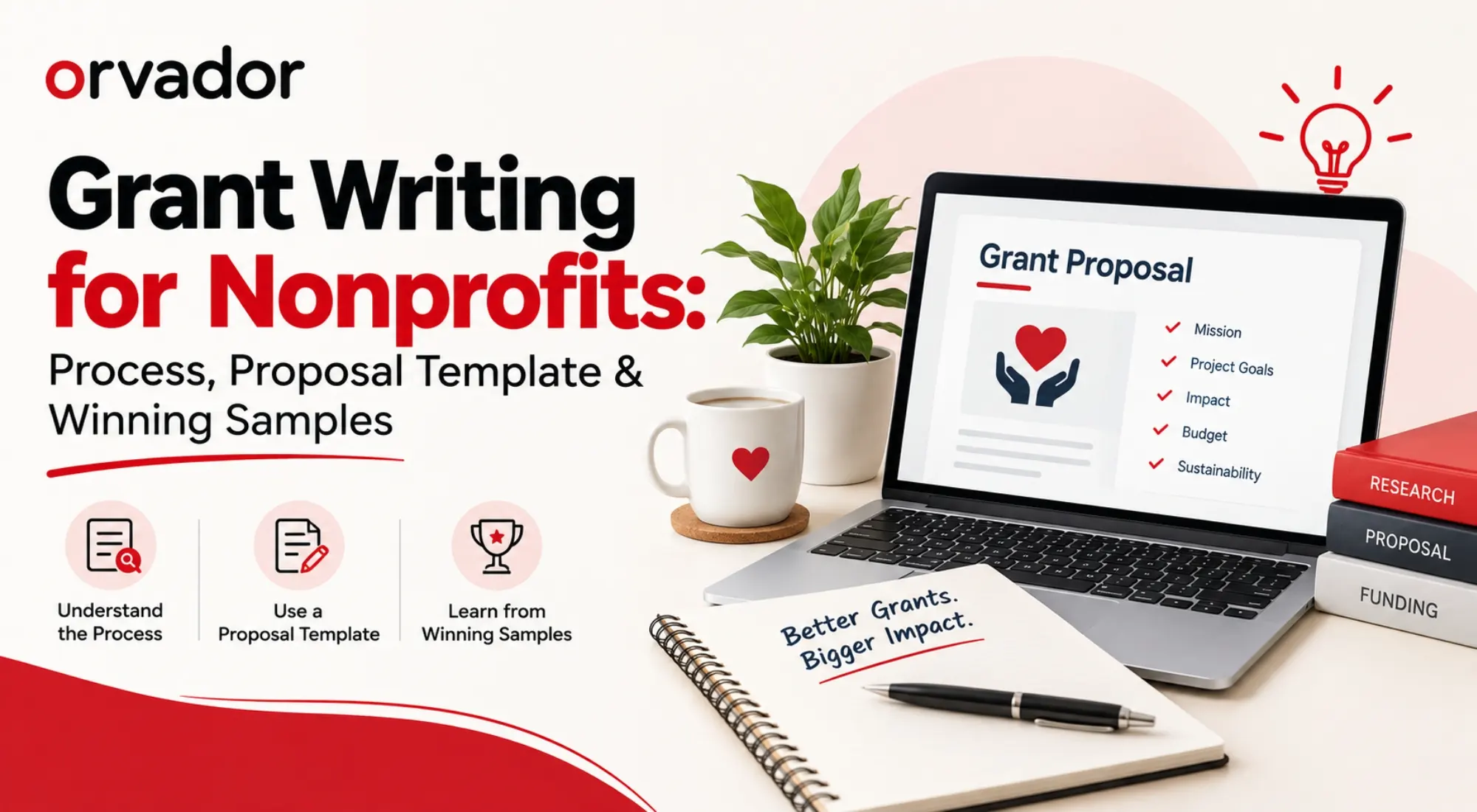
A proposal that consistently wins funding tends to include the same core parts, even when the funder’s application portal reshuffles the section names:
- Executive summary. Two to three sentences a program officer could repeat to their board. What you do, who it serves, and what this grant makes possible.
- Statement of need. The problem, backed by data specific to your community, not a national statistic that could apply to any city.
- Goals and outcomes. What changes because this grant existed. Framed as results, not activities.
- Project description / methodology. How you’ll actually deliver the outcomes – the sequence of activities, timeline, and who’s responsible.
- Organizational capacity. Why your team, specifically, can pull this off. Past results, staff qualifications, relevant partnerships.
- Evaluation plan. How you’ll know it worked, and how you’ll report that back to the funder.
- Budget and budget narrative. Line items that map directly to the activities you just described.
- Sustainability. What happens after this specific grant runs out.
Notice what’s missing from that list: filler. Reviewers reward proposals where every paragraph earns its place. If a sentence doesn’t move the reader from “interesting cause” to “fundable, specific plan,” it’s a candidate for the cutting room floor.
Step-by-Step Writing Process (Need → Outcomes → Budget)
Most writers get stuck because they try to write top to bottom, in the order the application asks for it. That’s backwards. The strongest proposals are built in this sequence, then reordered to fit the funder’s template at the end.
Step 1: Nail the statement of need first
Everything else in the proposal has to serve the need you establish here, so get specific before you write a single other section.
- Use local data, not national averages. “1 in 4 children in [your service area] lacks reliable access to X” beats a national CDC stat every time.
- Cite your source inline or in a footnote. Funders check.
- Frame the need from the community’s perspective, not your organization’s. It’s their problem your program solves, not your program’s gap in funding.
- Keep it to one tight paragraph or two. A need section that runs a full page usually means it isn’t specific enough yet.
Step 2: Define outcomes before you touch activities
This is the step most nonprofit writers skip, and it’s the one that separates a strong application from a middling one. Don’t start with “we will run 12 workshops.” Start with what changes because those workshops happened.
- Write outcomes as measurable statements: “80% of participants will demonstrate improved X by month 6,” not “participants will benefit from the program.”
- Separate outputs (what you do – workshops held, meals served) from outcomes (what changes – skills gained, food security improved). Funders fund outcomes; outputs are just the evidence you’re on track.
- Pressure-test each outcome by asking: could we actually measure this with the tools we have? If not, either scale it back or add a data-collection line item to the budget.
Step 3: Build the budget to match the story, not the other way around
The budget is where reviewers check whether your narrative is real. A mismatch here, say, a proposal that promises a full-time coordinator but budgets for ten hours a week is one of the fastest ways to lose credibility.
- Every activity in your project description should trace to a line item. If it’s in the narrative, it should cost something (or you should explain why it’s in-kind).
- Separate personnel, direct program costs, and indirect/overhead, and check the funder’s cap on indirect costs before you submit.
- Include matching funds or other committed revenue if you have them. It signals the project doesn’t live or die on this one grant.
- Round realistically. Suspiciously round numbers ($10,000 exactly for everything) read as estimated rather than budgeted.
Write the budget narrative last, once the numbers are locked, so it can explain the “why” behind each figure instead of just restating it.
Free Proposal Template (Downloadable)
To save you from rebuilding this structure from scratch every time a new RFP lands, we’ve put together a nonprofit grant proposal template that maps directly to the anatomy above – need, outcomes, methodology, capacity, evaluation, budget, and sustainability, each with prompts for what to fill in and roughly how long each section should run.
[Download the free nonprofit grant proposal template →]
A few ways teams on our client roster use it:
- As a first-draft skeleton for every new application, so the structure never has to be rebuilt from zero.
- As an internal boilerplate library. The organizational capacity and evaluation sections change the least between funders, so once they’re strong, they’re mostly reusable.
- As a review checklist before submission, to catch missing sections before a funder does.
3 Annotated Sample Excerpts: What Reviewers Reward
Reading about proposal structure only gets you so far. It helps to see what a strong paragraph actually looks like next to a weak one. Below are three anonymized, lightly adapted excerpts pulled from real proposal patterns, annotated to show exactly why the stronger version works. These aren’t full samples of grant proposals for nonprofit organizations to copy wholesale. Funder requirements vary too much for that, but the underlying moves transfer across almost any application.
Excerpt 1 – Statement of Need
Weaker version: “Many children in our community struggle with reading. Literacy is essential for future success, and our organization is committed to helping.”
Stronger version: “62% of third-graders in [district] read below grade level, compared to a state average of 34% (State Department of Education, 2026). Without intervention by third grade, students are four times less likely to graduate high school on time.”
Why it wins: The stronger version names a specific place, cites a source, and connects the problem to a consequence the funder cares about. It gives the reviewer a number to hold onto. Something they can reference back to when scoring or when advocating for your proposal in a committee meeting.
Excerpt 2 – Outcomes Statement
Weaker version: “Participants will gain valuable skills through our job training program and be better prepared for employment.”
Stronger version: “75% of program graduates will secure employment within 90 days of program completion, and 60% will retain that employment at the six-month mark, tracked through employer verification and participant follow-up calls.”
Why it wins: It’s measurable, time-bound, and tells the reviewer exactly how you’ll know if it worked, which also previews that your evaluation plan is already thought through, not bolted on later.
Excerpt 3 – Organizational Capacity
Weaker version: “Our organization has years of experience serving the community and a dedicated, passionate staff.”
Stronger version: “Over the past four years, our team has delivered this program to 1,200 participants across three counties, maintaining an 85% completion rate – 20 points above the state average for similar programs. Our program director has led workforce initiatives for over a decade, including two prior grants from [comparable funder].”
Why it wins: Specific numbers and a named track record do the work that adjectives like “passionate” and “dedicated” can’t. Reviewers aren’t scoring your enthusiasm; they’re scoring your evidence.
The pattern across all three: specificity beats sentiment, every single time.
Using AI to Draft Faster (Without Sounding Generic)
AI tools have genuinely changed how fast a first draft comes together, but the nonprofits winning more grants aren’t the ones handing the whole proposal to a chatbot. They’re the ones using AI for the parts that don’t need a human voice and reserving their own judgment for the parts that do.
Where it helps:
- Turning a bulleted outline into a first-draft paragraph you can then edit for voice.
- Rewriting a section to fit a different funder’s word count without starting over.
- Checking a draft against a funder’s stated priorities to flag gaps before you submit.
- Drafting boilerplate, organizational history, staff bios, that changes rarely between applications.
Where it tends to backfire: statements of need and outcomes sections written entirely by AI often read the same way every other nonprofit’s AI-drafted section reads – competent, but generic, and missing the local data and specific numbers that actually persuade a reviewer. The fix isn’t avoiding AI; it’s feeding it your own data and editing hard for specificity before you submit.
We’ve written a more detailed walkthrough of this exact workflow in how to leverage generative AI to write grant proposals that win, including prompt structures and a review checklist for catching AI-flattened language before a funder does.
Tracking Applications & Following Up
A strong proposal can still lose if it’s tracked poorly – missed deadlines, duplicate outreach to the same program officer, or no record of what a funder asked for last cycle all cost nonprofits funding that had nothing to do with the writing itself.
A workable tracking system doesn’t need to be complicated. At minimum, track:
- Funder name, program officer, and their stated priorities or focus areas
- Deadline (and whether it’s a rolling, LOI, or full-proposal deadline)
- Amount requested and amount awarded (once known)
- Reporting deadlines if funded
- Notes from any prior submission – what a reviewer flagged, what got funded, what didn’t
A shared spreadsheet or a lightweight CRM both work; what matters is that the whole team can see it, not just the one person who wrote the last application. After submission, a short thank-you note to the program officer, even before a decision, keeps the relationship warm. If you’re declined, a brief, genuine request for feedback often gets a useful answer and sets up a stronger resubmission next cycle.
Ready to stop rebuilding your proposal structure from scratch every cycle? Download the free nonprofit grant proposal template to get started, or if funding is just one piece of a bigger digital growth puzzle, see how Orvador’s nonprofit digital marketing support helps NGOs build the online presence and data infrastructure that make every grant application stronger.