Most nonprofit websites rank for the wrong things. They show up for their organization’s name and not much else, while the searches that actually lead to a donation, a volunteer sign-up, or a grant application go to somebody else’s site entirely.
That’s usually a keyword problem, not a content problem. The team wrote the blog, built the program page, and published the impact report. But nobody checked whether real people search for those exact terms, or whether the phrasing matches how a donor actually thinks when they type into Google.
Search engine optimization for nonprofits isn’t the same exercise as ecommerce keyword research, because the conversion you’re chasing (a donation, a volunteer application, a grant inquiry) has different intent behind it than a product purchase. This guide breaks down the keyword types your nonprofit actually needs, a practical process for finding them, and where to put them once you have the list.
Why Do Nonprofit Keyword Research Work Differently?
Most SEO advice is written for ecommerce brands, and a lot of it doesn’t transfer cleanly to a nonprofit.
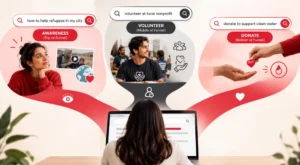
An ecommerce shopper searching ‘waterproof hiking boots men’ is close to a purchase. They know what they want, and they’re comparing options. A person searching ‘how to help refugees in [city]’ isn’t ready to donate yet. They’re still working out whether the problem is real, whether it affects them, and whether your organisation is the one to trust with their money or time.
That gap matters because it changes what ranking well even means for a nonprofit:
A donation-page keyword needs to convert immediately, because the searcher already knows they want to give.
An awareness-stage keyword needs to earn trust first. Ranking for it and then hitting the reader with a donate button in the first line usually backfires.
A volunteer or program keyword sits somewhere in between. The searcher wants to help, but they’re still figuring out how.
If your keyword list treats all three the same way, either as pure ‘donate now’ terms or pure informational terms, you’ll either scare off top-of-funnel readers or fail to capture people who are ready to act. The fix is building out all three layers deliberately, which is what the rest of this guide covers.
The Five Keyword Types Every Nonprofit Needs
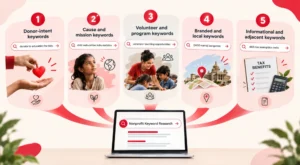
Before opening a keyword tool, it helps to know what categories you’re actually filling in. Most nonprofit SEO strategies fall apart because they only ever chase one of these five, usually the cause-awareness type, while leaving the highest-converting ones untouched.
1. Donor-intent keywords
These are searches from someone close to giving. Think ‘donate to [cause] India,’ ‘best NGO for [cause],’ ‘child education charity near me.’ Low volume individually, but the searcher is warm. These belong on your donation page and homepage, not buried in a blog post three clicks deep.
2. Cause and mission keywords
Broader, awareness-stage searches tied to the problem you solve: ‘child malnutrition India statistics,’ ‘why is ocean plastic a problem,’ ‘girls education gap causes.’ These bring in top-of-funnel traffic and are where most of your blog content should live.
3. Volunteer and program keywords
Searches from people who want to get hands-on: ‘volunteer teaching opportunities [city],’ ‘NGO internship for students’, ‘how to volunteer at an animal shelter.’ These convert differently than donor keywords, so they need their own landing pages.
4. Branded and local keywords
Your organisation’s name, plus name + location or name + program combinations: ‘[NGO name] reviews,’ ‘[NGO name] Bangalore,’ ‘[NGO name] annual report.’ These are usually easy wins because there’s little competition, but they only bring in people who already know you exist.
5. Informational and adjacent keywords
Terms your audience searches that aren’t directly about your cause but sit next to it: ‘80G tax exemption India,’ ‘CSR partner NGO checklist,’ ‘how to choose a charity to donate to.’ These pull in donors, corporate partners, and grant officers who are further along in their research than a pure awareness search suggests.
Most nonprofit sites we’ve audited are overweighted on category two and almost empty on categories one and three, which explains a lot of the traffic-without-donations problem.
How to Actually Find These Keywords?
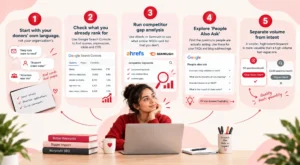
Once you know the categories, the research process is mostly about filling each bucket with real search terms, not guesses.
Step 1: Start with your donors’ own language, not your organization’s
Pull actual phrases from donor emails, volunteer applications, and social comments. Nonprofits often write in program language (‘early childhood development intervention’) while donors search in plain language (‘help kids learn to read’). The gap between those two phrasings is where most missed keywords live.
Step 2: Check what you already rank for
Google Search Console shows every query that’s already bringing you impressions, including ones you never targeted on purpose. Sort by impressions with low click-through rate. That list is often full of terms you’re already halfway ranking for, and a small content or title tweak can push them onto page one. Google’s Search Console Performance report lets you review queries, impressions, clicks, CTR, and pages shown for specific searches. Google Search Console Performance report
Step 3: Run competitor gap analysis
Tools like Ahrefs or Semrush let you plug in two or three comparable NGOs and see what they rank for that you don’t. This is faster than building a keyword list from scratch, and it surfaces terms you’d never think to search for on your own.
Step 4: Explore ‘People Also Ask’
Search your core terms on Google and pull every question in the ‘People Also Ask’ box. These are near-verbatim searches, and they map directly onto FAQ sections and blog subheadings. AnswerThePublic keyword research guide does the same thing at scale and groups the questions by intent, which saves you the manual sorting.
Step 5: Separate volume from intent
A keyword with 50 searches a month and clear donor intent is worth more than one with 5,000 searches and vague intent. Nonprofit search volumes are almost always lower than ecommerce or SaaS categories, so don’t discard a term just because the tool shows a small number. Ask what the person searching it actually wants, then decide if it fits your funnel.
Weak vs. Strong Keyword Targeting: What Actually Works
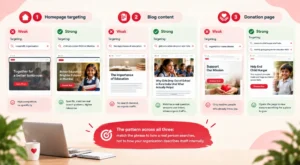
Seeing the difference in practice makes this concrete faster than more theory does.
Example 1 – Homepage targeting
Weaker: Targeting ‘nonprofit organisation’ as the primary homepage keyword.
Stronger: Targeting ‘child education NGO in Mumbai’ or ‘NGO for girls education India.’
Why it wins: The generic version has enormous competition and zero specificity, so Google has no signal about who should actually see your page. The specific version matches exactly how someone searches when they already have a cause and a location in mind, which is a far more common search pattern than the generic version.
Example 2 – Blog content
Weaker: A blog post titled ‘The Importance of Education’ targeting nothing in particular.
Stronger: A blog post titled ‘Why Girls Drop Out of School in Rural India (And What Actually Helps)’ targeting the keyword ‘girls education dropout rate India.’
Why it wins: The stronger version answers a question someone is actually typing into Google, with a title that mirrors the search. The weaker version might be well-written, but it isn’t built around anything searchable, so it has no path to organic traffic regardless of quality.
Example 3 – Donation page
Weaker: A donation page optimised only for ‘[Organisation name] donate.’
Stronger: The same page also optimised for ‘donate to child hunger relief India’ and ‘monthly giving program for education NGO.’
Why it wins: Branded-only targeting caps your ceiling at people who already know you. Adding cause-based, donor-intent phrasing opens the page to people actively searching for a place to give who haven’t heard of your organisation yet, which is a much larger pool.
The pattern across all three: match the phrase to how a real person searches, not to how your organization describes itself internally.
Where to Actually Place These Keywords
Finding the keywords is half the job. Most of the impact comes from placing them correctly.
Donation and campaign pages should carry donor-intent keywords in the H1, the first paragraph, and the meta title. This is the highest-value real estate on the site.
Program and ‘get involved’ pages should carry volunteer and program keywords, separated by program type rather than lumped into one generic page.
Blog content should carry cause and informational keywords, one primary keyword per post, with internal links pointing back to the relevant donation or program page.
About and impact pages are a natural home for branded and local keywords, plus the informational terms corporate partners and grant officers search.
A common mistake is stuffing every keyword type onto the homepage and leaving every other page untargeted. Split the categories across the pages actually built to convert that specific intent.
For a broader framework, see Orvador’s guide to SEO for nonprofits, which covers how nonprofit SEO connects visibility with donors, volunteers, and supporters.
Common Mistakes Nonprofits Make With SEO Keywords
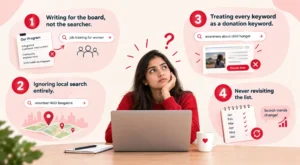
Writing for the board, not the searcher. Program names and internal jargon rarely match search behaviour. If your team calls it ‘integrated livelihood intervention’ and donors search ‘job training for women,’ the donor’s phrase wins every time.
Ignoring local search entirely. Even national and international NGOs get meaningful traffic from city-level searches (‘volunteer NGO Bangalore,’ ‘donate old clothes Delhi’), and most nonprofit sites have no pages built to catch them. Orvador also covers this in its earlier guide to local SEO for nonprofits.
Treating every keyword as a donation keyword. Slapping a ‘Donate Now’ CTA onto a page targeting an awareness-stage search usually raises bounce rate instead of donations.
Never revisiting the list. Search behaviour shifts with news cycles, disaster response periods, and tax season. A keyword list built once and never updated goes stale within a year.
Not sure which of these keyword types your nonprofit is missing?
Our team can run a quick audit of your current rankings and show you exactly where the gaps are. Get in touch with our team
Getting the keyword list right is the starting point. Turning it into pages that actually rank and convert is where most nonprofits get stuck. If you’d rather have someone build and run this system for you, take a look at how Orvador’s SEO for Nonprofits service handles the full loop, from keyword research through to donation-page optimisation.