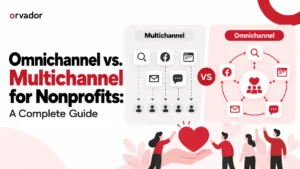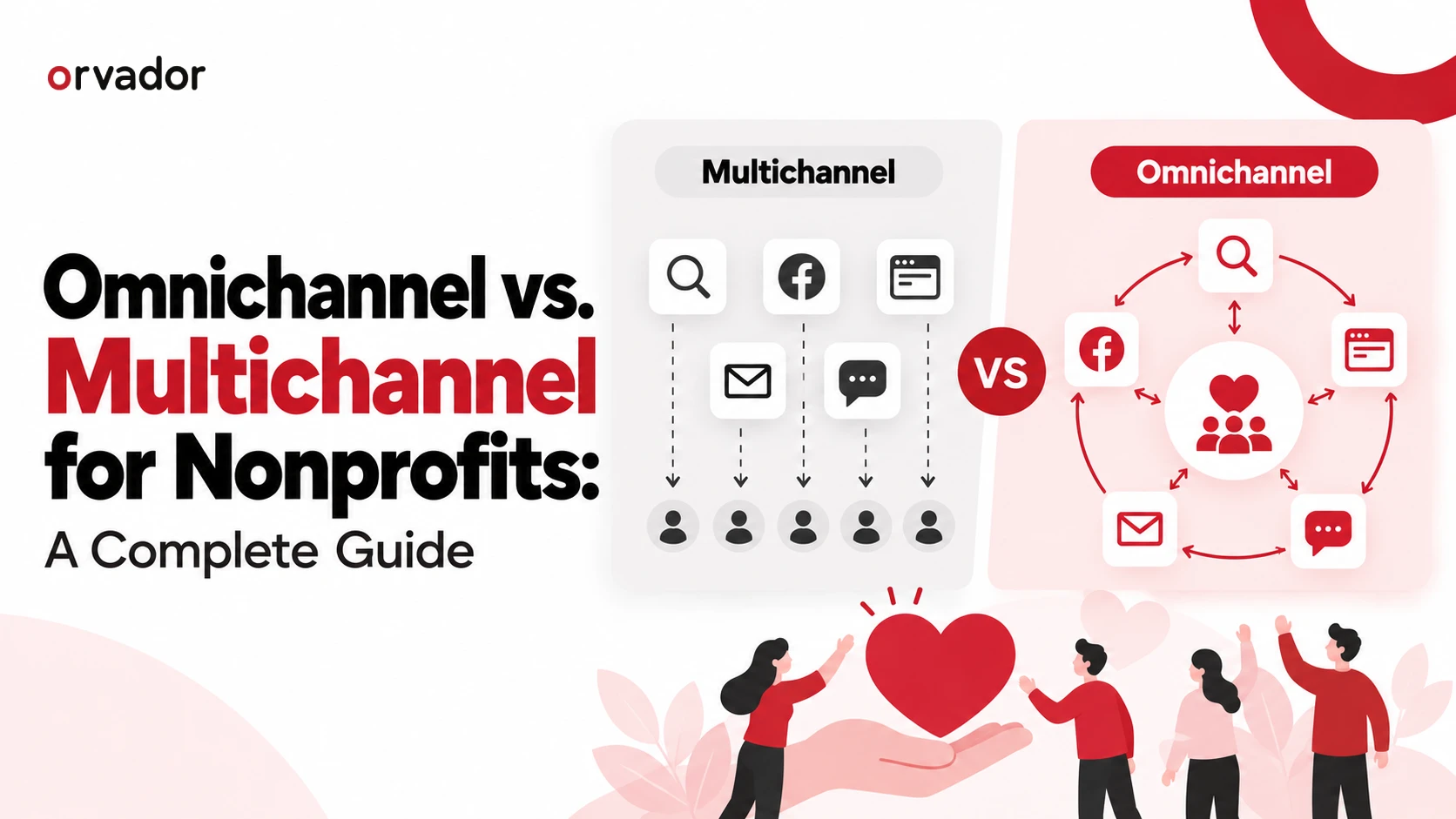
Multichannel means a nonprofit uses several channels, but each one runs on its own, with separate data, reporting and messaging. Omnichannel connects those same channels through shared supporter data, so every interaction picks up where the last one left off.
Most nonprofits are already active on more than one channel. There is a website, an email list, a Facebook page, an Instagram account, maybe a WhatsApp group for volunteers and a Google Ad Grant running quietly in the background. On paper, that looks like a healthy nonprofit digital engagement setup. In practice, a supporter who donated through your website on Tuesday can still receive a "become a first-time donor" appeal on Thursday.
That gap sits at the center of the omnichannel vs multichannel for nonprofits question. Supporters do not think in channels. They find you on Google, check your Instagram, read an email and donate on their phone, sometimes within the same week. What they expect is that your organization remembers them at every step. Being present on many channels is not the same as being omnichannel, and the difference shows up in donor retention, volunteer sign-ups and the time your team spends on every campaign.
This guide explains both approaches, compares them side by side, walks through the tools and journeys involved, and helps you decide which one suits your organization right now.
What Is Multichannel Engagement for Nonprofits?
Multichannel engagement means a nonprofit communicates with supporters across several channels, with each channel managed on its own. The email team sends the newsletter, the social team posts on Instagram and LinkedIn, the fundraising team runs the donation page, and each group works toward its own targets, calendar and report.
This is how most nonprofit multichannel marketing starts, and there is nothing wrong with that. A monthly newsletter, a Facebook fundraiser, a Google Ads campaign and a WhatsApp broadcast list are all examples of separate channels doing their own job. A supporter can reach you through any of them.
The benefits are real. Multichannel setups widen your reach, they are easy to start on a limited budget, and they let small teams build skill in one channel at a time. Among the benefits of multichannel marketing for nonprofits is simply that you meet people where they already spend time.
The limits show up as you grow. Channels do not share supporter data, so messages repeat, contradict each other or arrive at the wrong moment. Nobody sees the full picture of what a donor has done, and reporting ends up scattered across five dashboards. In a multichannel vs omnichannel comparison, this is the point where the two approaches start to part ways.
What Is Omnichannel Engagement for Nonprofits?
Omnichannel engagement for nonprofits connects every channel through shared supporter data, so each interaction continues from the last one instead of starting over. The channels still exist: website, email, social, WhatsApp, ads. What changes is that they all work from the same information about the person on the other end.
In a connected setup, a supporter who reads a blog post, signs up for updates and then donates is recognized at each of those steps. The donation updates the CRM, the CRM stops the acquisition appeal, and the thank-you email goes out before any new ask. A WhatsApp follow-up or a social retargeting ad can pick up from the right point.
That is the idea behind nonprofit omnichannel engagement: one supporter, one continuous conversation, many places to have it. It relies on three things. A supporter journey that is planned rather than accidental. Data that moves between platforms. And communication that stays consistent in tone and timing wherever the person meets you.
Omnichannel does not mean being on every channel. A nonprofit using only email, a website and WhatsApp can be fully omnichannel if those three are connected and coordinated.
Omnichannel vs. Multichannel for Nonprofits: Key Differences
The simplest way to understand multichannel vs omnichannel is to look at how each approach treats the supporter rather than the channel. Multichannel organizes work around channels. Omnichannel organizes work around the supporter's journey. Here is how that plays out across the areas that matter most.
| Area | Multichannel | Omnichannel |
|---|---|---|
| Channel structure | Each channel runs independently with its own owner | Channels are planned together around shared goals |
| Data integration | Supporter data sits in separate tools | Data flows into one connected record, usually a CRM |
| Supporter journey | Fragmented; the supporter starts over on each channel | Continuous; each step builds on the last |
| Personalization | Limited to what each channel knows | Based on full history across channels |
| Communication | Messages can overlap or contradict | Timing and tone are coordinated |
| Reporting | Separate reports per channel | One view from first touch to donation and retention |
| Automation | Channel-level, such as a single email sequence | Cross-channel, such as one donation triggering an email, a WhatsApp message and ad suppression |
The same logic holds for omnichannel vs multichannel marketing for nonprofits more broadly. The question is not how many channels you use. It is whether those channels know about each other.
Multichannel vs. Omnichannel Nonprofit Journey
The Channels and Tools Nonprofits Can Use for Omnichannel Engagement
There is no required toolkit. The goal is to choose nonprofit engagement channels that your supporters actually use, and then connect them. The tools below are common examples, grouped by the job they do in a connected journey. It is not a list to adopt in full.
Search & Advertising
Google and Google Ads bring people in. Search results and Ad Grants campaigns often start the journey, so landing pages and tracking need to be set up to pass information along.
Social Media
Facebook, Instagram, LinkedIn and YouTube build awareness and trust. They are also strong places to retarget people who have already visited your site.
Messaging & Communication
WhatsApp and email platforms handle direct, personal contact. Thank-yous, updates and reminders live here, and this is where omnichannel communication for nonprofits prevents the same ask from going out twice.
Website & Content Platforms
WordPress and Webflow host the pages where supporters learn, donate and sign up. They act as the hub that most other channels point toward.
CRM & Marketing Platforms
HubSpot and similar CRM systems hold the supporter record. Phone and communication tools such as GoTo can also feed into the CRM where relevant.
Automation & Integration
Zapier moves data between tools that do not connect natively, for example sending one form submission to both the CRM and an email list.
AI & Emerging Engagement Tools
ChatGPT and other AI-powered tools can help draft messages, answer common supporter questions and summarize feedback, as long as a person reviews anything that goes out under your name.
Ecommerce / Donation & Transaction Platforms
Shopify suits nonprofits with a merchandise or social-enterprise store, and donation platforms handle one-off and recurring gifts. Whichever you use, each transaction should update the supporter's record.
What matters is how these pieces fit together. A connected path might look like this: Google → Website → Donation → CRM → Email/WhatsApp → Social retargeting. Each tool does one job, and the CRM passes what it learns to the next step.
How Omnichannel Engagement Works for Nonprofits
A useful way to picture a nonprofit supporter journey is in six stages: Discover → Visit → Engage → Donate/Sign Up → Follow Up → Retain.
-
Discover: Search, Ad Grants, social posts and video introduce the cause.
-
Visit: The website or landing page explains your work, and tracking records where the visit came from.
-
Engage: Blog content, newsletter sign-ups, WhatsApp opt-ins and social follows keep the person close.
-
Donate/Sign Up: The donation page, volunteer form or event registration captures the action and writes it to the CRM.
-
Follow Up: A thank-you email, a WhatsApp confirmation and a pause on acquisition ads happen automatically.
-
Retain: Impact updates, recurring-gift invitations and personalized asks keep the relationship going.
Not every stage needs every channel. The point is that whichever channel handles a stage knows what happened in the one before. Some teams still call this the nonprofit customer journey, though supporter journey describes it better. Either way, the journey turns from a set of disconnected touchpoints into a relationship.
Examples of Omnichannel Nonprofit Journeys
Here are five common paths, each a nonprofit supporter journey built on the same idea: every step knows what came before it. Planning them is the heart of any nonprofit donor engagement strategy.
-
Donor Acquisition Journey
A first-time visitor finds a blog post through Google, joins the email list and sees a short story on Instagram a few days later. A welcome email links to the donation page. A first gift triggers a thank-you message and ends acquisition ads for that person.
-
Recurring Donor Engagement Journey
A one-time donor receives an impact update by email and, a month later, an invitation to give monthly through WhatsApp or the website. Once they start, receipts and reminders run automatically, and a quarterly update shows what their gifts made possible.
-
Volunteer Recruitment Journey
A LinkedIn post or Facebook event reaches a possible volunteer, who fills in an interest form. The CRM tags their skills and location, an email confirms the next orientation date, and a WhatsApp group keeps them connected until their first shift.
-
Event Registration Journey
Registration begins on the website, flows into the CRM and triggers a confirmation email, plus a reminder message the day before. After the event, attendees get a thank-you and a prompt to donate or volunteer, based on whether they joined in person or online.
-
Advocacy & Campaign Engagement Journey
Someone signs a petition from a social post. The signature is recorded, a follow-up email explains the next action, and social retargeting invites them to share the campaign. People who take a second action move into a group that receives deeper updates.
Benefits of an Omnichannel Strategy for Nonprofits
Omnichannel marketing for nonprofits pays off in ways that go beyond tidier dashboards. Done well, nonprofit omnichannel marketing tends to show up in these six areas.
Consistent Supporter Experience
Supporters see the same voice, offers and timing wherever they meet you, with no repeat asks after a gift.
Better Data Connectivity
One record per supporter replaces scattered lists, which makes segmentation and reporting more accurate.
More Relevant Communication
Messages reflect what someone has already done, so appeals feel personal rather than generic. That is the foundation of strong nonprofit supporter engagement.
Better Understanding of Supporter Journeys
You can see which channels introduce supporters, which ones convince them and where people drop off.
Coordinated Campaigns
Email, social, ads and WhatsApp support each other during a campaign instead of competing for attention.
Improved Engagement Measurement
Reporting follows the supporter from first visit to repeat gift, so you measure outcomes rather than channel activity.
Challenges of Implementing Omnichannel Engagement
Moving to a connected model takes work, and most of the obstacles are practical rather than technical. Knowing them early makes your nonprofit communication strategy easier to plan and your nonprofit digital engagement easier to sustain.
-
Data Silos
Supporter details often live in spreadsheets, email tools, donation platforms and social accounts that do not talk to each other. Start by finding where each piece of data lives.
-
Multiple Disconnected Platforms
Years of adding tools one at a time leave overlapping systems. Consolidate where you can before adding anything new.
-
Integration Complexity
Connecting tools takes setup and testing. Native integrations and tools like Zapier reduce the effort, but someone has to own them.
-
Limited Resources
Small teams cannot do everything at once. Connect two or three channels first and expand once the basics work.
-
Data Privacy and Consent
Sharing data across channels requires clear consent and compliance with rules such as GDPR or local data protection laws. Record opt-ins for each channel and honor opt-outs everywhere.
-
Maintaining Consistent Messaging
More channels mean more people writing. A short messaging guide covering tone, key facts and calls to action keeps everyone aligned.
How to Build an Omnichannel Strategy for Your Nonprofit
You do not need a large budget to start with omnichannel marketing for nonprofits or to build an omnichannel nonprofit strategy. A practical digital engagement strategy for nonprofits follows seven steps.
-
Step 11. Identify Your Audiences
Separate donors, volunteers, beneficiaries and partners. Each group uses different channels and wants different things from you.
-
Step 22. Map Supporter Journeys
Sketch how each audience moves from first contact to long-term involvement, and note where people stall.
-
Step 33. Identify Your Channels
Choose channels based on where each audience already is, not on what is fashionable. Fewer, well-connected channels beat many scattered ones. Your website is usually the hub, so it helps to make sure supporters can find it through nonprofit SEO.
-
Step 44. Connect Your Data and Platforms
Pick a central record, usually a CRM, and connect forms, donation pages, email and ads to it.
-
Step 55. Create Consistent Messaging
Agree on tone, your core story and calls to action so a supporter hears one voice everywhere.
-
Step 66. Personalize Communications
Use what you know, such as past gifts, interests and event attendance, to tailor messages. Start with simple rules, like skipping acquisition appeals for current donors.
-
Step 77. Measure and Optimize
Track journeys rather than channels: conversion from first visit to gift, repeat donation rate, and volunteer sign-up to first shift. Review the numbers every quarter and adjust.
Multichannel vs. Omnichannel: Which Approach Fits Your Nonprofit?
The omnichannel vs multichannel for nonprofits decision is not about picking a winner. Multichannel is a reasonable fit when your team is small, you use two or three channels and your campaigns are simple. Speed, low cost and simplicity matter most at that stage.
Omnichannel starts to pay off when supporters use several channels, repeated messages are becoming a problem or you want to measure the full journey.
| Consideration | Multichannel may fit if... | Omnichannel may fit if... |
|---|---|---|
| Organization size | You have a small team with few staff | You have a dedicated team or agency support |
| Number of channels | You use two or three | You use four or more that overlap |
| Technology stack | You run standalone tools | You have a CRM or plan to adopt one |
| Data maturity | Data lives in spreadsheets | Supporter data is clean and consented |
| Campaign complexity | Campaigns are single-purpose | Campaigns are multi-step, with recurring giving |
| Available resources | Time and budget are limited | You can set up and maintain integrations |
Many organizations move gradually. Start multichannel, connect the two channels that matter most, then expand from there.
Build a More Connected Nonprofit Engagement Strategy
Supporters already move between channels. The only question is whether your organization moves with them. In the omnichannel vs multichannel for nonprofits decision, the right choice depends on your size, data and goals, but the direction is clear: connect what you have before adding more.
If you want help mapping supporter journeys, connecting your tools or planning campaigns that work across channels, Orvador's omnichannel engagement services are built for nonprofits at every stage. Talk to our team about where your engagement strategy can become more connected.
Talk to our team →