TL;DR: A strong nonprofit marketing plan turns scattered social posts and one-off email blasts into a coordinated system for reaching donors, volunteers, and beneficiaries. This guide walks you through five practical steps: setting mission-aligned goals, building audience personas, choosing the right channels and budget, creating a content calendar, and tracking the KPIs that actually matter. Whether you’re building a marketing plan for non profit organizations from scratch or improving an existing strategy, you’ll find a simple framework you can follow. There’s also a free, downloadable nonprofit marketing plan template at the end, along with answers to common questions nonprofits have before getting started.
Why Every Nonprofit Needs a Written Marketing Plan
Most nonprofits don’t struggle with marketing because they lack passion or have a weak cause. The bigger problem is that marketing often becomes reactive.
A newsletter goes out when someone remembers. A social post gets published because a board member asks, “Why haven’t we posted this week?” One campaign starts before the previous one has really finished. Over time, there’s no clear connection between the organization’s mission, its messaging, and the people it is trying to reach.
A written marketing plan nonprofit teams can actually use helps fix that.
It gives your team a chance to define what success looks like, who you’re trying to reach, where your limited time and budget should go, and how you’ll know whether your efforts are working. When everyone has the same roadmap, staff, volunteers, and board members can work toward the same priorities instead of pulling in different directions.
This matters even more for nonprofits because your audiences aren’t all the same. You may be communicating with donors, volunteers, beneficiaries, policymakers, and the media, sometimes with the same small team and a very limited budget.
Each audience has different needs and motivations. Without a plan, it becomes difficult to serve all of them effectively. With one, you can organize your communications so the right audience receives the right message at the right time without overwhelming your staff or your supporters.
A good nonprofit marketing strategy also doesn’t need to become a 40-page document that nobody reads. Effective nonprofit marketing plans can be simple. At their core, they need five things: clear goals, defined audiences, a realistic channel and budget plan, a calendar that turns strategy into action, and a way to measure the results.
This guide walks through each part step by step. If you want to understand the bigger picture first, our complete guide to nonprofit digital marketing explains how these different pieces fit together.
Step 1: Mission-Aligned Goals & SMART Objectives
Every marketing plan for non profit organizations should begin with the mission, not with a particular social platform or marketing tactic.
Before deciding whether to post on Instagram, start an email series, or run paid ads, ask a more important question: What should our marketing actually help the organization achieve this year?
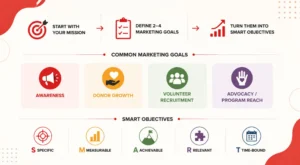
Start by translating your mission into two to four marketing goals. These will usually fall into a few common areas:
- Awareness – Help more people recognize your organization and understand the cause you work on.
- Donor growth – Bring in more first-time donors or improve retention among existing supporters.
- Volunteer recruitment – Attract enough volunteers to support specific programs, events, or ongoing needs.
- Advocacy or program reach – Help more beneficiaries access your services or encourage supporters to take a specific action.
Once you’ve identified your priorities, turn each one into a SMART objective: Specific, Measurable, Achievable, Relevant, and Time-bound.
For example, “Grow our donor base” is a broad goal. It gives your team direction, but not enough detail to build a campaign around.
“Increase first-time online donors by 20% between September and December, ahead of year-end giving” is much more useful. Your team knows exactly what needs to improve, by how much, and within what timeframe.
One useful habit is to limit the number of goals you set.
Nonprofit teams are often small, and trying to manage eight major priorities at once usually means none of them receives enough attention. Pick the two or three goals that matter most during the current planning cycle. Your audiences, channels, content calendar, and campaigns should then support those priorities.
Step 2: Audience Personas – Donors, Volunteers, Beneficiaries
This is one of the steps that many nonprofit marketing plans overlook, and it can be one of the biggest reasons a strategy underperforms.
“Supporters” isn’t really an audience.
A first-time donor, a long-term volunteer, and a beneficiary looking for services may all interact with your organization, but they have different motivations, questions, and expectations. Your marketing should reflect those differences.
Start by creating a simple one-page persona for each core audience.
Donors
Ask yourself:
- What motivated them to make their first gift?
- Are they more responsive to urgency, such as disaster response or a matching-gift deadline?
- Do they respond better to long-term impact stories?
- What giving level are they currently at?
- What might encourage them to increase their support?
Volunteers
Consider:
- Are they looking for one-time opportunities or ongoing involvement?
- Are they motivated by hands-on service?
- Would they prefer skill-based volunteering?
- Is community involvement or belonging a major motivation?
Beneficiaries
Think about:
- What information do they need to access your programs?
- What questions or concerns might prevent them from taking the next step?
- Which language and content formats work best for them?
- Which channels actually reach them?
That last question is particularly important. The channel that works for your donors may not be the channel that works for your beneficiaries.
For each persona, identify their biggest objection or hesitation, the channel where you’re most likely to reach them, and the message most likely to resonate.
These details can then become the filter for the content you create.
Before publishing something, ask: Who is this for, and what do we want it to accomplish?
If your nonprofit serves a specific niche, such as healthcare or education, your personas should reflect the decisions and challenges specific to that mission rather than relying on generic “supporter” language.
A one-time crisis donor and someone enrolled in your monthly giving program may both support the same organization, but from a marketing perspective, they are two very different audiences.
Step 3: Channel Selection & Budget Allocation
Once your goals and audiences are clear, choosing marketing channels becomes much easier.
Instead of asking, “Should we be on TikTok?” ask:
Where does each audience already spend time, and which channels can our team realistically maintain?
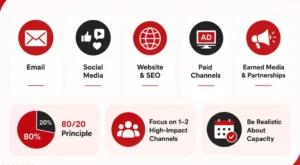
A practical nonprofit marketing strategy usually combines several channels:
- Email – Still one of the strongest channels for donor communication and retention. It’s relatively inexpensive and gives you more control over your audience.
- Social media – Useful for awareness and volunteer recruitment, especially when your organization has strong visual stories, photos, short videos, or behind-the-scenes content.
- Website & SEO – Your website is one of your most durable marketing assets. Unlike a social post that can disappear from attention within hours, useful website content can continue attracting people over time.
- Paid channels – This includes Google Ad Grants, which can provide eligible nonprofits with free search advertising and should be explored before committing limited funds to other paid channels.
- Earned media & partnerships – Press coverage, community partnerships, and co-marketing with organizations that share your values can extend your reach without requiring a large advertising budget.
Budget allocation should follow an 80/20 approach where possible.
Put roughly 80% of your available time and money behind the one or two channels that reach your priority audiences most effectively. Use the remaining resources to test new opportunities.
One common mistake is spreading a small budget across six different channels and doing all of them poorly. It’s usually more effective to do two channels consistently well.
Capacity matters just as much as budget.
If your team can’t maintain a channel consistently, it may do more harm than good. An abandoned social account or newsletter that disappears for months can make an organization appear inactive.
You don’t need to be everywhere. Choose the channels that make sense for your audiences and commit to them.
Step 4: Content Calendar & Campaign Timeline
This is where your strategy turns into actual work.
A content calendar takes your goals, audiences, and chosen channels and turns them into a week-by-week or month-by-month production schedule.
Start with the natural rhythm of your organization. This might include:
- Year-end giving
- GivingTuesday
- Program milestones
- Grant deadlines
- Volunteer recruitment periods
- Major events
- Awareness months related to your cause
These should become your anchor points. You can then build always-on content, such as blog posts, social updates, and email newsletters, around them.
This approach helps prevent a common nonprofit marketing problem: going silent for most of the year and then trying to generate attention only when a major fundraising campaign arrives.
At minimum, map out the following for each month:
- Campaign or theme – What is the main focus?
- Primary persona – Who are you trying to reach?
- Channels – Where will the campaign appear?
- Content required – What needs to be created?
- Owner – Who is responsible for producing and approving it?
- Publish date – When does everything need to go live?
Keep your calendar realistic.
If you have one part-time marketing employee, planning three major campaigns every month isn’t a strategy. It’s a wish list.
Whenever possible, batch your content creation. For example, you might write four weeks of social captions in one sitting or prepare several email drafts together. This protects time for more demanding work, such as donor stories, campaign strategy, and video production.
Step 5: KPIs, Reporting Cadence & Review Loops
A marketing plan without measurement is really just a list of activities.
Connect each goal from Step 1 to one or two KPIs and decide in advance how often you’ll review them.
Here are some useful nonprofit KPIs by goal:
- Awareness – Website traffic, social reach and impressions, branded search volume
- Donor growth – Number of new donors, average gift size, donor retention rate, email open and click rates
- Volunteer recruitment – Applications started versus completed, volunteer registrations, event sign-ups
- Advocacy/reach – Petition signatures, program inquiries, beneficiary sign-ups
Your reporting schedule should match your team’s capacity.
Monthly reporting is enough for many nonprofits, while active campaigns may need a lighter weekly review.
The purpose of reporting isn’t simply to send numbers to leadership. It should create a feedback loop.
If a particular channel or message underperforms for two months in a row, treat that as a reason to adjust the plan. Don’t keep repeating the same approach simply because it’s already in the calendar.
It’s also worth building a quarterly review into your plan. Step back and ask whether your original goals still make sense, what has changed, and what needs to be adjusted.
A marketing plan should guide your organization, not trap it in decisions that no longer make sense.
Free Nonprofit Marketing Plan Template (Downloadable)
You don’t need to build this entire framework from a blank page.
Our free nonprofit marketing plan template includes ready-to-use worksheets for each step covered above, including:
- SMART goal-setting
- Donor, volunteer, and beneficiary persona templates
- Channel and budget planning
- Monthly content calendar
- KPI tracking sheet
[Download the Free Nonprofit Marketing Plan Template →]
Use the template as a working document rather than something you complete once and file away.
Review and update it quarterly as your goals, audiences, campaigns, and available resources change. That way, it can continue keeping your team aligned as your organization grows.
Ready to Put Your Nonprofit Marketing Plan Into Action?
A template can help you get organized, but turning that framework into a strategy that consistently supports your goals takes planning, testing, and ongoing improvement.
Book a free strategy call with Orvador and get help turning your plan into a practical nonprofit marketing strategy built around your goals, your team, and your budget.