
June 2026 - Orvador

10 Must-Have AI Tools for Nonprofits in 2026: Tested, Ranked & Reviewed

TL;DR: Nonprofits are adopting AI faster than ever, but most teams don’t know which tools are actually worth their limited budget. We tested 10 of the most popular AI tools for nonprofits and ranked them by impact, ease of use, and value for mission-driven teams, from free options to premium platforms. Get set, go.

Why Do Nonprofits Need AI Tools in 2026?

Most nonprofit teams run lean. One communications manager wears five hats: donor emails, social posts, grant reports, and a website that hasn’t been updated since 2023. AI tools for nonprofits exist to close exactly this gap. The right nonprofit AI tools don’t replace your mission-driven team. They give back hours that were previously lost to repetitive admin work. Hours that can go straight into donor relationships, program delivery, and the actual cause you exist for. We tested dozens of platforms marketed toward the social sector and narrowed it down to 10 tools for nonprofits that consistently delivered real value, whether you’re working with zero budget or a modest annual tech spend.

How Did We Test and Rank These Tools?

Before ranking anything, Orvador evaluated each platform against five criteria that matter specifically to nonprofits:
  • Cost-to-value ratio – does the free or discounted tier actually do useful work?
  • Ease of use – can a non-technical team member use it without training?
  • Nonprofit-specific features – donor segmentation, grant writing, volunteer coordination, etc.
  • Data privacy – is donor and beneficiary data handled responsibly?
  • Integration – does it work with tools nonprofits already use, like CRMs and email platforms?

The 10 Best AI Tools for Nonprofits, Ranked

Quick Comparison Table

Rank Tool Best For Free Plan? Starting Price
1 Claude (Anthropic)  Content drafting, research & grant writing  Yes  Free–$20/mo 
2 Donorbox + AI Insights Donor management & predictions Yes Free-$99/mo
3 Canva for Nonprofits Design & social content Yes (free for eligible NGOs) Free
4 ChatGPT (Nonprofit use) Content drafting & strategy Yes Free-$20/mo
5 HubSpot for Nonprofits CRM & marketing automation Discounted plans 40% nonprofit discount
6 Otter.ai Meeting notes & transcription Yes Free-$16.99/mo
7 Jasper Long-form content & campaigns No $39/mo
8 Fundraise Up AI-optimized donation pages Yes (revenue share) Free to start
9 Zapier (AI workflows) Automating repetitive tasks Yes Free-$19.99/mo
10 Google Gemini for Nonprofits Research & drafting Yes (via Google for Nonprofits) Free
Claude logo
★ Top Pick

Claude

Best All-Purpose AI Assistant for Nonprofits

Claude has quickly become a go-to tool for nonprofit teams that need one assistant capable of handling several jobs well: drafting grant proposals, summarising board documents, writing donor emails, and researching programme data — all while maintaining a careful, accurate tone that matters when you're representing a cause.

What sets it apart for nonprofit use is its handling of longer documents. Teams can upload an entire grant-guideline PDF or a board report and get a clear, accurate summary or first draft back, rather than working in disconnected snippets.

Why it ranks #1

Most nonprofit teams don't have the bandwidth to learn five specialised tools. Claude covers grant writing, content drafting, research, and document summarisation in one place — with a free tier that's genuinely usable for small teams.

Best forNonprofits of any size that want one reliable AI assistant for writing and research tasks, rather than juggling multiple subscriptions.

Google Gemini logo

02Google Gemini for NonprofitsBest Free Research Assistant

Available through the Google for Nonprofits programme, Gemini helps with research, first drafts, and data summarisation — integrated directly with Google Workspace, which many nonprofits already use.

Best forNonprofits already on Google Workspace who want AI without adding another subscription.

Donorbox logo

03Donorbox + AI InsightsBest for Donor Prediction

Donorbox has become a default donation platform for many nonprofits, and its AI-powered insights layer now helps predict which donors are likely to lapse — and which are ready for a larger ask.

Best forOrganisations already using Donorbox who want smarter segmentation without switching platforms.

Canva logo

04Canva for NonprofitsBest Free AI Tool for Nonprofits

Canva's nonprofit programme gives eligible organisations free access to its Pro plan, including AI-powered design features like Magic Design and background removal. It's one of the most genuinely useful free marketing tools for nonprofits available today.

Best forAny nonprofit producing social graphics, flyers, or annual reports without a designer on staff.

ChatGPT logo

05ChatGPTBest All-Purpose Online Tool for Nonprofits

ChatGPT remains one of the most versatile options on this list. Teams use it for drafting donor emails, summarising board-meeting notes, brainstorming campaign angles, and editing grant copy.

Best forTeams that need one flexible tool rather than five specialised ones.
HubSpot logo

06HubSpot for NonprofitsBest for CRM + Marketing Automation

HubSpot offers a steep nonprofit discount, and its AI features now assist with email subject lines, content generation, and lead (donor) scoring inside the same CRM your team already lives in.

Best forNonprofits managing both donor and volunteer pipelines who want everything in one system.
Otter.ai logo

07Otter.aiBest for Meeting Notes

Board meetings, donor calls, and programme check-ins generate a lot of unrecorded knowledge. Otter.ai transcribes and summarises these automatically, with action items pulled out for you.

Best forTeams that want a written record of every donor or partner call without manual note-taking.

Jasper logo

08JasperBest for Campaign Content at Scale

Jasper is a paid-only tool, but it earns its place for nonprofits running multi-channel campaigns that need consistent messaging across email, social, and web copy.

Best forLarger nonprofits with dedicated marketing budgets running seasonal campaigns like Giving Tuesday.

Fundraise Up logo

09Fundraise UpBest AI-Optimised Donation Page

Fundraise Up uses AI to optimise donation-page design, suggested gift amounts, and payment options in real time, based on donor behaviour. Several nonprofits report a meaningful lift in average gift size after switching.

Best forOrganisations looking to convert more website traffic into actual donations.
Zapier logo

10Zapier (AI Workflows)Best for Automating the Busywork

Zapier's AI-enhanced workflows connect your existing tools so that, for example, a new donor is automatically added to your CRM, your thank-you email sequence, and your spreadsheet — without anyone touching three different platforms.

Best forTeams juggling too many disconnected tools and no IT support.
Free vs. Paid: Which AI Tools for Nonprofits Actually Need a Budget?

Not every nonprofit needs to spend money to get value from AI. Here’s how to think about it:
Situation Recommended Approach
Small team, no tech budget Start with Canva, ChatGPT free tier, and Google Gemini
Applying for grants regularly Invest in Grantable. The time saved pays for itself
Running donation campaigns Try Fundraise Up’s free-to-start model
Managing donor relationships at scale Budget for HubSpot’s nonprofit discount or Donorbox’s paid tier
A good rule: start free, prove the value internally, then make the case for a paid tool using the hours saved as your justification.

Common Mistakes Nonprofits Make When Adopting AI Tools

  • Choosing a tool before defining the problem. Map out where your team loses the most time before picking software.
  • Ignoring data privacy policies. Donor and beneficiary data deserves the same scrutiny you’d apply to any vendor contract.
  • Treating AI tools as a content shortcut, not a content strategy. Tools can draft faster, but they can’t replace a real SEO, GEO, and content strategy that gets that content found in the first place.
  • Forgetting the human review step. AI-drafted donor communications still need a human eye for tone and accuracy.

AI Tools Are Only Half the Equation

Even the best nonprofit tools can’t fix a website that doesn’t rank, or content that AI engines and Google don’t surface to donors searching for your cause. That’s where a dedicated nonprofit SEO strategy becomes the other half of the equation; the part that makes sure all the content your team produces with these tools is actually found. This is increasingly about more than traditional search too. With AI tools influencing how people find and choose causes to support, Generative Engine Optimization is now part of that same picture, alongside the more familiar SEO services for nonprofits Orvador already provides.

Ready to Turn That Content Into Traffic? 

AI tools can help your nonprofit move faster, but moving faster only matters if the right people are finding your content in the first place. If your team is producing great content but not seeing it translate into traffic, donations, or volunteer sign-ups, that’s usually an SEO gap, not a content gap. Talk to Orvador about nonprofit SEO and let’s figure out where your biggest visibility gaps are.

Frequently Asked Questions

What are the best free AI tools for nonprofits?

Canva for Nonprofits, ChatGPT’s free tier, and Google Gemini (via Google for Nonprofits) are the strongest free options, covering design, content drafting, and research.

Many tools offer genuine free tiers or nonprofit-specific discounts, but usage limits, watermarks, or feature caps are common. Always check the nonprofit eligibility program directly rather than the standard pricing page.

Grantable is purpose-built for grant writing, using a response library to speed up proposal drafting. ChatGPT and Gemini can also help draft and edit grant copy.

Yes. Canva, ChatGPT, and Google Gemini all offer free tiers that cover most small-team needs: design, content, and research, without any subscription cost.

AI content tools can help draft blog posts and web copy faster, but they don’t fix technical SEO issues or build the search visibility needed to actually rank. That requires a dedicated SEO strategy alongside the content.

It depends on the platform. Always review a tool’s data privacy policy before connecting donor or beneficiary data, and avoid pasting sensitive donor information into general-purpose AI chat tools.

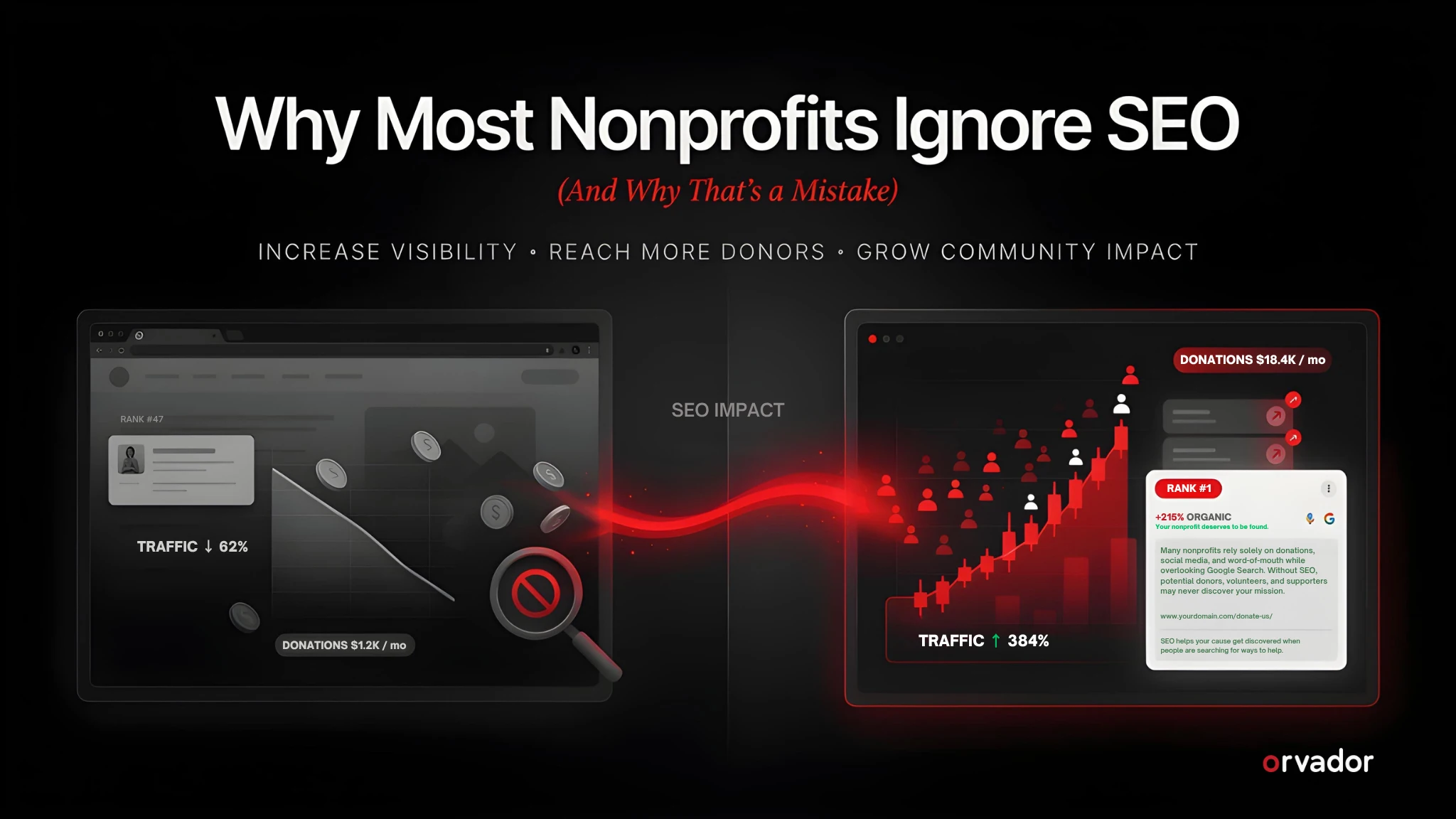
Why Most Nonprofits Ignore SEO (And Why That’s a Mistake)

“TL;DR: Only 37% of nonprofits run a year-round SEO strategy, missing out huge visibility and funding. This article is for nonprofit organizations, fundraising managers, and communications teams. Which means, basically for those who want to attract donors, volunteers, and supporters through unpaid search results. By the end, you’ll understand what nonprofit SEO services for nonprofits really mean, why most organizations skip it, and how Orvador can change that.


1. The Costly Gap in Nonprofit Digital Strategy

Imagine you are a donor sitting at home, searching Google for “best nonprofits supporting education in India.” you will probably go with the organization that comes first. This is how your potential donors find your competitor and donate. Though your organization does exactly that work, only because your website isn’t optimized, you can lose interested donors.

This happens thousands of times every day. And it’s almost completely avoidable.

A 2021 survey found that only 37% of nonprofits actively implement a year-round SEO strategy. That’s not just a statistic — it’s an open door for every mission-driven organization that invests in non profit SEO to pull ahead. The organizations that show up on page one of Google aren’t necessarily doing better work. They’ve simply made themselves findable.


2. What Is SEO for Nonprofits?

SEO for nonprofits (search engine optimization) is a practice where we improve your organization’s website so it appears first when donors, volunteers, grant makers, and beneficiaries search for causes and services like yours.

For example, when someone types “donate to child education nonprofit” or “volunteer opportunities for NGOs near me” into Google, your site can be one of the first answers they see. This is only possible with well-executed nonprofit SEO services. 

These are unlike paid ads, they do not disappear the moment your budget runs out, organic search visibility compounds over time. Every blog post, every optimized program page, every backlink from a trusted partner ensures long-term authority that keeps working around the clock — without ongoing ad expenses.


3. Why Most Nonprofits Ignore SEO

The first step is to understand why nonprofits skip SEO. Here are those five common reasons:

They are low on budget.

This is the most common reason given by various nonprofits. It is important to understand that SEO is one of the most cost-effective digital channels available. It is completely opposite from Google Ads, it continues even when funding stops. Nonprofits with tight budgets can actually gain from SEO. Additionally, they can even qualify for the Google Ad Grants program, which provides up to $10,000/month in free Google Ads. It is a powerful complement to organic SEO.

They rely on referrals and events.

It is well-known that referrals are valuable, but it does not scale the way SEO does. Events are intermittent. A donor who will hear about you, will still search your name on Google before approaching. If your website looks weak or ranks poorly, the trust vanishes. According to BrightEdge, 68% of all online activities start with a search engine. Which means your online credibility is checked before almost any offline relationship is made.

SEO can be too technical for them.

When we talk about NGOs, a specialized SEO company can become really important. You don’t need a SEO expert in the team. All you need is a reliable partner that understands your requirements and makes sure the content of your website is aligned to the mission. You need someone who can actually simply the complex strategy to actual growth, even without hiring a full-time digital team. 

They already post on social media.

Social media is a good platform to promote your causes. However, it has a totally opposite purpose from SEO. Social media can drive awareness in the moment but SEO drives interest-based research over time. When a person actively searches for a cause to support, they go to Google, not instagram. Both the channels are equally important, but SEO can capture highly interested audiences that social media cannot reach. 

They’ve tried it before but it didn’t work.

SEO is something that should be done by professionals. If done without proper strategy, it will rarely provide results. Several nonprofits have had bad experiences with digital agencies that use the same strategies, without understanding their mission. It is important to understand that skipping SEO will not fix the problem. You need someone that actually understands your vision. Look for an SEO company that specializes in nonprofits. 


4. The Real Cost of Ignoring Nonprofit SEO

The cost of ignoring non profit SEO isn’t just theoretical. You must consider the following:

What You’re Missing The Impact
Donor discovery Donors search Google before giving and if you’re not there, they give somewhere else.
Volunteer recruitment Searches like “Volunteer for an NGO near me” go unanswered by your organization.
Grant visibility Grant makers increasingly research organizations online before deciding.
Corporate partnership CSR teams vet NGOs via search before approaching them.
Beneficiary reach Most of the time, people can’t find your services even after searching for them.
Credibility signals As a donor, if your site ranks low, you are believed to be less trustworthy.

Continue reading “Why Most Nonprofits Ignore SEO (And Why That’s a Mistake)”