August 10, 2026 - Orvador

Generative Engine Optimization for Nonprofits: How to Get Recommended by ChatGPT & AI Search

TL;DR: Donors, volunteers, and grant researchers are increasingly asking ChatGPT, Perplexity, and Google AI Overviews for nonprofit recommendations instead of scrolling search results. Generative Engine Optimization (GEO) is the practice of structuring your content so AI engines can understand, trust, and cite your organization. This guide breaks down how GEO differs from classic SEO for nonprofit websites, what signals AI models use to decide who gets recommended, and a practical checklist covering entities, FAQs, structured data, and digital PR, plus how to measure whether it’s working.

Search Is Changing: Where Donors Ask Questions in 2026

A few years ago, “seo for nonprofit” meant one thing: rank on page one of Google. That’s no longer the whole picture. In 2026, a growing share of donors, volunteers, and even institutional funders start their research inside a chat window, not a search bar. Someone deciding where to give this quarter might simply ask ChatGPT, “which education nonprofits in [region] have the strongest track record?” A program officer scoping grantees might ask an AI assistant to summarize an organization’s impact before ever visiting the website.

This shift matters because generative engines don’t return ten blue links. They return one synthesized answer, often naming two or three organizations by name. If your nonprofit isn’t part of that answer, you’re invisible at the exact moment someone is deciding who to trust. That’s the gap GEO is built to close, and it’s why we’ve made it a standalone service alongside our nonprofit SEO work rather than treating it as an afterthought.

What GEO Is (and How It Differs From Classic SEO)

Generative Engine Optimization is the discipline of optimizing content so large language models (ChatGPT, Claude, Gemini, Perplexity) can accurately extract, understand, and cite it when generating answers. It shares DNA with traditional SEO, but the mechanics diverge in a few important ways.

Classic nonprofit website SEO best practices for 2025 and beyond still matter: fast page speed, clean URL structure, keyword-aligned headings, backlinks. But ranking algorithms and generative engines don’t evaluate content the same way. Search engines rank pages; AI engines extract facts, statistics, and claims from pages and recombine them into a new answer. That means:

  • Clarity beats cleverness. AI models favor content that states facts plainly and early, rather than burying the answer under a long narrative lead-in.
  • Source credibility carries more weight. If your data point is cited elsewhere (a partner site, a press mention, a directory listing), an AI model is more likely to trust and repeat it.
  • Structure is read as meaning. Headings, lists, and tables aren’t just for skimmers anymore; they help language models parse what a section is actually about.

For a nonprofit, this means GEO and SEO for nonprofit organizations should run together, not as competing budgets. Our GEO services for nonprofits are built to sit on top of existing SEO foundations rather than replace them.

How AI Engines Pick Which Nonprofits to Cite
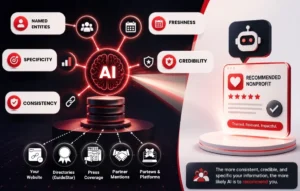
AI Engines

AI for nonprofits isn’t magic; it’s pattern recognition applied at scale. When a generative engine is asked to recommend or describe an organization, it’s pulling from a blend of sources: your own website, third-party mentions (GuideStar/Candid, press coverage, partner nonprofits, review platforms), and structured data markup that explicitly labels who you are and what you do.

A few patterns we’ve observed in how AI engines choose which nonprofits to surface:

  • Named entities win. Organizations that consistently use their full, exact name (not “we” or “our team”) across pages are easier for a model to associate facts with.
  • Specificity beats vagueness. “We’ve provided clean water access to 40,000 people across 12 districts since 2019” is far more citable than “we’ve made a big impact on water access.”
  • Consistency across the web matters. If your mission statement, program numbers, and location differ between your website, your GuideStar profile, and a press release, AI engines struggle to resolve which version is authoritative, and often skip citing you at all.
  • Freshness signals trust. Pages that are clearly dated and recently updated are treated as more reliable than static, undated content.

This is why ChatGPT for nonprofits visibility isn’t just a content problem. It’s a consistency and structure problem that spans your whole digital footprint.

The GEO Checklist: Entities, FAQs, Structured Data, Digital PR

Here’s the practical framework we run for every NGO client moving into GEO.

Entity clarity

  • State your organization’s full legal name, mission, founding year, and service area explicitly on your About page, not just in a tagline.
  • Use the same entity name and phrasing consistently across your website, social bios, and third-party listings.
  • Name your programs specifically (with proper nouns) rather than describing them generically.

FAQ-formatted content

  • Add a genuine FAQ section to key pages, phrased as real questions donors and volunteers ask (“How is my donation used?” “Is [org] a registered 501(c)(3)?”).
  • Answer each question in 2-3 sentences immediately, before adding nuance. This is the format generative engines lift most easily.

Structured data

  • Implement Organization, FAQPage, and Article schema markup so AI crawlers can parse your identity and content type programmatically.
  • Mark up donation pages, program pages, and impact reports with relevant schema so numbers and outcomes are machine-readable.

Digital PR and third-party mentions

  • Pursue coverage, partner mentions, and directory listings (GuideStar, Charity Navigator, local press) that reference your organization by exact name.
  • Encourage partner organizations and grant funders to link to and mention you consistently. Third-party corroboration is one of the strongest trust signals AI engines use.

Together, these four pillars are what separate a nonprofit that gets cited by AI search from one that gets skipped entirely, regardless of how strong its actual programmatic impact is.

Measuring AI-Search Visibility
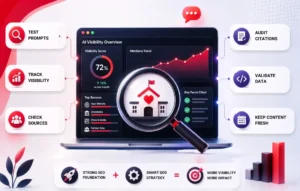
AI-Search Visibility

Traditional SEO has mature analytics: rankings, organic traffic, click-through rate. GEO measurement is younger, but a few practical methods work today:

  • Manual prompt testing. Regularly ask ChatGPT, Perplexity, and Gemini the questions your donors would ask (“best nonprofits working on [cause] in [region]”) and track whether, and how, your organization appears.
  • Referral traffic from AI platforms. Check your analytics for traffic sourced from chat.openai.com, perplexity.ai, and similar referrers; this segment is growing but still often mislabeled as “direct” traffic, so filtering carefully matters.
  • Citation audits. Track whether your key facts (program numbers, mission statement, impact stats) appear correctly when AI tools summarize your organization. Inconsistent or outdated citations are a signal to update source content.
  • Structured data validation. Periodically test your schema markup with validation tools to confirm AI crawlers can parse it without errors.

None of these replace classic SEO metrics. They sit alongside them, because a nonprofit with strong seo for nonprofit fundamentals is already halfway to AI-search visibility.

Case Notes: What We’re Seeing Across NGO Clients

Across the nonprofit accounts we manage, a consistent pattern has emerged: organizations with clear, consistently repeated program names and specific impact numbers get cited by AI tools noticeably more often than organizations with similar (or even larger) actual impact but vaguer messaging. Clients who added FAQ sections written in plain donor language to their program and grants pages saw those exact questions echoed back, sometimes verbatim in structure, when we tested AI search prompts.

We’ve also seen that nonprofits investing in digital PR and consistent third-party listings (rather than website content alone) tend to appear in AI-generated recommendation lists faster than those relying purely on on-site optimization. This reinforces that AI for nonprofits visibility is a cross-channel effort, not a one-page fix, which is exactly why we treat GEO as a layered service built on top of core nonprofit website SEO best practices, not a bolt-on tactic.

Do I need to choose between ChatGPT optimization and Google SEO? 

No. The same foundational work (clear entity information, structured content, FAQs, schema markup) improves visibility across both traditional search and AI engines simultaneously.

Ready to make sure your organization is part of the answer when donors ask AI tools who to support? Explore our GEO services for nonprofits and see how we pair it with proven nonprofit SEO strategy to build visibility across both search and AI.

How to Create a Nonprofit Marketing Plan (Step-by-Step + Free Template)

TL;DR: A strong nonprofit marketing plan turns scattered social posts and one-off email blasts into a coordinated system for reaching donors, volunteers, and beneficiaries. This guide walks through five steps – setting mission-aligned goals, building audience personas, choosing channels and budget, mapping a content calendar, and tracking the right KPIs, to help you build a marketing plan for your nonprofit organization from scratch. You’ll also find a free, downloadable nonprofit marketing plan template at the end, plus answers to common questions nonprofits ask before getting started.

Why Every Nonprofit Needs a Written Marketing Plan

Most nonprofits don’t fail at marketing because they lack passion or a good cause, they fail because their efforts are reactive. A newsletter goes out when someone remembers. A social post gets published because a board member asked “why haven’t we posted this week?” There’s no throughline connecting the mission to the message, and no way to tell what’s actually working.

A written nonprofit marketing plan fixes this. It forces your team to define what success looks like, who you’re actually trying to reach, where your limited time and budget should go, and how you’ll know if any of it is working. Nonprofits that operate off a documented plan consistently report stronger donor retention and more predictable campaign results than those working ad hoc, simply because everyone (staff, volunteers, and board members) is pulling in the same direction.

This matters more in a nonprofit context than a for-profit one for a specific reason: your “customers” aren’t one audience. You’re marketing to donors, volunteers, beneficiaries, and sometimes policymakers or media, often with the same small team and the same tight budget. Without a plan, it’s nearly impossible to serve all of them well. With one, you can sequence your efforts so each audience gets the right message at the right time, without burning out your staff or your list.

A good nonprofit marketing strategy doesn’t need to be a 40-page document. It needs five things: clear goals, clear audiences, a realistic channel and budget plan, a calendar that turns strategy into action, and a way to measure whether it worked. This guide focuses on building that plan step by step. If you’re looking for the bigger picture first, our complete guide to nonprofit digital marketing covers how all these pieces fit into a broader strategy. Below is how to build each one.

Step 1: Mission-Aligned Goals & SMART Objectives

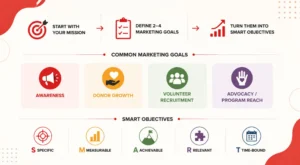
Mission-Aligned Goals & SMART Objectives

Every marketing plan for a nonprofit organization should start with the mission, not the tactics. Before you decide whether to post on Instagram or launch an email series, decide what the marketing is actually supposed to achieve this year.

Start by translating your mission into 2–4 marketing goals. These usually fall into a few buckets:

  • Awareness – more people recognizing your organization and understanding your cause
  • Donor growth – more first-time donors, or higher retention among existing ones
  • Volunteer recruitment – filling specific program or event needs
  • Advocacy or program reach – getting more beneficiaries to access your services, or more supporters to take an action

Once you’ve picked your priorities, turn each into a SMART objective – Specific, Measurable, Achievable, Relevant, Time-bound. “Grow our donor base” is a wish. “Increase first-time online donors by 20% between September and December, ahead of year-end giving” is an objective you can actually plan a campaign around.

A useful habit here is to cap your goals. Nonprofit teams are typically small, and a plan with eight priorities is really a plan with none. Pick the two or three that matter most this cycle, and let everything else in the plan  (audiences, channels, calendar) exist to serve them.

Step 2: Audience Personas – Donors, Volunteers, Beneficiaries

This is the step most nonprofit marketing plans skip, and it’s usually why the plan underperforms. “Supporters” is not an audience. Donors, volunteers, and beneficiaries have different motivations, different questions, and different content they respond to, so they need to be planned for separately, even if some messages overlap.

Build a simple one-page persona for each core audience:

Donors – What triggered their first gift? Are they driven by urgency (disaster response, a matching gift deadline) or by long-term impact stories? What giving level are they at, and what would move them up a tier?

Volunteers – Are they looking for one-time opportunities or ongoing involvement? Are they motivated by hands-on service, skill-based volunteering, or community belonging?

Beneficiaries – What do they need to know to access your programs? What language, format, or channel actually reaches them (this is often not the same channel your donors are on)?

For each persona, note: their biggest objection or hesitation, the channel where you’re most likely to reach them, and the single message that resonates most. This becomes the filter for every piece of content you create. Before writing anything, ask which persona it’s for and what it needs to do.

If you serve a specific niche, say, a health-focused or education-focused nonprofit, your personas should reflect the specific decision points unique to that mission, not generic “supporter” language. A one-time crisis donor and a monthly-giving program member are, in marketing terms, two different people who happen to write checks to the same organization.

Step 3: Channel Selection & Budget Allocation

Channel Selection & Budget Allocation

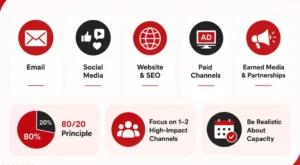
With goals and audiences defined, channel selection becomes a matching exercise rather than a guessing game. The question isn’t “should we be on TikTok”. It’s “where does each persona already spend time, and which of those channels can we realistically maintain?”

A workable nonprofit marketing strategy usually blends:

  • Email – still the highest-ROI channel for donor communication and retention; low cost, high control
  • Social media – best for awareness and volunteer recruitment, particularly where visual storytelling works (photos, short video, behind-the-scenes content)
  • Website & SEO – your most durable asset; content here compounds over time instead of disappearing after 24 hours
  • Paid channels – including Google Ad Grants, which gives eligible nonprofits free search ad spend and is worth applying for before allocating any paid budget elsewhere
  • Earned media & partnerships – press, community partnerships, and co-marketing with aligned organizations

Budget allocation should follow the 80/20 principle: put roughly 80% of your time and money behind the one or two channels that reach your priority audiences most efficiently, and treat the rest as experiments. A common mistake is spreading a thin budget across six channels and doing all of them poorly, rather than doing two channels well.

If your team is small, be honest about capacity. A channel you can’t maintain consistently will hurt more than help. An abandoned social account or a newsletter that goes quiet for months signals inactivity to donors. Choose fewer channels and commit to them rather than attempting a presence everywhere.

Step 4: Content Calendar & Campaign Timeline

This is where the plan becomes real. A content calendar takes your goals, audiences, and channels and turns them into a week-by-week (or month-by-month) production schedule.

Build the calendar around your organization’s natural rhythm first (year-end giving, Giving Tuesday, program milestones, grant deadlines, volunteer recruitment cycles), and layer always-on content (blog posts, social updates, email newsletters) around those anchor points. This prevents the common trap of only marketing during major campaigns and going quiet the rest of the year, which makes each campaign feel like it’s starting from zero.

At minimum, map out for each month:

  • The campaign or theme (if any)
  • Which persona it’s primarily targeting
  • The channels involved and content needed for each
  • Who owns production and the publish date

Keep the calendar realistic against your actual staff and volunteer capacity. A plan with three campaigns a month and one part-time marketing staffer is not a plan, it’s a wish list. Batch content creation where possible (writing four weeks of social captions in one sitting, for instance) to protect time for the higher-effort pieces like donor stories or video.

Step 5: KPIs, Reporting Cadence & Review Loops

A marketing plan without measurement is just a set of activities. Tie each goal from Step 1 to one or two KPIs, and decide upfront how often you’ll check them.

Typical nonprofit KPIs by goal:

  • Awareness – website traffic, social reach/impressions, branded search volume
  • Donor growth – number of new donors, average gift size, donor retention rate, email open/click rates
  • Volunteer recruitment – applications started vs. completed, event sign-ups
  • Advocacy/reach – petition signatures, program inquiries, beneficiary sign-ups

Set a reporting cadence that matches your team’s bandwidth. Monthly is typical for most nonprofits, with a lighter weekly check on live campaigns. The point of the review isn’t just reporting numbers upward; it’s a feedback loop. If a channel or message underperforms two months running, that’s a signal to adjust the plan rather than repeat it. Build in a quarterly step-back to ask whether the original goals from Step 1 still make sense, and revise the plan rather than treating it as fixed once written.

Free Nonprofit Marketing Plan Template (Downloadable)

You don’t need to build this framework from a blank page. Our free nonprofit marketing plan template includes ready-to-use worksheets for each step above – SMART goal-setting, donor/volunteer/beneficiary persona templates, a channel-and-budget planner, a monthly content calendar, and a KPI tracking sheet.

[Download the Free Nonprofit Marketing Plan Template →]

Use it as a working document. Updated quarterly, not filed away after year one, and it will keep your entire team aligned as your organization grows.

Ready to put this into action? A template gets you organized, a dedicated strategy gets you results. Book a free strategy call with Orvador and we’ll help you turn this plan into a working nonprofit marketing strategy built around your goals, your team, and your budget.