
December 29, 2025 - Orvador

How to Leverage Generative AI to Write Grant Proposals That Win


How to Leverage Generative AI to Write Grant Proposals That Win

The process of grant writing may be tiring. Tight deadlines. Complex guidelines. And the continual stress to be different.

And, as we all know, when you have ever asked yourself whether technology can be used to assist you in writing better proposals without losing your human voice, you are not alone. Today, AI for grant writing is changing how nonprofits approach funding — making proposal creation faster, smarter, and more strategic.

Through this guide, we will demonstrate how nonprofits can write grant proposals using AI, where automation can be really useful, and how nonprofits can remain authentic while achieving more impact. At Orvador, an experienced ngos marketing agency, we see this shift every day.

How AI for Grant Writing Is Transforming Nonprofit Fundraising

The traditional grant writing is manual-intensive. Research, writing, revising, and editing are all that is time-consuming.

With generative AI grant proposals, nonprofits can reduce that load without compromising quality.

This is what recommendation writing with the help of AI can really do:

  1. Examines successful proposals in the past.
  2. Organizes responses according to funder requirements.
  3. Proposes language that would comply with the interests of donors.
  4. Enhances clarity, tone, and readability.

This isn’t about shortcuts. It’s about working smarter. And so it can be very normcore and human when it is done right.

Using Grant Writing With AI Tools Without Losing Authenticity

One common fear I hear:

Can AI make our proposals sound generic?

Only if you let it.

The real power of grant writing with AI tools lies in collaboration. You bring the mission. AI supports the execution.

Best practices include:

  1. Entering the past proposals in the organization into AI.
  2. Tone and impact of language are stimulated by training.
  3. Reading line by line and correcting.

This hybrid approach is how to win grants for nonprofits, which becomes repeatable,  not random.

How To Write Grant Proposals With AI Step By Step

Let’s get practical. Here’s how nonprofits are actually using AI tools for nonprofits today.

Step 1: Research and Alignment

AI scans guidelines and derives priorities. This assists in a quicker matching of your programs to funder intent.

Step 2: Drafting Core Sections

By having someone write a proposal by AI, it can take minutes rather than days to have the first draft of the need statement, outcomes, and goals.

Step 3: Editing for Impact

Flow is enhanced, jargon is eliminated, and readability is increased with AI. Making your proposal concise and friendly to funders.

This is where grant proposal writing strategies meet automation.


Automating Grant Applications With AI Tools for Nonprofits

Duplication is the actual adversary when there are various applications run by nonprofits. That is where it would be reasonable to automate grant applications.

AI helps by:

  1. Re-using fundamental stories in applications.
  2. Funders have customized language.
  3. Monitoring submission requirements.
  4. Reducing turnaround time

This is transformational in the case of lean teams. Especially when paired with a strong ngo digital marketing foundation.

Smart Grant Proposal Writing Strategies Using AI

The strategy of AI is as good as AI itself.

Winning nonprofits use grant proposal writing strategies that combine:

  1. Data-backed impact metrics
  2. Need statements that are story-based.
  3. Evident results and assessment strategies.

The three are supported by AI, the first of which is strategy. This is where nonprofits are not only given guidance on tools, but also placed in the hands of such agencies as Orvador, a marketing agency focused on nonprofits.

Scaling Impact With AI-Powered Proposal Writing

It is not just speed that is beneficial. It’s consistency.

With AI-powered proposal writing, nonprofits:

  1. Make more grants applications.
  2. Enhance quality applications.
  3. Eliminate burnout among fundraising teams.

This would particularly be useful in cases where an organization would be dealing with a mature ngo digital marketing partner who will not only know the systems, but also the content.


Why Orvador Recommends AI for Grant Writing (And When Not To)

At Orvador, we don’t push tools blindly.

As a purpose-led ngos marketing agency, we recommend AI for grant writing when:

  1. You apply to grants regularly
  2. You have past proposal data
  3. You want scalable fundraising systems

We don’t recommend it when clarity on mission or programs is missing. Strategy always comes first.


FAQ

  1. What is AI for grant writing?

It’s the use of AI tools to research, draft, edit, and optimize grant proposals while keeping human oversight.

  1. Can Generative AI grant proposals really win funding?

Yes, when combined with strong strategy, personalization, and review.

  1. Are AI tools for nonprofits affordable?

Many tools are cost-effective and save more time than they cost.

  1. How does AI help in Automating grant applications?

AI reuses core content, adapts it per funder, and reduces repetitive manual work.

  1. Does AI replace grant writers?

No. It supports them. Strategy, storytelling, and judgment remain human-led.
 

Donor Retention Through Email Automation: Segmenting Strategies for High-Value Giving

Donor Retention Strategies Start With Lifecycle Thinking

Donor Retention Through Email Automation: Segmenting Strategies for High-Value Giving


You must have experienced it the same way where getting donors is costly in terms of time, money and serious work, but retaining them is even more difficult. Attention-span is less, inboxes are congested, and general-to-fit all emails no longer suffice. That’s where a donor retention email strategy powered by smart automation steps in.

At Orvador, we’ve seen how thoughtful email marketing for nonprofits can turn one-time contributors into long-term partners. Automation can be done in a way that does not make it seem robotic, but rather personal, timely, and human. Virtually uncomplicated in its core, but effective in outcomes.

Donor Retention Strategies Start With Lifecycle Thinking

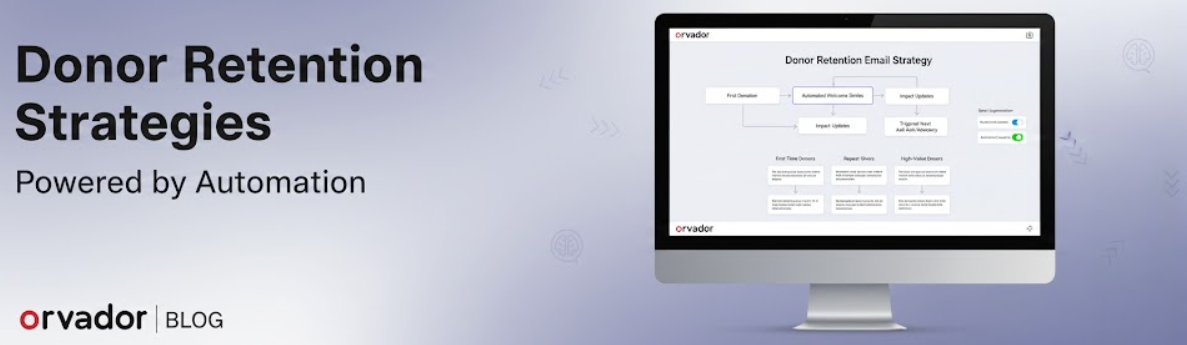
In order to be retention-oriented, you must think out of campaigns. The strategies of the Real Donor retention are based on the donor lifecycle which is first donation, repeat giving, and advocacy.

A strong donor lifecycle email marketing approach ensures that:

  1.   The new donors are welcome and appreciated.
  2.   Repeat donors experience the effect of their donations.
  3.   Valuable donors do not feel like they are being solicited.


Donor


Email Marketing For Nonprofits Works Best With Automation

Emails done manually are limited to a certain extent. Email automation for donors allows nonprofits to scale conversations without losing warmth.

Using nonprofit email campaigns by branding agency for ngos that are automation-driven, you are able to:

  1. Immediate thank-you emails on a donation.
  2. Trigger impact updates are given history based.
  3. Timetable notifications do not sound persuasive.

This is the place where Email automation of NGOs is retention engine, not a communication tool anymore.

Donor Segmentation Strategies Unlock Relevance

All donors are not the same – and your emails should not be either. Donor segmentation strategies help you group donors based on behavior, intent, and value.

Common segments include:

  1. First-time donors
  2. Repeat small-value donors
  3. Lapsed donors
  4. High-value and major donors

The concept of segmentation serves as an in between of automation and personalization. It is simply the key to even the most successful Automated email journeys of donors.

High-Value Donor Engagement Needs A Different Tone

In the case of high-value donor engagement, minor details count. These donors do not prefer to see frequent asks, they desire trust, transparency and impact.

Successful High-value donor segmentation gives attention to:

  1. Less emails and important ones.
  2. First-hand information and previews.
  3. Direct comments by leadership.

This tailored Donor retention email strategy often leads to higher lifetime value with fewer emails overall.

Automated Email Journeys For Donors Build Long-Term Trust

Automation is a process, not an event. Properly designed Automated email journeys of donors lead the supporters through anecdotes, milestones, and results.

Examples include:

  1. Inviting voyages of new donors.
  2. Post campaigns impact journeys.
  3. Re-engagement trips of dormant donors.

Every travel empowers your donor retention strategies as well as lessening manual workload.

Email Automation For Donors Improves Consistency

Credibility creates consistency. With email automation for donors and ngo digital marketing, you never miss a moment that matters.

Automation ensures:

  1. Timely acknowledgements
  2. Frequent impact communication.
  3. Foresightful, evidence-based outreach.

Such consistency is an important aspect of successful .

Measuring Success In Donor Retention Email Strategy

Nothing can be enhanced without being measured. A performance-focused Donor retention email strategy tracks metrics that actually matter.

Key KPIs include:

  1. Repeat donation rate
  2. Email engagement by segment
  3. Donor lifetime value
  4. Retention rate by journey

At Orvador, we align email marketing for nonprofits with real fundraising outcomes, not vanity metrics.

Ready To Improve Donor Retention With Automation?

If your emails feel scattered or underperforming, it’s time to rethink your approach. Orvador helps nonprofits design data-led Email automation for NGOs that feels personal, scalable, and sustainable.

Book a free donor email audit with Orvador today.


FAQ

  1. What is a donor retention email strategy?

A Donor retention email strategy uses segmented, automated emails to nurture donors across their lifecycle, increasing repeat giving and long-term engagement.


  1. How does donor segmentation improve retention?

Donor segmentation strategies ensure donors receive relevant content based on behavior and value, making emails feel more personal and effective.


  1. Is email automation suitable for small nonprofits?

Yes. Email automation for donors actually saves time and resources, making it ideal for lean nonprofit teams.


  1. How often should nonprofits email high-value donors?

For high-value donor engagement, quality matters more than quantity. Fewer, impact-driven emails work best.