
Blog - Orvador

Turning Case Studies into Donor Magnets: The Power of Impact Storytelling in Digital

Turning Case Studies into Donor Magnets: The Power of Impact Storytelling in Digital

The digital world today is full of noise and it is almost impossible to cut through it and reach potential supporters and make a connection. You are now in possession of the data, in possession of the results, but are you making a connection? It is not a statistic but a story, which is the hidden gun. Mastering Impact storytelling for non-profits is how you turn passive scrollers into passionate donors. It is not merely that you share what you do, but you make someone feel that they need to be a part of this. What happens to you when you read a story that really resonates? It’s the leverage we are going to open up and make your case studies your surest donor magnets.

Why Your Nonprofit Impact Storytelling Needs A Digital Shift

Statistics create faith, narratives create connections. Your annual report is critical to transparency, but it is a story that is well told that will be shared, remember and acted upon. Non-profit impact storytelling is the art of framing your mission around people. It is the difference between adhering to the rules and telling the story of the family where this 10,000 meals were the difference between stability and hope. This emotional bridge is critical for donor engagement case studies. These stories are fungible assets in the digital environment, ideal as social media bites, effective email campaigns, and impactful web functionality that is the heart of a contemporary nonprofit marketing plan. Imagine that you are changing the formal report into a compelling documentary about your work.

The Blueprint: Crafting a Winning Non-Profit Case Study Format

Your case studies that you have so far are enormous. The trick is to repackage them as more than dull papers into dramatic stories. At Orvador, we assist clients in embracing an established non-profit case study framework that abides by a coherent storyline, which is aimed at guiding the reader through empathy to action.

  1. The Problem: The Challenge: Begin with a person, not a problem. Present not only the statistics concerning housing insecurity, but also Maya, a single parent at risk of being evicted.
  2. The Journey & Your Role: Explain the way to change. What was the response of your organization? Give attention to human support, and not the program name only.
  3. The Transformational Outcome: This is the core of your impact story in the nonprofit. Show the new reality. So, what is the hope of Maya now? Use her words.
  4. The Invitation to Participate: There should be a clear connection of her change to the potential of the donor. You are able to bring the key to a stable family to another family.

This structure transforms facts into a relatable narrative, making your donor engagement case studies impossible to ignore. It’s a foundational element of sophisticated fundraising strategies for nonprofits.

Potential donor engaged with impact storytelling for non-profit content on a tablet
Strategic impact storytelling for non-profits meets supporters right where they are in their donor journey

Placing Your Story: The Strategy Of Donor Journey Mapping

It is only half the battle to create a great story. You have to pitch it to the right man at the right time. This is where strategic donor journey mapping becomes non-negotiable. Imagine it as a guide to the experience of your supporter with stories as the poles.

  1. Awareness (Top of Funnel): Nonprofits through short, compelling impact stories should be used in social media advertisements or in the blog. Even a 60-second video teaser can become an attraction to a brand-new audience.
  2. Consideration (Middle of Funnel): Offer more detailed donor engagement case studies in a dedicated email nurture series or on your “Our Work” page. Here, you build deeper trust.
  3. Decision (Bottom of Funnel): Put your best, full-length story in the middle of the donation pitch. Demonstrate the precise effect of a fifty dollar present.
  4. Advocacy (Post-Donation): Disseminate information about previous stories in thank-you messages and magazines. This has long-term effect and loyalty is created where one-time givers become life long champions.

This strategic approach ensures your storytelling for nonprofits online is a cohesive system, not a scattered effort. It is the distinction between screaming a tale into nothingness and having an emotional talk with a person willing to hear.

Digital Tools For Storytelling For Nonprofits Online

The Internet can provide amazing resources to make your stories come to life. Going beyond text enables you to relate on a higher level of sensation. Here’s how to enhance your nonprofit’s impact storytelling:

  1. Video Testimonials: There is no king like authenticity. The sincere and raw footage of a beneficiary expressing gratitude may be more effective than the highly produced one.
  2. Interactive Web Pages: Scroll-triggered animations, embedded audio clips, and pull-out quotes achieve a sense of immersion that transforms a visitor to the website into a participant in a story.
  3. Photo Essays with Captions: A potent set of photos on Instagram or Facebook, where a story is told between the captions, can halt a scroll and evoke a great deal of emotion.

Embracing these formats moves you beyond basic storytelling for nonprofits online and into creating shareable experiences that extend your reach organically. It is about embracing a normcore ethos around technology, which is accepting basic and easily available tools in remarkably productive ways to the service of your central mission.

The Orvador Method: Weaving Strategy into Every Narrative

You have seen your stories at Orvador as your most important strategic property. The way we do this is to systematize the way your impact becomes engagement.

  1. Deep-Dive Discovery: We listen to unravel your strongest stories, which support your strategic objectives.
  2. Journey-First Integration: We use donor journey mapping to create a content deployment plan, ensuring each story reaches its ideal audience at the perfect moment.
  3. Multi-Format Story Crafting: The essential story is converted into video scripts, social posts, and web copy with a consistent and professional voice.
  4. Amplification & Insight: We help share your stories and rigorously analyze performance, constantly refining to improve your fundraising strategies for nonprofits.

We believe a powerful nonprofit case study format is the engine of growth. That engine is what we have known as our expertise, throwing it in a new direction squarely your way.

Ready To Turn Your Impact Into Growth?

Your mission changes lives. Your communication must be no less potent. Through perfecting the art of impact storytelling of non-profits, you become no longer the one to report on your work but rather to offer an invitation to the world to be part of it. The best weapon you have to build your community and your resources is a strategic story that was strategically placed on the path of the donor.

Now, shall we write your next chapter? Book a free strategy session with Orvador to audit your existing stories and develop a plan to turn them into your best donor magnets.

FAQ

  1. How long should a good impact story be?
    It depends on the platform! A social media story can be 150 words or a 90-second video. A full donor engagement case study on your website can be 500-800 words. The key is to match the depth to the audience’s intent.


  1. We’re a small team with no video budget. What can we do?
    Start with what you have! A smartphone can record a powerful testimonial. Compelling photo pairs with a written quote can be incredibly effective. The authenticity of nonprofit impact storytelling often matters more than high production value.


  1. How do we measure if our stories are working?
    Track metrics like time-on-page for story articles, click-through rates in emails featuring stories, and, most importantly, conversion rates on donation pages linked from those stories. This data is gold for refining your nonprofit marketing strategy.


  1. How often should we share new impact stories?
    Consistency is key. Aim for one major, in-depth story per quarter, supported by smaller updates, testimonials, or “story echoes” (updates on past subjects) monthly. This keeps your storytelling for nonprofits online fresh and ongoing.

6 Advanced Blueprint: Maximizing Your Non-Profit’s Google Ad Grant Performance

Advanced Blueprint: Maximizing Your Non-Profit’s Google Ad Grant Performance

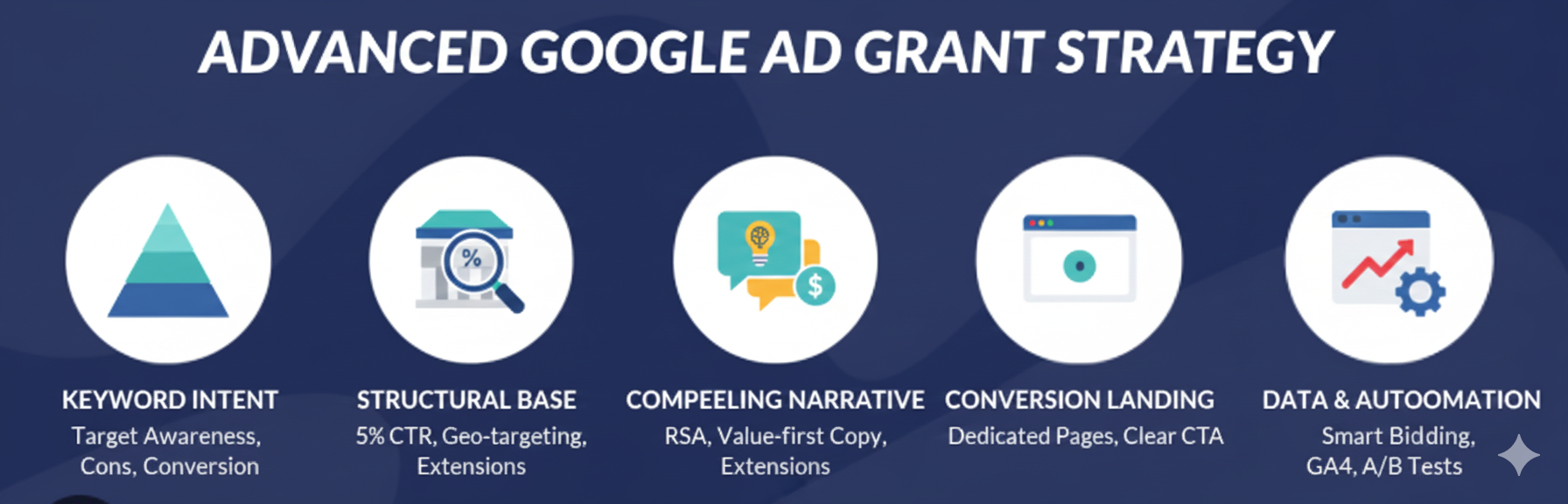
Consider your grant account to be a house foundation. When it is sloppy, all that is constructed on it will be unstable. Consider your grant account to be a house foundation. When it is sloppy, all that is constructed on it will be unstable. Effective Google Ads for nonprofits starts with a structurally sound, policy-compliant base. It implies that one should always surpass the 5% CTR threshold, apply powerful geo-targeting, and apply an entire package of ad extensions.
But the progressive thinking sees them not as work, but as tactical benefits. Arrange your account with surgical precision: form tightly themed ad groups around particular programs, donor intentions, or volunteer positions. This level of Google Ad Grants management creates clarity, allowing for precise messaging and measurement, the essential first step in any non-profit PPC strategy. And what does it feel like to realize that you are on solid ground and you are poised to grow big?

Advanced Google Ad Grant Strategy

At Orvador, we believe true Google Ad Grant maximization requires moving beyond basic compliance into the realm of sophisticated, mission-driven strategy. It is not merely about spending a budget, but spending every dollar you have to make yourself even more impactful, appeal to unwavering support, and push your cause ahead. We will discuss ways in which your grant can be turned into your most vibrant growth driver.

Mastering Keyword Intent: The Heart of Google Ad Grant Optimization

The core of Google Ad Grant maximization is a deep understanding of searcher intent. Get rid of the generic, high-volume keywords that appeal to window-shoppers. Rather, develop a strategic keyword pyramid:

  1. Awareness Level: M Mission-oriented words words (climate change solutions).
  2. Consideration Level: Search services that are local food bank volunteer opportunities.
  3. Level of Conversion: High motivation acts (donate to disaster relief today).

This intent-based approach is how you optimize Google Ad Grant spending for value, not just volume. Manage the conversation by using phrase match (“”) and exact match [ ] and have an uncompromising list of negative keywords. This disciplined focus ensures you connect with people at the exact moment they are ready to engage, which is the ultimate goal of nonprofit marketing with Google Grants.

Crafting Compelling Narratives: Ad Copy for Ad Grant Conversion Optimization

Your advertisement is your introduction. In the context of nonprofit marketing with Google Grants, your copy must resonate emotionally and prompt immediate action. We suggest a mix of normcore clarity (straight, reliable, message) and strong differentiators. Test various headlines and descriptions with the use of Responsive Search Ads (RSAs). Make value first: 100 per of Donations Finance Clean Water Projects or Join 50,000 Advocates of Change.

This is a critical Google Ad Grants optimization tip. Get the most out of your cause using all extensions: callout extensions, where you can advertise benefits, structured snippets, where you can advertise services, and multiple sitelinks that will help users navigate to a landing page. This comprehensive approach is key to maximizing Google Ad Grant performance.

The Conversion Crucible: Landing Pages for Non-Profit PPC Strategy

A click is a promise. It is stored in the landing page. Ad Grant conversion optimization lives and dies on the destination page. Prepare a special, targeted landing page for each of your major campaign themes. In case the ad is on mentorship, the page must be all about being a mentor. Eliminate navigation distractions, employ action-oriented imagery, and include one powerful call-to-action. Such a single point of focus lowers friction and leads the user covertly but decisively to conversion. It’s the pivotal piece that turns interest into action, answering the question of how to optimize Google Ad Grant efforts for tangible results.

Leveraging Data & Automation: Advanced Google Ad Grant Strategies

In order to scale, you need to adopt intelligent bidding and audience insights. Search campaigns are keyword-based; however, in Observation mode, audience signals can be used. Compare performance based on affinity groups (e.g., “Charity and Cause Supporters”) to narrow down your message. When it comes to bidding, Target CPA or Maximize Conversions Smart is an option that you can consider, especially in cases where you have predictable conversion data.
This allows Google’s machine learning to optimize bids in real-time for users most likely to convert, a pinnacle Google Ad Grant advanced strategy. It represents a shift from manual management to intelligent, automated Google Ad Grants management.

Building a Performance Culture: Continuous Google Ad Grants Optimization

A grant account is a living system. The analysis is an implicit requirement, and it is the key to growth. Move beyond clicks and measure meaningful conversions: petition signatures, newsletter subscriptions, and visits to the donation page. Figure out the customer experience using Google Analytics 4. What are the sources of engaged users? Where do they drop off? This data fuels a cycle of continuous testing and refinement; the essence of maximizing Google Ad Grant performance.
Test the value propositions of your ads A/B. Test landing page designs. It is this insatiable, investigative attitude that makes the difference between a high-performing non-profit and others. Are you willing to develop this culture of optimization?

Your Path to Masterful Google Ad Grant Maximization

Learning how to use Google Ad Grant is a promise to strategic excellence. It is a process of just using a tool to plan an elaborate and multi-channel non-profit PPC operation that expands with your purpose. By implementing these Google Ad Grant advanced strategies, focusing on intent, crafting compelling journeys, and embracing data, you transform your monthly grant into a predictable, scalable source of support and awareness. It is all about making your clicks count for your cause.

FAQ

  1. What’s the biggest mistake non-profits make with their Google Ad Grant?

The most common mistake is a passive, “set-and-forget” approach. Without ongoing Google Ad Grants optimization tips like keyword refinement, ad testing, and conversion tracking, the grant spends its budget inefficiently and fails to deliver meaningful results.

  1. How long does it take to see results from advanced optimization?

While some tweaks can improve CTR within weeks, building a fully optimized, conversion-focused account as part of a mature non-profit PPC strategy typically takes 3-6 months of consistent testing, data collection, and iteration.

  1. Can we really use all $10,000 every month with these strategies?

Absolutely. The challenge for many is spending it effectively. By moving up the funnel with awareness campaigns and deeply targeting high-intent donors and volunteers, maximizing Google Ad Grant performance often involves strategically spending the full budget to maximize reach and conversions.

  1. Is Smart Bidding, like Target CPA, suitable for Ad Grant accounts?

Yes, but with a prerequisite. Smart bidding is a powerful Google Ad Grant advanced strategy, but it requires consistent conversion data (typically 15-30 conversions per month per campaign) to learn effectively. Focus first on driving and tracking conversions before enabling these automated strategies.

How to Choose the Right Digital Partner for Your Nonprofit SEO agency

How to Choose the Right Digital Partner for Your Nonprofit

Running a nonprofit SEO Agency is not only about passion—it’s about making a real difference with limited money and resources. A good digital partner SEO Agency can help you reach more donors, motivate volunteers, and spread your mission online. But with so many SEO Agency saying they know “digital for good,” the question is—how do you choose the right one?

This guide will explain what makes a digital partner effective for NGOs, how you can judge them step by step, and why working with a Sustainable Digital Marketing Agency is the smart way to grow for the long run.

Digital Marketing Agency

Why Nonprofits Need a Specialized Digital Partner

Unlike businesses, nonprofits face unique challenges:

  1. Smaller budgets and limited resources
  2. More accountability to donors and communities
  3. Need for emotional storytelling that also shows real impact

A normal agency may know the digital tools, but an NGO Digital Marketing Agency knows how to design campaigns with purpose, compliance, and long-term results in mind.

Key Things to Look for in a Digital Partner

1. Experience With NGOs and Nonprofits

Not every agency is right for NGOs. Ask:

  1. Have they worked with nonprofits before?
  2. Do they know donation funnels, Google Ad Grants, and donor journeys?
  3. Can they show you case studies from other NGOs?

Picking a Nonprofit SEO agency that already understands donor psychology will save you time and money.

2. A Sustainable Approach to Marketing

Google rules and ad platforms keep changing. Shortcuts may give you fast results, but they don’t last. A Sustainable Marketing Agency will focus on:

  1. Ethical SEO (no spammy links or black-hat tricks)
  2. Long-term donor building strategies
  3. Content that educates, inspires, and converts
  4. Clear and honest reporting

This way, your growth won’t vanish after the next Google update.

3. Full Digital Support

Nonprofits need more than just SEO. A good partner should help with:

  1. Accessible websites for all users
  2. Mission-driven content marketing
  3. Proper use of Google Ad Grants and donor ads
  4. Data tracking with GA4, Search Console, and dashboards
  5. Social media that builds a strong community

In short, they should act like digital support for NGOs, not just a vendor.

4. Alignment With Your Values

Nonprofits run on values. Partnering with ethical SEO experts ensures campaigns respect your mission instead of just chasing clicks. Ask:

  1. Do they practice responsible and inclusive storytelling?
  2. Do they avoid manipulative tactics?
  3. Are they clear about budget and reports?

Your digital partner should feel like part of your own team.

People Also Ask Quick Answers

What does a digital marketing agency for nonprofits do?
They help NGOs increase online presence, attract donations, engage volunteers, and share their story effectively.

How is a nonprofit SEO agency different?
They focus on donor intent and mission storytelling, not just product sales. Keywords like “donate,” “support,” or “partner with” are their focus.

Why is sustainability important in NGO marketing?

 Because NGOs cannot waste money. A Sustainable Digital Marketing Agency builds lasting visibility with ethical methods and evergreen content.

How do I choose the best digital partner for my NGO?

  1. Check their NGO experience
  2. Ask for case studies
  3. See if they provide SEO, ads, content, analytics together
  4. Confirm ethical and sustainable practices
  5. Match their values with yours

Can small NGOs also benefit?
Yes. A good SEO agency for ngo’s will design campaigns that fit your budget and help you get maximum impact.

Step-by-Step Way to Choose Your Partner

  1. Set Your Goals – Do you need more donations, volunteers, or reach?
  2. Shortlist Agencies – Only those with proven NGO work.
  3. Request Proposals – Look for clear strategies, not only big promises.
  4. Check Tools – GA4, GSC, and donor tracking are musts.
  5. Confirm Sustainability – Long-term focus is key.
  6. Start Small – Begin with a pilot project before committing big.

Voice Search Friendly Phrasing

Today many people ask Google and Alexa questions like:

  1. Best NGO digital marketing agency near me
  2. How can my nonprofit get more donations online?
  3. Which is the most sustainable marketing agency for NGOs?

Using conversational language helps you rank in these searches.

Why Orvador Could Be the Right Choice

At Orvador, we’ve built our name as a Sustainable Digital Marketing Agency trusted by NGOs, social enterprises, and purpose-driven brands.

  1. We understand donor psychology and Google Grant rules.
  2. We believe in ethical, long-term growth strategies.
  3. We work as your long-term digital partner, not just as vendors.

Whether you’re a local NGO or a global foundation, we design strategies that help you grow impact in a sustainable way.

Final Thoughts

Choosing the right digital partner is one of the biggest decisions for your nonprofit. The right NGO Digital Marketing Agency will not just provide services—they will become a partner who amplifies your mission, respects your values, and supports your growth year after year.

So, when you ask “How to choose a digital partner for nonprofits?”—remember, the best choice combines expertise, ethics, and sustainability. Because your mission deserves nothing less.

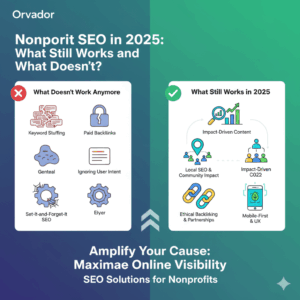
SEO for Non Profits in 2025: What Still Works and What Doesn’t?

What does it take SEO for nonprofit to be seen in a world that’s always scrolling? Every brand is fighting for that, however small a span of undivided attention that they can get. 

This attention is important not just for brands looking to generate business but for nonprofits as well. So staying visible online is non-negotiable in 2025. Nonprofit SEO is about trust, authenticity, and connection. We at Orvador, a sustainable marketing agency, know what could do the trick for an organization like yours online. Your mission should speak louder than any algorithm trick. Let’s explore SEO strategies for nonprofits that deliver real results and the outdated tactics you can finally leave behind.


Nonprofit SEO in 2025: What Still Works and What Doesn't?

What Still Works in 2025

 1. Impact-Driven Content

Content is as important for SEO as it was earlier. However, standards have risen. Generic blogs won’t cut it. Your stories need depth, data, and a sense of purpose. Show transformation, how a single donation changed a child’s education or a program revived an entire community.

Numbers strengthen your stories. Data-backed narratives demonstrate accountability, while real voices bring emotion and authenticity. Think about your content as an invitation. People should feel closer to your cause with every page they read.

Focus on evergreen resources. Long-form guides, explainer articles, and educational content can serve your audience year-round, while also positioning your organization as an expert. Nonprofit content optimization in 2025 is about blending narrative and insight, quality over quantity.

2. Local SEO for Community Impact

Most nonprofits operate in specific communities, yet many underuse Local SEO. Optimizing locally helps you appear where your donors, volunteers, and partners are searching. Update your Google Business Profile with attention to detail. This is often your first impression online.

Show up in your community, local SEO is a lot about that. Keep your NAP (Name, Address, Phone) consistent everywhere and create content that actually feels local. Think:

  1. Celebrating neighborhood milestones and events
  2. Highlighting collaborations with local partners
  3. Showcasing the impact of your grassroots initiatives


That’s not all. A mention in a regional publication or a local blog can drive lasting credibility. This can also enhance your visibility. The closer you get to your community, the stronger your online presence becomes.

 3. Ethical Backlinking and Partnerships

Forget shortcuts. Backlinks are still vital, but 2025 is all about ethical SEO for nonprofits. Seek genuine collaborations. Guest articles for aligned organizations, co-branded campaigns, or a shared community resource page can create high-quality backlinks that mean more than numbers.

Building thought leadership is another organic way to earn links. Secure speaking opportunities, podcast features, or opinion pieces on industry platforms. These naturally result in backlinks and raise your credibility.

Consider partnerships strategically. Backlinks should come from organizations or publishers that reflect your values. Quality always beats quantity, and authenticity strengthens both SEO and trust.

 4. Mobile-First & UX That Feels Human

Your website is your nonprofit’s digital home. If it’s slow or hard to use, people won’t stay. In 2025, mobile optimization can’t be done without. Your site should load in seconds, with menus that are intuitive and pages that are easy to navigate.

Accessibility is equally important. Adding alt text, captions, and clear fonts doesn’t just comply with regulations; it ensures everyone can engage with your mission. Google values sites that are inclusive.

Your calls-to-action should feel effortless. Visitors shouldn’t have to dig to find donation pages or volunteer sign-ups. A well-designed user experience keeps people engaged longer and signals quality to search engines.

What Doesn’t Work Anymore?

Some old-school tactics still linger, but they’re dead ends in 2025.

  1. Keyword Stuffing: Overusing terms like “Nonprofit SEO 2025” won’t fool search engines. Write for humans first.
  2. Buying Backlinks: Paid link farms and schemes risk penalties that are hard to recover from.
  3. Ignoring User Intent: If your content doesn’t solve problems or answer questions, people will bounce.
  4. Set-It-and-Forget-It SEO: Search algorithms evolve constantly. Regular content audits and updates are essential.

These outdated methods damage your credibility.

Latest Nonprofit SEO Trends for 2025


1. AI-Powered Content and SEO Tools

AI is everywhere. It’s great for generating outlines, finding content gaps, and spotting technical issues. But don’t let automation take over your storytelling. AI can save time; your authenticity keeps donors coming back.

Use AI to scale smarter, not lazier. Let it help with research and data, while your voice remains front and center.

2. E-A-T: Expertise, Authoritativeness, Trustworthiness

It’s important to conform to Google’s E-A-T guidelines. Your website should prove expertise, highlight staff credentials, partnerships, and case studies. Authoritativeness means being referenced by credible sites, while trust comes from transparency.

Publish impact reports, financial data, and stories with clear attribution. Secure your site with HTTPS. 

3. Semantic SEO and Topic Clusters

The future is topic-driven, not keyword-obsessed. Build topic clusters that connect related content. Start with a strong pillar page, like “Girls’ Education in India,” and link to supporting articles about government initiatives, success stories, and challenges.

This structure signals to search engines that you’re a trusted authority in your space. It also improves navigation for readers who want to explore your work deeply.

4. Video SEO

Owing to the decreasing attention spans, short-form video continues to dominate. Platforms like YouTube and Instagram are now search engines in their own way. You need to smartly optimize video titles, tags, and transcripts.

Video gives donors and supporters a window into your work. It builds emotional connections faster than text. Embedding videos also increases the overall time spent by users on your page, thus improving SEO signals.

Partnering for Sustainable Growth

Mastering SEO strategies for nonprofits is a long game that blends strategy, creativity, and technical know-how. For many organizations, partnering with a Sustainable Digital Marketing Agency like Orvador can help unlock growth.

We design campaigns rooted in authenticity and measurable impact. By following the latest nonprofit SEO trends and prioritizing ethical practices, we help nonprofits reach the right people and amplify their message.

SEO in 2025 is about building trust, sharing your story, and driving real-world change. Get your foundation right, focus on quality, and stay consistent. Visibility is transformation.

Want to explore? Contact Us.

How Nonprofits Can Use Google Ad Grants to Drive Impact

Every NGO works day and night to bring change. But today, only hard work is not enough – visibility is also needed. If people don’t know about your cause, how will they support you? This is where Google Ad Grants make a big difference.

Google Ad Grants give $10,000 per month in free Google Ads to eligible NGOs and nonprofits. With this, NGOs can spread awareness, raise funds, attract volunteers, and grow their mission.

At Orvador, we are not just another digital agency. We are a sustainable digital marketing agency that works with NGOs to create real, long-term impact. In this blog, we explain what Google Ad Grants are, how they work, and how NGOs can use them effectively with the right strategy.


orvador blog 2Google Ad Grants

What is Google Ad Grants?

Google Ad Grants is a global program to support nonprofits. Eligible NGOs get $10,000 every month in free advertising credit on Google Search.

This means your ads can show whenever people search for topics connected to your cause.

For example:

  1. Education NGO → Ads for “donate for girl child education”
  2. Environment NGO → Ads for “plant trees donation”
  3. Health NGO → Ads for “support cancer patients”

This program allows NGOs to appear in Google search results, without spending from their own pocket.


Why Google Ad Grants Matter for NGOs

Most NGOs depend on donations, volunteers, and awareness. But reaching the right audience is difficult. With Google Ad Grants, NGOs can:

  1. Increase Awareness – Reach people searching online for causes.
  2. Boost Donations – Bring donors directly to your fundraising pages.
  3. Recruit Volunteers – Show ads for volunteering opportunities.
  4. Promote Events – Spread word about marathons, fundraisers, or campaigns.
  5. Build Credibility – Being on top of Google results builds trust.

At Orvador, we have seen how NGOs grow fast when they use Google Ad Grants with the right strategy.


Who Can Apply for Google Ad Grants?

Not every organization is eligible. Google has rules:

  1. Must be a registered NGO / nonprofit
  2. Government bodies, schools, hospitals are not eligible
  3. Website must meet standards (good content, secure, no broken links)
  4. Must agree to Google’s donation & non-discrimination policies


How to Apply for Google Ad Grants

Step-by-step process:

  1. Check Eligibility – Confirm your NGO is registered and meets criteria.
  2. Register with TechSoup – Google verifies NGOs through TechSoup or partners.
  3. Apply for Google for Nonprofits – After verification, apply.
  4. Activate Google Ad Grants – Once approved, get ad account access.

Create Campaigns – Start building ads for your audience.

On paper it looks simple, but in reality NGOs face challenges—policies, optimizations, low results. Thats why many NGOs work with experts like Orvador, a trusted NGO Digital Marketing Agency.

Best Ways NGOs Can Use Google Ad Grants

Just having $10,000 free ads is not enough. It must be used wisely.

  1. Drive Online Donations – Ads for keywords like “donate for children education.”
  2. Spread Awareness – Ads explaining your mission.
  3. Attract Volunteers – Example: “Volunteer with environment NGO in Delhi.”
  4. Promote Events – Ads to get registrations for marathons, awareness drives.
  5. Educate Public – Promote blogs/resources to build long-term trust.


Common Challenges NGOs Face

Many NGOs fail to fully use the grant. Common issues are:

  1. Low CTR (ads not engaging)
  2. Weak landing pages (people click but don’t act)
  3. Policy violations (ads disapproved often)
  4. Unused budget (not spending the full $10,000)

The solution is expert management. Agencies like Orvador ensure every rupee of credit is used properly.


How Orvador Helps NGOs

We are more than just a marketing agency. As a Sustainable Digital Marketing Agency, we focus only on good causes

We help NGOs by:

  1. Keyword Research – Finding what donors/volunteers are searching.
  2. Ad Creation – Writing ads that get more clicks.
  3. Campaign Optimization – Ensuring ads follow Google rules and perform better.
  4. Landing Page Improvements – Making donation/signup pages effective.
  5. Analytics & Reporting – Showing what’s working, what’s not.


Real NGO Success Stories

  1. Education NGO – Online donations grew by 60% after running ads for “donate for girls’ education.”
  2. Environment NGO – Got 300+ volunteers through “tree plantation drive” ads.
  3. Health NGO – Doubled website traffic in 3 months.


Final Tips for NGOs

  1. Set clear goals (fundraising, awareness, volunteers)
  2. Keep testing ad copy for better CTR
  3. Track results with Google Analytics / GA4
  4. Focus on landing page quality
  5. Work with specialized partners like Orvador


Conclusion

Google Ad Grants is a golden chance for NGOs to expand their reach without spending money. But success depends on smart use. Many NGOs struggle because they lack expertise or resources.

Thas where Orvador comes in. We help NGOs maximize every bit of the $10,000 grant &nd whether its fundraising, volunteer recruitment, or awareness campaigns.

 If you are an NGO and want to make the most of Google Ad Grants, connect with Orvador today. Together, we can grow your mission and bring real change.

SEO for Nonprofits: 7 Proven Strategies to Win Organic Traffic

Sustainable Digital Marketing Agency

Let’s be honest, sustainable brands don’t always play by the usual marketing rules. They lead with impact, values, and a vision that often puts community before conversion. But even if your goal isn’t profit-first, your visibility still matters. That’s where SEO for sustainable brands becomes critical. Done right, it helps your content rise above the noise and meet the people already searching for change. SEO for nonprofits is the key to winning organic traffic and building long-term visibility. By using smart SEO strategies, NGOs can reach more supporters online.

Orvador specializes in building organic strategies tailored for ethical and eco-driven organizations. We don’t sell your story. We help the right audience find it, whether they’re donors, customers, or collaborators.

Digital Marketing for Conscious Brands Is a Winning Game. See How!

If your brand exists to serve a cause or drive positive change, traditional digital marketing advice may fall flat. Conscious brands don’t grow through clickbait. They grow through connection, purpose, and clarity. That’s why working with a Sustainable Digital Marketing Agency is essential—digital marketing for sustainable brands isn’t about flooding social feeds; it’s about building trust through thoughtful, well-structured content.

Orvador supports mission-led teams with SEO, analytics, and messaging strategies that reflect who they are and why they exist. We turn your blog, impact stories, and educational pages into long-term drivers of visibility and action. Think quality over quantity always. As a dedicated NGO Digital Marketing Agency, we know how to connect purpose with performance.


How To Drive Targeted Organic Traffic for Nonprofits?

Most nonprofits and conscious brands can’t compete with the search volume behind broad keywords like “education” or “climate change.” But long-tail keywords, specific, lower-competition phrases like “ways to get involved in community water projects”, can be game-changing.

Why? Because they reflect real intent. Someone searching for that phrase wants more than just information. They’re looking for the next step. That’s where your content can shine. We map keyword intent to your mission so your content serves a purpose and gets found.

More relevance, better engagement, and no clicks wasted.

1. E-E-A-T: The Core of Authentic SEO for Nonprofits and Charities

Google’s ranking signals have changed, and one acronym carries a lot of weight: E-E-A-T. E-E-A-T means Experience, Expertise, Authoritativeness, and Trustworthiness. Especially for nonprofits and issue-based brands, this isn’t just a guideline. It’s the foundation.

Search engines now ask: Who’s writing this? Do they know what they’re talking about? Are they part of the community they’re serving? We help tell stories backed by credible voices. That might mean including quotes from field staff and referencing published research. It’s a key part of strong SEO for nonprofits & charities that actually earns trust and clicks. This is where a mission-aligned NGO digital marketing agency like Orvador brings real value—by pairing impact storytelling with credibility signals.

2. Aligning with Google’s Helpful Content Update

In recent years, Google rolled out the Helpful Content Update to prioritize human-first writing. That means pages built purely for rankings with no real value are getting pushed down. For mission-driven brands, this is a huge opportunity.

You already have something real to say. The work lies in packaging it clearly and intentionally. We help clients take existing content, impact reports, blogs, and landing pages, and optimize them around what people are actually searching for.

This work is what fuels consistent, high-quality organic traffic for nonprofits who want to be found without relying on ads or algorithm luck.

3. SEO for Conscious Brands Builds Brand Over Time

The ROI of SEO for conscious brands isn’t just in traffic stats, it’s in authority. It’s in journalists citing your pages. It’s in donors finding you through Google. It’s in volunteers discovering your mission.

We’ve helped ethical brands improve rankings for mission-critical terms across sustainability, education, healthcare, and more. Our work is rooted in strategy but always tied back to storytelling.

SEO isn’t a tactic here. It’s a long-term investment in discoverability. If you believe in what you’re building, you should believe in helping people find it, every single day.

4. Grow Organic Traffic for Nonprofits by Creating the Right Content

You don’t need to publish constantly to be visible; you need to publish intentionally. For many nonprofits, the challenge isn’t writing more, it’s writing with purpose. Your mission is strong, but if your content isn’t answering the kinds of questions your audience is typing into search, you’re staying invisible.

That’s where we come in. We work closely with nonprofits to plan and write content that meets real search demand, blogs, long-forms, Quora answers, and more. The goal? To grow organic traffic for nonprofits through clear, relevant, and mission-aligned writing that builds trust and drives action.

It’s SEO that speaks human.

What Does Organic Traffic for Purpose-Driven Brands Mean?

Let’s clear something up: traffic isn’t the end goal. Alignment is. When you optimize for organic search, you’re not just attracting more people; you’re attracting the right people.

Whether that’s someone donating for the first time or exploring your ethical product line, organic discovery builds credibility. It means people are coming to you because your mission matches their intent.

That’s what organic traffic for purpose-driven brands delivers. It’s high-quality visibility that lasts longer than any social campaign, and it builds year after year, with the right SEO support behind it.

Get Ready to Make Your Mission Easier to Find with Orvador

You’re already doing the work. The missing piece might just be making it visible to the people who need to see it.

At Orvador, we work exclusively with nonprofits, conscious brands, and social impact startups. We understand your language, your priorities, and your pace. Whether it’s a content audit, full-funnel SEO strategy, or ongoing organic growth partnership, we’re in this for the long game

Sustainable Marketing: Crafting Stories For Eco-Conscious Consumers

Now, more than ever, sustainability is at the forefront of the global conversation. As consumers become aware of the environmental impact, brands are realizing that sustainable practices are not just about meeting consumer needs. They do things to make a difference. One of the most effective ways for brands to connect with this new generation of environmentalists is through sustainable marketing.

Orvador always strives to highlight the importance of sustainability in today’s business environment; look at some of our most effective sustainable marketing strategies that have helped brands grow and create a lasting image. We are here today, to explain why a sustainable digital marketing agency is essential for creating compelling stories for sustainable brands.

Why Should Marketers Consider Sustainability

Sustainability isn’t just a buzzword anymore. It’s a must-have. Climate change, resource crunch, and corporate social responsibility are taking the spotlight, and people are looking out for the brands they trust. A recent McKinsey & Co survey revealed that, nearly 75% of the youngsters consider the sustainability of a product before making the purchase decision – which clearly means sustainability and eco-consciousness are at the top of everyone’s mind today.  Sustainable marketing isn’t just about meeting the needs of consumers, it’s also about making sure your brand is ready for the future. Businesses that adopt sustainable practices are more resilient in the long run, are economic, and boost their brand image. That’s where sustainable marketing comes in – it’s a great way for brands to show their support for positive change.

Sustainable Marketing Strategies for the Eco-conscious Brands:

In today’s ever-changing world of business, sustainable marketing strategies are a shining example of innovation and sustainability. Come join us on an adventure where eco-consciousness meets strategic genius, creating a future where businesses can grow responsibly and sustainably. These are the strategies that Orvador believes in, and have worked in favour of all our patrons.

These are just some of the techniques that Orvador believes in, and have worked in favour of all our clients:

1. Authenticity is a Must: Authenticity is the key to sustainable marketing. People can tell the difference between real dedication and greenwashing. Companies need to make sustainability a part of their identity and show how they’re doing their part to make a difference.

2. Content Matters: A digital marketing company can use content marketing to help people understand how their decisions affect the environment. Through blog posts, graphics, and videos, you can give people the info they need to make more eco-friendly choices.

3. Storytelling for Impact: Stories are what people want to hear, and that’s why sustainable marketing is so important. Create amazing stories and case studies that show why people should choose sustainable products, and how they can help make the world a better place.

4. Transparency and Traceability: Make sure you’re clear about where your products come from, how they’re made, and where they’re sold. Plus, having certificates and endorsements from people who know what they’re doing can help build trust with customers.

The Role of Digital Marketing Agencies in Sustainable Marketing

Digital marketing agencies are really important for brands that want to make a difference in the world. They help ensure their brand is seen and heard online, and use their knowledge of digital channels to get a sustainable message out. Here are the different ways digital marketing companies like Orvador can help with sustainable marketing:

1. Strategic Campaign Development: Digital marketing agencies are great at creating campaigns that are tailored to sustainable brands’ needs and values. They do a lot of research to figure out who their target audience is, what’s popular, and how to create campaigns that appeal to eco-conscious consumers.

2. Content Creation and Storytelling: Digital marketing agencies are great at writing content that shows how a brand cares about sustainability. They create blog posts, articles, videos, and infographics that tell stories that go beyond just the product. They make the brand more human and show how the brand goes through its sustainability journey. This helps them make a better connection with people.

3. Social Media Management: Social media is a great way to get your message out there and connect with people on a one-on-one basis. Digital marketing agencies use these platforms to create and implement social media campaigns that showcase a brand’s sustainability initiatives.

4. Data-Driven Insights: Agencies use analytics tools to get a better understanding of how people shop, what they like, and what’s going on in the world. With this data-driven approach, they can keep improving and staying ahead of the curve in an ever-changing digital world.

5. SEO for Sustainability: Digital marketing agencies use sustainable keywords and messaging in your website, content, and campaigns. This makes sure your brand is easily found by people who are looking for green products and info, so you can reach a more specific audience.

6. Partnerships and Influencer Collaborations: Digital marketing agencies can find influencers who share your brand’s values and work with them to create strategic partnerships and collaborations. This way, you can get your influencer’s audience engaged and help spread the word about your brand’s sustainability initiatives.

7. Monitoring and Reporting: Digital marketing agencies keep track of KPIs and create reports that show how successful your campaigns are. With this data-driven approach, you can track your impact, figure out what needs to be improved, and show off your sustainability efforts to people who care about your brand.

Sustainable marketing isn’t just a buzzword, it’s a game-changer that can completely change the way brands interact with consumers. With more and more people becoming more conscious of their impact on the environment, the key to sustainable marketing is to not only draw in eco-minded consumers, but also to actually make a difference. By teaming up with an experienced digital marketing agency that knows the ins and outs of sustainable marketing – such as Orvador, brands can really make a statement about how they’re committed to a better future. It’s not just about selling stuff — it’s about inspiring a movement to make the world a better place.

Brands can really tell a story about how committed they are to a better future. It’s not just about selling products — it’s about motivating a team to make the world a better place.

Elevating Green Presence: SEO Strategies For Sustainable Brands

In the digital age, where visibility is paramount, Search Engine Optimization (SEO) stands as the linchpin for companies. But what happens when this fundamental tool meets the world of sustainability?

Welcome to Orvador, where we are all about offering sustainable SEO solutions to brands that are making their mark in the world of sustainability. In this blog, let’s unravel the dynamic realm of SEO for sustainable brands, exploring how strategic virtual visibility can amplify the impact of eco-friendly organizations.

The Game-Changing Power of SEO for Eco-Friendly Brands

In the vast landscape of the internet, SEO isn’t just about climbing search rankings; it’s a game changer for sustainable brands aiming to leave a lasting mark. Consider this: 70-80% of users focus on organic results and ignore paid advertising. As sustainability becomes a priority for consumers, the demand for environmentally friendly products and services increases. A quality online service not only attracts environmentally conscious consumers, but also conforms to the standards that define sustainable consumption.

Defining Sustainable Brands in the Digital Age – Before we dive into SEO techniques, let’s understand what makes a brand truly sustainable in the digital age. Sustainability goes beyond green packaging; they embrace ethical sourcing, minimize environmental impact, and encourage open communication. These brands put people, planet, and profit first—a triple bottom line that resonates with conscious consumers who want products that align with their values.

SEO for Sustainable Businesses

In an ever-evolving digital landscape, where environmental sentiment meets online visibility, sustainable brands are finding their niche through SEO strategies tailored to their unique values. With this insight, let’s unpack how these businesses can enforce their environmentally friendly policies, encourage meetings and connect with a growing audience of discerning consumers. From green keywords to transparent communication, let’s embark on a journey infused with sustainable standards into the world of optimizing search engines and creating a digital footprint that lays principle forms of ethical, environmentally conscious living.

Embrace Eco-Friendly Keywords: Sustainable search engine marketing starts off with choosing keywords that mirror the brand’s commitment to the surroundings. Incorporate terms like “green,” “sustainable,” and “clean” into your search engine optimization strategy to resonate with an audience obsessed with sustainability.

Content is Key: Develop content material that tells the tale of your brand’s sustainability journey. Engage customers with blog posts, articles, and infographics that highlight eco-friendly practices, moral sourcing, and the high-quality effect your brand has on the environment. Take the example of a business enterprise that features blogs that tell memories of environmental activism, sustainable practices, and the corporation’s dedication to developing a wonderful alternative, aligning seamlessly with their eco-aware audience.

Optimize for Local Impact: Use local SEO to connect with the community and promote your sustainable business at a grassroots level. Use Google My Business, local keywords, and location-specific profiles to connect with customers interested in supporting environmentally friendly businesses in your area. Imagine this – an eco-friendly local grocery store in Bangalore can optimize for local search terms, such as “sustainable grocery store in Bangalore”, to reach customers looking for greener options closer to home. Or how BigBasket projects itself as a store that sources veggies and fruits directly from local farmers.

Transparency and Traceability: Transparent communication is a cornerstone of sustainable brands. Use meta descriptions, title tags, and on-page text to talk about your environmentally friendly practices. Be honest about your environmental efforts, certifications, and any testimonials from third parties, while building customer trust. Think of a sustainable home cleaning products brand that is clear with its commitment to using only plant-based materials, minimal environmental impact and cruelty-free testing throughout its website – that’s what we’re also talking about!

Leverage Social Media: Social media is a powerful ally in sustainable SEO. Share content that highlights your brand’s commitment to sustainability, connects with environmentally conscious communities, and increases your reach. Social cues such as likes and shares help reinforce usability research. Brands like Vedix, or Traya are a couple of those that make good use of social media to model a commitment to 100% natural or Ayurvedic, cruelty-free beauty products, environmental activism and fair trade practices, and it helps develop a strong online community too.

SEO for Eco-Friendly Brands for Opening New Horizons:

As the virtual panorama evolves, sustainable manufacturers have the opportunity to redefine search engine marketing norms. Optimizing no longer just for search engines like Google and Yahoo, rather for the values of environmentally conscious clients, creates a digital environment wherein reason and profit coexist harmoniously. The marriage of SEO and sustainability isn’t only a tool; it is a paradigm shift that paves the way for a greener, more moral online market.

In the adventure towards a sustainable future, search engine marketing emerges as a compass, guiding environmentally aware manufacturers. By combining eco-friendly keywords, clear communication, and eye-catching visuals, sustainable brands are not only amplifying their online presence, but they are also helping to change the way customers interact with brands. As conscious consumerism continues to rise, search engine marketing for sustainable manufacturers will become not only an approach but also a commitment to a greener destiny — one where digital landscapes echo the ideas of moral, eco-conscious residing.

Come, join us at Orvador, and give your sustainable brand an eco-marketing boost with our unmatchable SEO strategies and content creation services.

7 Effective SEO Strategies for Sustainable Businesses

The circular economy has been of increasing importance to the Indian consumer. Combined with the expanding middle class, people are actively looking for ethical products and businesses. Quick purchases were the norm in the previous decade. Consumers are now doing their research. They do not hoard their belongings and look for a singular long-term usage of their products, be it food or fashion.

7 Effective SEO Strategies for Sustainable Businesses


A potential customer, who always carries a mobile, is always on the lookout for new products, wherever they are. Such micro-moments have to be created by brands, with an IBM report mentioning that 35% of consumers shop in this manner. Customers are increasingly turning to online sustainable businesses, which provide information about what and why the consumer is buying, unlike traditional brands. 

The Voice of Fashion’s (TVF) India Sustainability Report mentions that 49% of respondents were open to adopting sustainable practices. In this article, we outline a few SEO strategies for sustainable businesses to gain better reach and customers online:-‘


SEO for Sustainable Businesses

SEO (Search Engine Optimization) is a method where organizations can organically get business leads or users without paying for ads or sponsored content. 

Building your SEO for a sustainable brand will involve two primary requirements- time and research. Doing thorough research of what your customers want would help to build your SEO content. Are customers looking for a specific requirement? Or are they looking for answers via your brand? SEO, like a brand, is to be built over time by earning trust. Posting content daily on social media and updating your website would go a great way in helping your Google Rankings. Also, read a detailed guide about the most common ecommerce SEO mistakes here. 


Create a Blog

Sustainable brands should educate consumers on what their product is all about. They inform them and do not bombard them with ads or posts. Having a conversation with a customer is what is utmost for a sustainable brand to gain trust.

Blogs help sustainable brands to educate and thereby gain the trust of their customers. Posting regularly about the latest developments in the industry, while also talking about your product enables your SEO too.

B Label, an Indian clothing line uses hemp to make affordable and everyday garments. It is a part of the Bombay Hemp Company, an Agro-enterprise. B label is consistent in writing articles on their blog. Examples include celebrities who use sustainable brands, the role of hemp, and the rise of slow fashion amongst others. Posting consistently has enabled B-Label to rise to the first page on Google Rankings. This also helps their parent company with its SEO, directing consumers to find out more about Bombay Hemp Company.

Posting high-quality and relevant content will keep consumers on your website for longer. The longer they stay on your website, the better it is for your SEO. Blogs help generate trust for the consumer and SEO for you, as an owner of a sustainable brand.

Create a Local Google Business Page

Local SEO, in simple terms, is optimizing your website for a specific local area. For this, you should include the name of your brand and the area it is located in. Both should go up in prominent areas such as contact us or our story on your webite.

Google Listings is another way to amplify your local SEO strategy. For example, Bhumika and Jyoti is a brand that makes clothes out of waste. Termed as a zero-waste concept store, they have successfully added their details on Google, which appears on the first page. This ensures consumers do not have to search aimlessly for the brand. Remember, you are fighting for attention in a world filled with noises. You will have to add or claim your organization, verify it thereafter and then add photos, videos, and your office timings on the page. In this way, people from a particular area can directly contact and rate you, which is a potential business opportunity for you and also increases your Google ranking.

For example, X runs a vegan food brand in Koramangla Bangalore. X should tailor their SEO to vegan food near me for consumers staying in Bangalore. People will click on the business profile and will be curious enough to go onto the website. Consumers who are conscious about their choice but unsure of their sustainable decision will often rely on ratings. How do unknown people feel about this product? Hence, ensure that your brand has ratings on Google.

Using the Skyscraper Technique

The Skyscraper Technique is a way of generating clicks in articles that are already published. Started by Brian Dean in 2015, this technique builds on content that is already out there. Let us go through it step by step for a sustainable band.

Finding Content That Has Many Backlinks

Sustainable brands, which are still at a nascent stage in India appear in an unorganized manner on Google. Most of the articles are listicles from websites that have a good reach. Such examples are Idiva, Elle, and Grazia. Use tools such as Ahrefs Site Explorer and Content Explorer to understand which websites have the most backlinks and organic search traffic.

Make The List Better

A preliminary Google search shows most articles on sustainable brands in India are from last year. Some even date back to 2019. Go through each listicle and find the brands which are not functional or the links which are broken. Add more brands to the list to better the original link. If the article lists 20 brands, you write 30.

Reach Out to the Original Creator

SEO has to be regularly updated. If you do not post regularly, your website will go down in the rankings. Articles written before will have information and broken links which are not of any use. Write to the website posting the original links to replace those with your superior links. They would gladly do it as their SEO rankings are maintained and your own rankings due to it being relevant.

In short, the skyscraper technique builds on content that is already out there. You need to find the best links, create updated and quality content and reach out to the original website.

Focus on Website Development

Perhaps an unnoticed feature of building a sustainable business, website development is gaining more importance. Google has indicated the mobile-first index will be used to determine SEO rankings in 2021. If a user is confused or irritated by the website layout, they will close the tab within seconds. The Google Search console helps website owners understand various user-experience issues for navigation via a mobile. Understand and hire an experienced web developer to solve all UX-related issues.

Meta Descriptions are short paragraphs that directly appear below the title tag on the search engine results. While meta description does not affect SEO rankings directly, it can lead to higher click-through rates. Each page on your website will have a unique meta-description, which involves page information and a call to action. Ensure the meta description is updated and carefully curated.

Adding an encrypted connection (HTTPS), checking for dead pages, and updating content are also the objectives a business owner should keep in mind for the website.

Long-Form SEO Queries is the Goal

2015: Organic Food in India

2021: Which are the best organic food brands in India?

The internet, which is a limitless sea of information, is often leaving consumers confused. Sustainable brands, in their nascent stage in India, would do well if they started using SEO to answer long-form queries. Users would use 3-4 words in their Google search in 2015, while 2021 has seen users use 7-8 words to ask queries. They want direct and simple answers.

A good idea would be to write blogs on such queries. Inform consumers by writing simple blogs, which tackle the answer in the very first paragraph. They will then read the rest of the article. 

Google’s RankBrain, a machine-learning algorithm has been functional since 2016 and is the third most important factor in determining search rankings. It rewards long-form content based on time spent on the site, click-through rate amongst others. Informative and longer content ensures more people on the website and more click-through rates. Long-form content on sustainability would be relevant for a few years, while trendy content will not last more than a month.

Research About Your Competitor’s SEO Game

Until you don’t understand which keywords are working, how would you begin using SEO for your business? At times, SEO marketing is based on assumptions that work only 50% of the time. It would be better if you back up your SEO with research.

Spyfu is a great resource to understand the SEO strategy of competitors. It covers organic keywords, paid keywords, and PPC (Pay Per Click) rates. You will eventually understand how well your competitor is doing, rankings, paid campaigns, and much more. You can eventually start maintaining a keyword list of successful and unsuccessful campaigns

Involve Your Customer in Your SEO Strategy

Show, don’t tell. Show your customer what the product is about and involve them. A sustainable business involves the customer making a conscious choice. Have them try and understand your product. Instead of saving the world through your product, show how their lives will change. 

Good Dot, a vegan food start-up based in India involves the customer in the journey and shares their feedback on their social media. Another idea would be generating SEO through video content on Youtube. Tie-up with digital influencers who are growing at a fast rate would be an additional source of increasing your SEO reach online.

Lastly, keep updating yourself on the latest SEO trends. Google has indicated that voice searches will be on the rise in 2021, with many consumers dependent on Alexa or Google Assistant for their daily needs. A good strategy would be to update yourself and try the latest SEO trends, even if they fail once a while. 

Orvador works primarily with sustainable brands. If you are looking for a sustainable brands digital marketing & SEO agency, you can contact us.

10 Ways in Which SEO Can Help eCommerce Businesses post COVID-19

The COVID-19 pandemic has shifted the way we consume the media, how we move about in public, and more importantly, our methods of buying essentials and products have completely moved online. 

In March 2020, when the lockdown was announced, UPI transactions skyrocketed to an incredible 565%, as per an ET Money report. Any business, be it a traditional or an eCommerce one has been forced to move online. 

Shopify, a proprietary eCommerce platform for online stores and retail point-of-sale systems, grew over 38% to 457 million merchants in 2020. 

SEO of Ecommerce in Covid


Let’s understand what is SEO?

The pandemic has seen most people searching for products via search engines. SEO offers a unique opportunity to grab eyeballs and in turn, customers. SEO or search engine optimization is a method where organizations and businesses can organically get business leads or users without paying for ads or sponsored content. A good starting point in the SEO game is to use the EAT (Expertise, Authority, and Trustworthiness) strategy while formulating your online strategy.


Now, let’s move on to 10 ways in which SEO can help eCommerce businesses move past COVID-19:


  • Earn From The Trend

Let’s assume, you are a retailer selling shoes of all types. It is summer in India and the cricket season is on. The particular manufacturing company has announced a discount on the sports shoe. As a retailer, you can run a small SEO campaign that focuses on that particular shoe.

The advantages would be that the customers would come across your website or social media pages on the first page of the search engine while searching for those shoes. Remember, customers are in a hurry and nobody goes beyond the first page. A Forbes report mentioned that the first page of Google captures over a staggering 71% of clicks.  You can then change your SEO strategy as per your sales and vice versa. 

Google has also indicated the mobile-first index will be used to determine SEO rankings in 2021. This means that the longer a user stays on your website, the higher your SEO rankings will go.


  • Leverage YouTube To Rank Higher

As per a report, India has 342.3 million YouTube users, up from 168 million in 2017. A 2019 Think with Google report on India also mentioned the following on the use of video- we found that 80% of auto buyers watch YouTube videos to find answers and reviews before making their purchase”. 

The pandemic has seen many consumers take to YouTube to make purchases for the household, be it a laptop or healthy food items for young children. 

If you are looking to amp your social media strategy, think in terms of video. Google owns Youtube, which means that if your SEO keywords for the search engine are optimized, your videos will also turn up in the video bar of the engine. Customers will search for a product and look for its reviews in the video format. 

YouTube is comprehensive in its parameters for reviewing SEO- target keywords, engagement rates on a video, subtitles, video descriptions, and sentiment among others. You can then add links to your website or social media in the description. A good thumb rule for YouTube is that of TOP- Targeting, Optimizing and Promoting your videos.


  • Go LOCAL in Your SEO Strategy

Local SEO, in simple terms, is optimizing your website for a specific local area. For this, you should include the name of your business and the area it is located in. If you are a sports store, make sure to add your details online. Ask happy customers to rate you online so that your Google Rankings improve.

Google Listings is another way to amplify your local SEO strategy. You will have to add or claim your organization/business, verify it thereafter and then add photos, videos, and your office timings on the page. If you are a supermarket, you can add your location and timings online. In the pandemic, consumers will want to shop local in their nearby areas, rather than traveling miles to buy their essentials.


  • Prepare For the Trend- Voice Searches

Hey Siri, play Despacito.”

Alexa, when is my order arriving?”

We have all used these two lines before. Voice-related technology is on the rise. 20% of searches in the Google App are done by voice. Google has its own Digital Assistant for a while, with the tech giant talking about schema on websites. But what is Schema?

Schema is a semantic vocabulary of tags (or microdata) that you can add to your HTML to improve the way search engines read and represent your page in SERPs (Search engine results pages). The technology is available only for news publications due to them putting out verified stories and information. It will soon be available for organizations and businesses.

How to prepare for this trend? Revamp your SEO strategy or hire a digital marketing agency specializing in eCommerce businesses. Write coherent and easy-to-read sentences on your website to rank higher in the search engines. Remember, you are writing for people and not robots. You are also writing for consumers who are busy and cannot read for more than a minute. 

As for the technical aspects, there are four points to understand- 

  1. Follow all the specifications that Google has mentioned (content, data protocol, etc.).
  2. Add the Google Schema in the coding of your website.
  3. Test and approve the data.
  4. Send the content for the eligibility and onboarding process.


  • Go Headless

The importance of SEO in eCommerce is only growing. The coronavirus pandemic has accelerated its importance manyfold. SEO, which is both, front and back end of a website would aid your content management, and by extension, headless commerce.

Headless Commerce is simply an eCommerce solution that stores, manages, and delivers content without a front-end delivery layer. A prominent example is that of Nike. The sports retailer wanted to get more sales via mobile. They implemented headless commerce. React SPA, combined with Node.js backend for frontend was what Nike did. They eventually overtook Adidas for the number of sales in 2020. You can read more examples of Headless Commerce here.

Part of the IoT (Internet of Things) technology where everything is connected to the cloud, Headless Commerce is also helpful when it comes to user experience. A good thumb rule to follow in UX is that of three clicks: users should find whatever they want within three clicks on a mouse. This gives the front-end developers the freedom and the backends the space to experiment on a website. Read a useful post about how to SEO for Headless Commerce 


  • Experiment With Your Content

Experiment with what you want to say on social media. Even if you run a bricks and mortar business, make sure to post adequately online. This solves two objectives. It will amplify your business among current customers and create a feeling of reliability and trust amongst potential customers. You can experiment with memes or even a few self-deprecatory can earn a snigger on social media and SEO channels. If you do not try, you would not know.


  • Understand Analytics

There are many tools available to evaluate your social media content. The process might take time but as a business owner, you can understand what type of content, marketing techniques are working for your business. Here are a few tools:-

  1. Google Search Central – For the latest updates on the Google Search algorithm and best SEO practices
  2. Crazy Egg –   Crazy Egg is essential in understanding what customers are looking at your websites. It generates heat maps and also provides A/B testing for your website.
  3. Semrush – A competitive marketing and business analytics, Semrush is known for its keyword research and local SEO features.
  4. Moz – A blog on the latest SEO trends and practices.


  • Make SEO A Part of Your Overall Marketing Strategy

Ensure that your overall brand tone and image are in sync with what is being on social media and for SEO content. Do not sacrifice your brand strategy just for a few clicks or numbers. Do away with dead links or pages on your website. Your website should talk about COVID-19 protocols, and ensure phone numbers and email IDs are in use. Your advertising strategy does not happen via a campaign, but on a daily basis through social media content and SEO changes.


  • Nurture The Relationship Between SEO & User Experience

SEO, which is a continuous and not a one-off process will be helpful when it comes to the user experience of your website. You might notice a navigation tool is not working, or a banner is not catching as much attention as you wanted. Such practices will only help you get better in a time where customers are spending extra time on the internet, due to the pandemic. 

Even if you are in a business that did not run during the pandemic, you can use this time to build trust and potential sales amongst clients. The Google Search console helps website owners understand various user-experience issues for navigation via a mobile. Understand and hire an experienced web developer to solve all UX-related issues.


  •  Search Your Customer & Your Brand

Potential customers are scouring the internet, looking for new content to consume and new items to go for tab shopping (the online term for window shopping). Search Engine analysis would be the best way to get to know your customer well and even find the pressure points of your brand story. It is time to revamp that.

eCommerce which had taken a hit due to the pandemic is slowly getting back to its hit. Our ways of shopping have changed, with AR/VR also going to play a major role. SEO would have its role in being consistent with its messaging and tone for every business, which is vying for those crucial 30-second attention spans. Every company is a media company in 2021, and it’s best to start now.