
Mandeep Kaur - Orvador

How to Leverage Generative AI to Write Grant Proposals That Win


How to Leverage Generative AI to Write Grant Proposals That Win

The process of grant writing may be tiring. Tight deadlines. Complex guidelines. And the continual stress to be different.

And, as we all know, when you have ever asked yourself whether technology can be used to assist you in writing better proposals without losing your human voice, you are not alone. Today, AI for grant writing is changing how nonprofits approach funding — making proposal creation faster, smarter, and more strategic.

Through this guide, we will demonstrate how nonprofits can write grant proposals using AI, where automation can be really useful, and how nonprofits can remain authentic while achieving more impact. At Orvador, an experienced ngos marketing agency, we see this shift every day.

How AI for Grant Writing Is Transforming Nonprofit Fundraising

The traditional grant writing is manual-intensive. Research, writing, revising, and editing are all that is time-consuming.

With generative AI grant proposals, nonprofits can reduce that load without compromising quality.

This is what recommendation writing with the help of AI can really do:

  1. Examines successful proposals in the past.
  2. Organizes responses according to funder requirements.
  3. Proposes language that would comply with the interests of donors.
  4. Enhances clarity, tone, and readability.

This isn’t about shortcuts. It’s about working smarter. And so it can be very normcore and human when it is done right.

Using Grant Writing With AI Tools Without Losing Authenticity

One common fear I hear:

Can AI make our proposals sound generic?

Only if you let it.

The real power of grant writing with AI tools lies in collaboration. You bring the mission. AI supports the execution.

Best practices include:

  1. Entering the past proposals in the organization into AI.
  2. Tone and impact of language are stimulated by training.
  3. Reading line by line and correcting.

This hybrid approach is how to win grants for nonprofits, which becomes repeatable,  not random.

How To Write Grant Proposals With AI Step By Step

Let’s get practical. Here’s how nonprofits are actually using AI tools for nonprofits today.

Step 1: Research and Alignment

AI scans guidelines and derives priorities. This assists in a quicker matching of your programs to funder intent.

Step 2: Drafting Core Sections

By having someone write a proposal by AI, it can take minutes rather than days to have the first draft of the need statement, outcomes, and goals.

Step 3: Editing for Impact

Flow is enhanced, jargon is eliminated, and readability is increased with AI. Making your proposal concise and friendly to funders.

This is where grant proposal writing strategies meet automation.


Automating Grant Applications With AI Tools for Nonprofits

Duplication is the actual adversary when there are various applications run by nonprofits. That is where it would be reasonable to automate grant applications.

AI helps by:

  1. Re-using fundamental stories in applications.
  2. Funders have customized language.
  3. Monitoring submission requirements.
  4. Reducing turnaround time

This is transformational in the case of lean teams. Especially when paired with a strong ngo digital marketing foundation.

Smart Grant Proposal Writing Strategies Using AI

The strategy of AI is as good as AI itself.

Winning nonprofits use grant proposal writing strategies that combine:

  1. Data-backed impact metrics
  2. Need statements that are story-based.
  3. Evident results and assessment strategies.

The three are supported by AI, the first of which is strategy. This is where nonprofits are not only given guidance on tools, but also placed in the hands of such agencies as Orvador, a marketing agency focused on nonprofits.

Scaling Impact With AI-Powered Proposal Writing

It is not just speed that is beneficial. It’s consistency.

With AI-powered proposal writing, nonprofits:

  1. Make more grants applications.
  2. Enhance quality applications.
  3. Eliminate burnout among fundraising teams.

This would particularly be useful in cases where an organization would be dealing with a mature ngo digital marketing partner who will not only know the systems, but also the content.


Why Orvador Recommends AI for Grant Writing (And When Not To)

At Orvador, we don’t push tools blindly.

As a purpose-led ngos marketing agency, we recommend AI for grant writing when:

  1. You apply to grants regularly
  2. You have past proposal data
  3. You want scalable fundraising systems

We don’t recommend it when clarity on mission or programs is missing. Strategy always comes first.


FAQ

  1. What is AI for grant writing?

It’s the use of AI tools to research, draft, edit, and optimize grant proposals while keeping human oversight.

  1. Can Generative AI grant proposals really win funding?

Yes, when combined with strong strategy, personalization, and review.

  1. Are AI tools for nonprofits affordable?

Many tools are cost-effective and save more time than they cost.

  1. How does AI help in Automating grant applications?

AI reuses core content, adapts it per funder, and reduces repetitive manual work.

  1. Does AI replace grant writers?

No. It supports them. Strategy, storytelling, and judgment remain human-led.
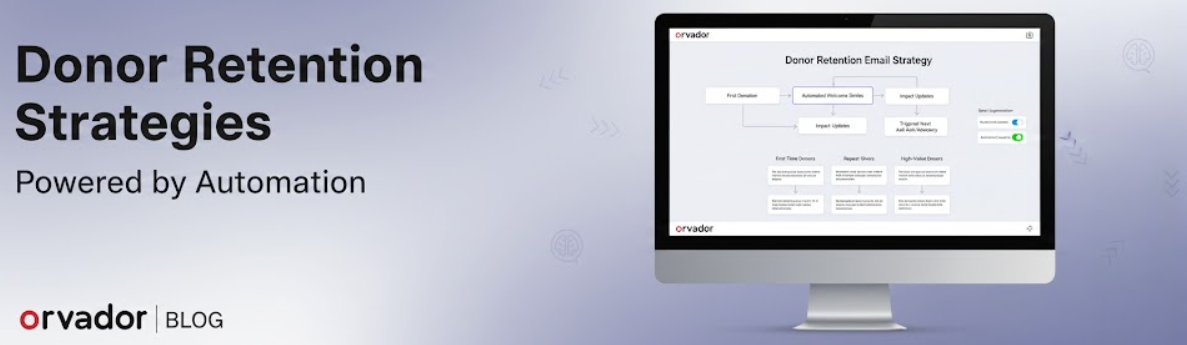
 

Donor Retention Through Email Automation: Segmenting Strategies for High-Value Giving

Donor Retention Strategies Start With Lifecycle Thinking

Donor Retention Through Email Automation: Segmenting Strategies for High-Value Giving


You must have experienced it the same way where getting donors is costly in terms of time, money and serious work, but retaining them is even more difficult. Attention-span is less, inboxes are congested, and general-to-fit all emails no longer suffice. That’s where a donor retention email strategy powered by smart automation steps in.

At Orvador, we’ve seen how thoughtful email marketing for nonprofits can turn one-time contributors into long-term partners. Automation can be done in a way that does not make it seem robotic, but rather personal, timely, and human. Virtually uncomplicated in its core, but effective in outcomes.

Donor Retention Strategies Start With Lifecycle Thinking

In order to be retention-oriented, you must think out of campaigns. The strategies of the Real Donor retention are based on the donor lifecycle which is first donation, repeat giving, and advocacy.

A strong donor lifecycle email marketing approach ensures that:

  1.   The new donors are welcome and appreciated.
  2.   Repeat donors experience the effect of their donations.
  3.   Valuable donors do not feel like they are being solicited.


Donor


Email Marketing For Nonprofits Works Best With Automation

Emails done manually are limited to a certain extent. Email automation for donors allows nonprofits to scale conversations without losing warmth.

Using nonprofit email campaigns by branding agency for ngos that are automation-driven, you are able to:

  1. Immediate thank-you emails on a donation.
  2. Trigger impact updates are given history based.
  3. Timetable notifications do not sound persuasive.

This is the place where Email automation of NGOs is retention engine, not a communication tool anymore.

Donor Segmentation Strategies Unlock Relevance

All donors are not the same – and your emails should not be either. Donor segmentation strategies help you group donors based on behavior, intent, and value.

Common segments include:

  1. First-time donors
  2. Repeat small-value donors
  3. Lapsed donors
  4. High-value and major donors

The concept of segmentation serves as an in between of automation and personalization. It is simply the key to even the most successful Automated email journeys of donors.

High-Value Donor Engagement Needs A Different Tone

In the case of high-value donor engagement, minor details count. These donors do not prefer to see frequent asks, they desire trust, transparency and impact.

Successful High-value donor segmentation gives attention to:

  1. Less emails and important ones.
  2. First-hand information and previews.
  3. Direct comments by leadership.

This tailored Donor retention email strategy often leads to higher lifetime value with fewer emails overall.

Automated Email Journeys For Donors Build Long-Term Trust

Automation is a process, not an event. Properly designed Automated email journeys of donors lead the supporters through anecdotes, milestones, and results.

Examples include:

  1. Inviting voyages of new donors.
  2. Post campaigns impact journeys.
  3. Re-engagement trips of dormant donors.

Every travel empowers your donor retention strategies as well as lessening manual workload.

Email Automation For Donors Improves Consistency

Credibility creates consistency. With email automation for donors and ngo digital marketing, you never miss a moment that matters.

Automation ensures:

  1. Timely acknowledgements
  2. Frequent impact communication.
  3. Foresightful, evidence-based outreach.

Such consistency is an important aspect of successful .

Measuring Success In Donor Retention Email Strategy

Nothing can be enhanced without being measured. A performance-focused Donor retention email strategy tracks metrics that actually matter.

Key KPIs include:

  1. Repeat donation rate
  2. Email engagement by segment
  3. Donor lifetime value
  4. Retention rate by journey

At Orvador, we align email marketing for nonprofits with real fundraising outcomes, not vanity metrics.

Ready To Improve Donor Retention With Automation?

If your emails feel scattered or underperforming, it’s time to rethink your approach. Orvador helps nonprofits design data-led Email automation for NGOs that feels personal, scalable, and sustainable.

Book a free donor email audit with Orvador today.


FAQ

  1. What is a donor retention email strategy?

A Donor retention email strategy uses segmented, automated emails to nurture donors across their lifecycle, increasing repeat giving and long-term engagement.


  1. How does donor segmentation improve retention?

Donor segmentation strategies ensure donors receive relevant content based on behavior and value, making emails feel more personal and effective.


  1. Is email automation suitable for small nonprofits?

Yes. Email automation for donors actually saves time and resources, making it ideal for lean nonprofit teams.


  1. How often should nonprofits email high-value donors?

For high-value donor engagement, quality matters more than quantity. Fewer, impact-driven emails work best.

Turning Case Studies into Donor Magnets: The Power of Impact Storytelling in Digital

Turning Case Studies into Donor Magnets: The Power of Impact Storytelling in Digital

The digital world today is full of noise and it is almost impossible to cut through it and reach potential supporters and make a connection. You are now in possession of the data, in possession of the results, but are you making a connection? It is not a statistic but a story, which is the hidden gun. Mastering Impact storytelling for non-profits is how you turn passive scrollers into passionate donors. It is not merely that you share what you do, but you make someone feel that they need to be a part of this. What happens to you when you read a story that really resonates? It’s the leverage we are going to open up and make your case studies your surest donor magnets.

Why Your Nonprofit Impact Storytelling Needs A Digital Shift

Statistics create faith, narratives create connections. Your annual report is critical to transparency, but it is a story that is well told that will be shared, remember and acted upon. Non-profit impact storytelling is the art of framing your mission around people. It is the difference between adhering to the rules and telling the story of the family where this 10,000 meals were the difference between stability and hope. This emotional bridge is critical for donor engagement case studies. These stories are fungible assets in the digital environment, ideal as social media bites, effective email campaigns, and impactful web functionality that is the heart of a contemporary nonprofit marketing plan. Imagine that you are changing the formal report into a compelling documentary about your work.

The Blueprint: Crafting a Winning Non-Profit Case Study Format

Your case studies that you have so far are enormous. The trick is to repackage them as more than dull papers into dramatic stories. At Orvador, we assist clients in embracing an established non-profit case study framework that abides by a coherent storyline, which is aimed at guiding the reader through empathy to action.

  1. The Problem: The Challenge: Begin with a person, not a problem. Present not only the statistics concerning housing insecurity, but also Maya, a single parent at risk of being evicted.
  2. The Journey & Your Role: Explain the way to change. What was the response of your organization? Give attention to human support, and not the program name only.
  3. The Transformational Outcome: This is the core of your impact story in the nonprofit. Show the new reality. So, what is the hope of Maya now? Use her words.
  4. The Invitation to Participate: There should be a clear connection of her change to the potential of the donor. You are able to bring the key to a stable family to another family.

This structure transforms facts into a relatable narrative, making your donor engagement case studies impossible to ignore. It’s a foundational element of sophisticated fundraising strategies for nonprofits.

Potential donor engaged with impact storytelling for non-profit content on a tablet
Strategic impact storytelling for non-profits meets supporters right where they are in their donor journey

Placing Your Story: The Strategy Of Donor Journey Mapping

It is only half the battle to create a great story. You have to pitch it to the right man at the right time. This is where strategic donor journey mapping becomes non-negotiable. Imagine it as a guide to the experience of your supporter with stories as the poles.

  1. Awareness (Top of Funnel): Nonprofits through short, compelling impact stories should be used in social media advertisements or in the blog. Even a 60-second video teaser can become an attraction to a brand-new audience.
  2. Consideration (Middle of Funnel): Offer more detailed donor engagement case studies in a dedicated email nurture series or on your “Our Work” page. Here, you build deeper trust.
  3. Decision (Bottom of Funnel): Put your best, full-length story in the middle of the donation pitch. Demonstrate the precise effect of a fifty dollar present.
  4. Advocacy (Post-Donation): Disseminate information about previous stories in thank-you messages and magazines. This has long-term effect and loyalty is created where one-time givers become life long champions.

This strategic approach ensures your storytelling for nonprofits online is a cohesive system, not a scattered effort. It is the distinction between screaming a tale into nothingness and having an emotional talk with a person willing to hear.

Digital Tools For Storytelling For Nonprofits Online

The Internet can provide amazing resources to make your stories come to life. Going beyond text enables you to relate on a higher level of sensation. Here’s how to enhance your nonprofit’s impact storytelling:

  1. Video Testimonials: There is no king like authenticity. The sincere and raw footage of a beneficiary expressing gratitude may be more effective than the highly produced one.
  2. Interactive Web Pages: Scroll-triggered animations, embedded audio clips, and pull-out quotes achieve a sense of immersion that transforms a visitor to the website into a participant in a story.
  3. Photo Essays with Captions: A potent set of photos on Instagram or Facebook, where a story is told between the captions, can halt a scroll and evoke a great deal of emotion.

Embracing these formats moves you beyond basic storytelling for nonprofits online and into creating shareable experiences that extend your reach organically. It is about embracing a normcore ethos around technology, which is accepting basic and easily available tools in remarkably productive ways to the service of your central mission.

The Orvador Method: Weaving Strategy into Every Narrative

You have seen your stories at Orvador as your most important strategic property. The way we do this is to systematize the way your impact becomes engagement.

  1. Deep-Dive Discovery: We listen to unravel your strongest stories, which support your strategic objectives.
  2. Journey-First Integration: We use donor journey mapping to create a content deployment plan, ensuring each story reaches its ideal audience at the perfect moment.
  3. Multi-Format Story Crafting: The essential story is converted into video scripts, social posts, and web copy with a consistent and professional voice.
  4. Amplification & Insight: We help share your stories and rigorously analyze performance, constantly refining to improve your fundraising strategies for nonprofits.

We believe a powerful nonprofit case study format is the engine of growth. That engine is what we have known as our expertise, throwing it in a new direction squarely your way.

Ready To Turn Your Impact Into Growth?

Your mission changes lives. Your communication must be no less potent. Through perfecting the art of impact storytelling of non-profits, you become no longer the one to report on your work but rather to offer an invitation to the world to be part of it. The best weapon you have to build your community and your resources is a strategic story that was strategically placed on the path of the donor.

Now, shall we write your next chapter? Book a free strategy session with Orvador to audit your existing stories and develop a plan to turn them into your best donor magnets.

FAQ

  1. How long should a good impact story be?
    It depends on the platform! A social media story can be 150 words or a 90-second video. A full donor engagement case study on your website can be 500-800 words. The key is to match the depth to the audience’s intent.


  1. We’re a small team with no video budget. What can we do?
    Start with what you have! A smartphone can record a powerful testimonial. Compelling photo pairs with a written quote can be incredibly effective. The authenticity of nonprofit impact storytelling often matters more than high production value.


  1. How do we measure if our stories are working?
    Track metrics like time-on-page for story articles, click-through rates in emails featuring stories, and, most importantly, conversion rates on donation pages linked from those stories. This data is gold for refining your nonprofit marketing strategy.


  1. How often should we share new impact stories?
    Consistency is key. Aim for one major, in-depth story per quarter, supported by smaller updates, testimonials, or “story echoes” (updates on past subjects) monthly. This keeps your storytelling for nonprofits online fresh and ongoing.

6 Advanced Blueprint: Maximizing Your Non-Profit’s Google Ad Grant Performance

Advanced Blueprint: Maximizing Your Non-Profit’s Google Ad Grant Performance

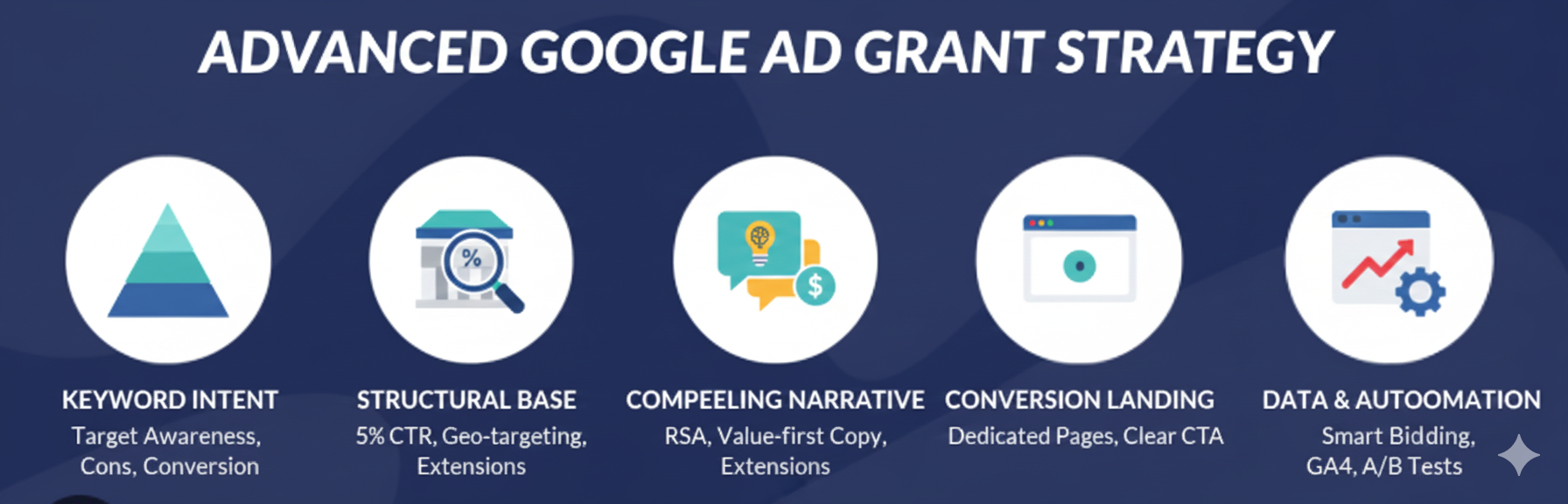
Consider your grant account to be a house foundation. When it is sloppy, all that is constructed on it will be unstable. Consider your grant account to be a house foundation. When it is sloppy, all that is constructed on it will be unstable. Effective Google Ads for nonprofits starts with a structurally sound, policy-compliant base. It implies that one should always surpass the 5% CTR threshold, apply powerful geo-targeting, and apply an entire package of ad extensions.
But the progressive thinking sees them not as work, but as tactical benefits. Arrange your account with surgical precision: form tightly themed ad groups around particular programs, donor intentions, or volunteer positions. This level of Google Ad Grants management creates clarity, allowing for precise messaging and measurement, the essential first step in any non-profit PPC strategy. And what does it feel like to realize that you are on solid ground and you are poised to grow big?

Advanced Google Ad Grant Strategy

At Orvador, we believe true Google Ad Grant maximization requires moving beyond basic compliance into the realm of sophisticated, mission-driven strategy. It is not merely about spending a budget, but spending every dollar you have to make yourself even more impactful, appeal to unwavering support, and push your cause ahead. We will discuss ways in which your grant can be turned into your most vibrant growth driver.

Mastering Keyword Intent: The Heart of Google Ad Grant Optimization

The core of Google Ad Grant maximization is a deep understanding of searcher intent. Get rid of the generic, high-volume keywords that appeal to window-shoppers. Rather, develop a strategic keyword pyramid:

  1. Awareness Level: M Mission-oriented words words (climate change solutions).
  2. Consideration Level: Search services that are local food bank volunteer opportunities.
  3. Level of Conversion: High motivation acts (donate to disaster relief today).

This intent-based approach is how you optimize Google Ad Grant spending for value, not just volume. Manage the conversation by using phrase match (“”) and exact match [ ] and have an uncompromising list of negative keywords. This disciplined focus ensures you connect with people at the exact moment they are ready to engage, which is the ultimate goal of nonprofit marketing with Google Grants.

Crafting Compelling Narratives: Ad Copy for Ad Grant Conversion Optimization

Your advertisement is your introduction. In the context of nonprofit marketing with Google Grants, your copy must resonate emotionally and prompt immediate action. We suggest a mix of normcore clarity (straight, reliable, message) and strong differentiators. Test various headlines and descriptions with the use of Responsive Search Ads (RSAs). Make value first: 100 per of Donations Finance Clean Water Projects or Join 50,000 Advocates of Change.

This is a critical Google Ad Grants optimization tip. Get the most out of your cause using all extensions: callout extensions, where you can advertise benefits, structured snippets, where you can advertise services, and multiple sitelinks that will help users navigate to a landing page. This comprehensive approach is key to maximizing Google Ad Grant performance.

The Conversion Crucible: Landing Pages for Non-Profit PPC Strategy

A click is a promise. It is stored in the landing page. Ad Grant conversion optimization lives and dies on the destination page. Prepare a special, targeted landing page for each of your major campaign themes. In case the ad is on mentorship, the page must be all about being a mentor. Eliminate navigation distractions, employ action-oriented imagery, and include one powerful call-to-action. Such a single point of focus lowers friction and leads the user covertly but decisively to conversion. It’s the pivotal piece that turns interest into action, answering the question of how to optimize Google Ad Grant efforts for tangible results.

Leveraging Data & Automation: Advanced Google Ad Grant Strategies

In order to scale, you need to adopt intelligent bidding and audience insights. Search campaigns are keyword-based; however, in Observation mode, audience signals can be used. Compare performance based on affinity groups (e.g., “Charity and Cause Supporters”) to narrow down your message. When it comes to bidding, Target CPA or Maximize Conversions Smart is an option that you can consider, especially in cases where you have predictable conversion data.
This allows Google’s machine learning to optimize bids in real-time for users most likely to convert, a pinnacle Google Ad Grant advanced strategy. It represents a shift from manual management to intelligent, automated Google Ad Grants management.

Building a Performance Culture: Continuous Google Ad Grants Optimization

A grant account is a living system. The analysis is an implicit requirement, and it is the key to growth. Move beyond clicks and measure meaningful conversions: petition signatures, newsletter subscriptions, and visits to the donation page. Figure out the customer experience using Google Analytics 4. What are the sources of engaged users? Where do they drop off? This data fuels a cycle of continuous testing and refinement; the essence of maximizing Google Ad Grant performance.
Test the value propositions of your ads A/B. Test landing page designs. It is this insatiable, investigative attitude that makes the difference between a high-performing non-profit and others. Are you willing to develop this culture of optimization?

Your Path to Masterful Google Ad Grant Maximization

Learning how to use Google Ad Grant is a promise to strategic excellence. It is a process of just using a tool to plan an elaborate and multi-channel non-profit PPC operation that expands with your purpose. By implementing these Google Ad Grant advanced strategies, focusing on intent, crafting compelling journeys, and embracing data, you transform your monthly grant into a predictable, scalable source of support and awareness. It is all about making your clicks count for your cause.

FAQ

  1. What’s the biggest mistake non-profits make with their Google Ad Grant?

The most common mistake is a passive, “set-and-forget” approach. Without ongoing Google Ad Grants optimization tips like keyword refinement, ad testing, and conversion tracking, the grant spends its budget inefficiently and fails to deliver meaningful results.

  1. How long does it take to see results from advanced optimization?

While some tweaks can improve CTR within weeks, building a fully optimized, conversion-focused account as part of a mature non-profit PPC strategy typically takes 3-6 months of consistent testing, data collection, and iteration.

  1. Can we really use all $10,000 every month with these strategies?

Absolutely. The challenge for many is spending it effectively. By moving up the funnel with awareness campaigns and deeply targeting high-intent donors and volunteers, maximizing Google Ad Grant performance often involves strategically spending the full budget to maximize reach and conversions.

  1. Is Smart Bidding, like Target CPA, suitable for Ad Grant accounts?

Yes, but with a prerequisite. Smart bidding is a powerful Google Ad Grant advanced strategy, but it requires consistent conversion data (typically 15-30 conversions per month per campaign) to learn effectively. Focus first on driving and tracking conversions before enabling these automated strategies.