TL;DR: Looking for grants for nonprofits in 2026? Funding now comes from three main channels – foundations, corporations, and government agencies- and each has its own databases, timelines, and paperwork. Unrestricted grants for nonprofits are harder to win but far more valuable than restricted, program-specific funding because you decide how to spend them. Government grants for nonprofits typically require SAM.gov and Grants.gov registration months before a deadline, so early setup matters. This guide walks through where to search for grants for nonprofit organizations, how to build a 12-month grant calendar, and a readiness checklist to run before you apply. If you want a funding source you can activate this week with zero application backlog, the Google Ad Grant gives eligible nonprofits $10,000 a month in free search advertising. We cover how it fits into your broader funding mix, and how Orvador can set it up for you, at the end of this guide.
Nonprofits chasing grants for nonprofits in 2026 are working in a noticeably different funding environment than they were even two or three years ago. Federal budgets have tightened in some categories and expanded in others, more foundations are experimenting with rolling and rapid-response applications, and corporate giving programs increasingly bundle cash with in-kind software credits. If your organization is still applying the way it did in 2022, you are likely missing funding sources that didn’t exist a few years back, and possibly wasting hours on databases that have gone stale.
This guide breaks down exactly where to look for grants for nonprofits in 2026, how foundation, corporate, and government funding differ in process and risk, and how to build a repeatable system so grant seeking stops being a once-a-year scramble.
1. The Grant Landscape in 2026: What’s Changed
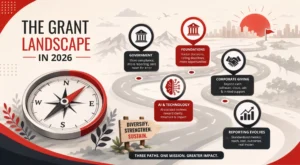
A few shifts are shaping how nonprofits should approach grants for nonprofit organizations this year.
Government funding has become more compliance-heavy. Agencies are asking for more detailed outcome reporting and cybersecurity attestations than they did a few years ago, particularly for federal pass-through grants administered at the state level. Organizations that haven’t updated their SAM.gov registration or their Unique Entity ID (UEI) in the last twelve months are finding applications rejected on technicalities before reviewers even read the narrative.
Foundations are moving faster. More private and community foundations have adopted rolling deadlines, letter-of-inquiry (LOI) triage, and shorter application windows modeled on participatory grantmaking. This is good news for smaller nonprofits without large development teams, but it also means funding pages need to be checked more frequently rather than bookmarked once a year.
Corporate giving has diversified beyond cash. Tech companies in particular have leaned into in-kind grants – software licenses, cloud credits, and advertising grants- as a lower-cost way to support the sector at scale. For a lean nonprofit, one of these in-kind grants can free up thousands of dollars a year in expenses that would otherwise compete with program funding.
AI-assisted proposal review has entered mainstream grantmaking. Some funders now use AI tools internally to pre-screen or summarize incoming applications, which puts a premium on proposals that are clearly structured, plainly written, and easy to parse, a shift that rewards well-organized applications over dense academic prose.
Reporting expectations have also become more standardized across channels. Where foundations, corporations, and government agencies once asked for wildly different formats, many now converge on similar outcome metrics – reach, cost per outcome, and demographic breakdowns of who a program served. Nonprofits that build one strong internal reporting system, rather than customizing from scratch for every funder, save significant staff time across an entire grant portfolio.
The practical upshot: nonprofits chasing grants for nonprofits now need a funding strategy that spans all three channels (foundation, corporate, and government) rather than leaning on just one. Organizations that diversify across all three tend to weather funding cuts in any single channel far better than those concentrated in one source, which is itself one of the strongest arguments for treating grants for non profits as a portfolio strategy rather than a single annual campaign.
2. Foundation Grants: Databases & How to Search Them
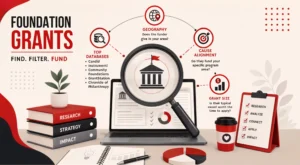
Foundation funding remains the most flexible and often the fastest-moving of the three channels, but it also requires the most active searching, since there is no single central database the way there is for federal grants.
Candid (formerly Foundation Center / GuideStar) is still the most comprehensive paid database for private and community foundation search, letting you filter by cause area, geography, and grant size, and cross-reference a foundation’s 990-PF filings to see who they’ve funded historically and at what dollar amounts. This history check matters. Many foundations only fund organizations working in specific regions or specific program areas, and a quick look at past grantees saves hours of writing proposals to funders who were never going to say yes.
Instrumentl is a subscription tool built specifically to match nonprofits to funders based on mission and past grant history, and it’s become popular with development teams that want automated deadline tracking layered on top of search.
Community foundations – there are hundreds across the US and UK covering specific cities or counties which are worth checking directly, since many maintain their own funding portals separate from Candid and specifically prioritize local or regional nonprofits, often with lighter application requirements than national funders.
GrantStation and the Chronicle of Philanthropy’s funding pages are useful lower-cost or free supplements, particularly for smaller organizations not ready to pay for a full Candid subscription.
When searching foundation databases for grants for nonprofits, three filters matter more than any keyword: geography (does the funder give in your state or country), cause alignment (do they fund your specific program area, not just your broad sector), and grant size (is their typical award in a range worth the hours it will take to apply). Skipping any of these three checks is the single biggest reason development teams waste time on foundation research that goes nowhere.
3. Corporate Grants & CSR Programs (Incl. In-Kind: Google, Canva, Microsoft)
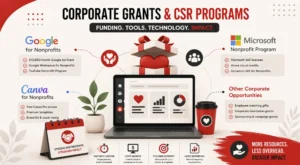
Corporate social responsibility (CSR) programs have become one of the more accessible funding channels for grants for nonprofit organizations, particularly for younger or smaller nonprofits that don’t yet have the grant history foundations look for.
Google for Nonprofits is the anchor of most tech-sector CSR strategies for the nonprofit space. Beyond the well-known $10,000/month Google Ad Grant (which we cover in detail in section 8), eligible organizations also get access to Google Workspace for Nonprofits at no cost, and YouTube Nonprofit Program features for storytelling and fundraising campaigns.
Canva for Nonprofits provides free access to Canva Pro, which includes premium design templates, brand kit tools, and stock media – a meaningful saving for organizations that would otherwise pay for design software or outsource basic graphics work.
Microsoft’s nonprofit program bundles free and discounted Microsoft 365 licenses, Azure cloud credits, and Dynamics 365 nonprofit-specific tools, aimed at organizations that need enterprise-grade software infrastructure without the enterprise price tag.
Other corporate grant programs worth tracking include employee-matching gift programs (which many companies operate quietly and nonprofits underuse), corporate foundation grant cycles tied to specific verticals (retailers funding food security, banks funding financial literacy, and so on), and sponsorship-style grants tied to specific campaigns or events.
The advantage of corporate and in-kind grants for non profits is speed. Many of these programs have simple online applications with fast turnaround, no LOI stage, and minimal reporting burden compared to government funding. The tradeoff is that most are restricted to a specific use (software, advertising, a named program) rather than general operating support, which is why they work best layered alongside, not instead of, foundation and government funding.
4. Government Grants: Where to Look & Register
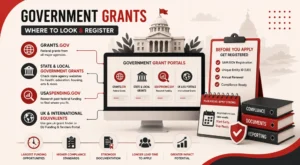
Government grants for nonprofits carry the largest dollar amounts available in the sector, but they also come with the heaviest compliance and reporting requirements, and the longest lead time before you can even submit an application.
Grants.gov is the single portal for federal discretionary grants in the US, covering everything from HHS and Department of Education funding to smaller agency-specific programs. Before you can apply for anything listed here, your organization needs an active SAM.gov registration and a Unique Entity ID (UEI). A process that can take several weeks the first time and needs annual renewal, so it should never be left until a deadline is close.
State and local government grants are frequently underused because they’re scattered across individual state agency websites rather than centralized in one database. Checking your state’s department pages for health, education, housing, or arts funding (depending on your program area) regularly surfaces smaller, less competitive grants that national nonprofits overlook.
USAspending.gov is a useful research tool even though it isn’t an application portal. It lets you see which federal agencies have funded organizations similar to yours in the past, which is a strong signal of where to focus limited grant-writing capacity.
UK and international equivalents. UK nonprofits should check gov.uk’s grant finder tool and individual local authority funding pages, while EU-based organizations can search the EU Funding & Tenders Portal for cross-border and country-specific programs.
Because government grants for nonprofits require the most upfront administrative setup (registration, compliance certifications, sometimes an audited financial statement). This is the channel where starting early pays off the most. An organization that registers with SAM.gov and Search federal grants on Grants.gov in January, well before any specific deadline, is in a far stronger position by application season than one starting registration the week a deadline opens.
5. Unrestricted vs Restricted Funding: Strategy

Not all grants for nonprofits carry the same strategic value, even when the dollar amounts look similar on paper. Understanding the difference between restricted and unrestricted funding should shape which grants your team prioritizes.
Restricted grants are tied to a specific program, project, or expense category – a foundation funding only your after-school tutoring program, for instance, or a corporate grant that can only be spent on advertising. These are usually easier to win because the funder’s intent is narrow and specific, and they’re valuable for growing a named program. But they can also create a “restricted funding trap,” where an organization’s overhead, staff salaries, and general operations remain underfunded even as program-specific grants pile up.
Unrestricted grants for nonprofits – sometimes called general operating support- let the organization decide how the money is spent, whether that’s covering rent, paying staff, investing in fundraising infrastructure, or filling a budget gap a restricted grant can’t touch. These grants are harder to win because funders are trusting the organization’s judgment rather than funding a specific, easily measured outcome, and they typically require a stronger track record and clearer impact reporting to secure.
A workable strategy is to treat restricted grants as the majority of an application pipeline, since they’re more numerous and more accessible, while actively cultivating relationships with a smaller number of funders capable of offering unrestricted support. Often, the same foundations that started with a restricted grant and increased trust (and flexibility) over multiple funding cycles. Multi-year unrestricted commitments, when they can be secured, are typically the single most valuable outcome a development team can achieve, since they reduce the year-to-year scramble that restricted, single-cycle funding creates.
6. Building a 12-Month Grant Calendar
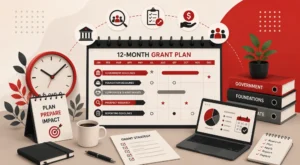
Because grants for nonprofit organizations come from three different channels with three different timelines, a single shared calendar is the only way to avoid missed deadlines and duplicated effort.
Start with government deadlines, since they’re the most fixed and the least forgiving. Federal agencies publish annual or multi-year funding cycles well in advance, so these should anchor the calendar first. Mark not just the submission deadline but the SAM.gov/Grants.gov registration renewal date, ideally 60–90 days before any major federal application.
Layer in foundation deadlines next, distinguishing between fixed annual deadlines and rolling/LOI-based funders. For rolling funders, set an internal quarterly check-in rather than a single date, since these opportunities can open and close with little notice.
Add corporate and in-kind grant cycles, many of which (like the Google Ad Grants for nonprofits) don’t have a fixed annual deadline at all and can be applied for as soon as eligibility requirements are met. These should be treated as “apply now” items rather than calendar deadlines.
Build in prospect research time, not just application-writing time. A common mistake is filling the calendar only with deadlines for grants already identified, leaving no dedicated time to search for new grants for non profits opportunities that open mid-year.
Schedule reporting deadlines with the same weight as application deadlines. Missed or late grant reports are one of the most common, and most avoidable, reasons a funder declines to renew, and they deserve calendar space just as much as the original application.
A well-built 12-month calendar turns grant seeking from a reactive scramble into a predictable operating rhythm, which is ultimately what separates nonprofits that grow their grant revenue year over year from those that plateau.
Assign ownership for each calendar item, not just a date. A deadline without a named owner tends to slip, especially in small development teams juggling multiple roles. Even a simple shared spreadsheet with a deadline column, an owner column, and a status column outperforms a calendar that lists dates alone. Reviewing the calendar monthly, not just at the start of the year, also catches new grant opportunities for nonprofit organizations that open outside the original planning cycle – new corporate CSR programs, emergency response funds, and mid-year foundation initiatives all tend to appear with little advance notice.
7. Grant Readiness Checklist Before You Apply
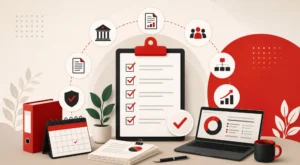
Before submitting any application for grants for nonprofits, run through this readiness checklist. Funders reject a surprising number of otherwise strong applications over items on this list rather than the quality of the program itself.
- Current 501(c)(3) determination letter (or country equivalent) on file and easy to attach
- Audited financials or a recent Form 990 ready to share, since most funders request at least one
- A clear, concise case for support – mission, program description, and target outcomes in plain language, not internal jargon
- Board list and key staff bios, since funders evaluate organizational capacity as much as the program itself
- A logic model or theory of change connecting activities to outcomes, which most foundation and government funders now expect as standard
- SAM.gov registration and UEI current (required for any federal government grants for nonprofits application)
- A realistic budget that matches the request amount and shows other committed or pending funding sources
- Data infrastructure – a donor/grants database or CRM that can produce the outcome metrics funders will ask for in reporting, not just at application time
If your organization is also actively working on proposal quality itself, our guide on using AI to write stronger grant proposals covers how to speed up drafting without losing the voice and specificity funders respond to.
Start With the Free $10K/Month Google Ad Grant – We’ll Set It Up
Before you spend weeks chasing foundation LOIs or building out a government compliance file, there’s a funding source most nonprofits qualify for right now: the Google Ad Grant, worth up to $10,000 a month in free Google Search advertising. Unlike most grants for nonprofits, it doesn’t have an annual deadline, doesn’t require a written proposal, and can be reinvested every month into donor acquisition, volunteer recruitment, and awareness campaigns that support the rest of your funding strategy.
Orvador handles the entire process – eligibility review, application, account setup, and ongoing compliance management- so your team can focus on foundation and government applications while your Ad Grant account runs in the background. Read our full breakdown of Google Ad Grants eligibility and management, or reach out and we’ll assess your nonprofit’s eligibility for free.