TL;DR: Donors, volunteers, and grant researchers are increasingly asking ChatGPT, Perplexity, and Google AI Overviews for nonprofit recommendations instead of scrolling search results. Generative Engine Optimization (GEO) is the practice of structuring your content so AI engines can understand, trust, and cite your organization. This guide breaks down how GEO differs from classic SEO for nonprofit websites, what signals AI models use to decide who gets recommended, and a practical checklist covering entities, FAQs, structured data, and digital PR, plus how to measure whether it’s working.
Search Is Changing: Where Donors Ask Questions in 2026
A few years ago, “seo for nonprofit” meant one thing: rank on page one of Google. That’s no longer the whole picture. In 2026, a growing share of donors, volunteers, and even institutional funders start their research inside a chat window, not a search bar. Someone deciding where to give this quarter might simply ask ChatGPT, “which education nonprofits in [region] have the strongest track record?” A program officer scoping grantees might ask an AI assistant to summarize an organization’s impact before ever visiting the website.
This shift matters because generative engines don’t return ten blue links. They return one synthesized answer, often naming two or three organizations by name. If your nonprofit isn’t part of that answer, you’re invisible at the exact moment someone is deciding who to trust. That’s the gap GEO is built to close, and it’s why we’ve made it a standalone service alongside our nonprofit SEO work rather than treating it as an afterthought.
What GEO Is (and How It Differs From Classic SEO)
Generative Engine Optimization is the discipline of optimizing content so large language models (ChatGPT, Claude, Gemini, Perplexity) can accurately extract, understand, and cite it when generating answers. It shares DNA with traditional SEO, but the mechanics diverge in a few important ways.
Classic nonprofit website SEO best practices for 2025 and beyond still matter: fast page speed, clean URL structure, keyword-aligned headings, backlinks. But ranking algorithms and generative engines don’t evaluate content the same way. Search engines rank pages; AI engines extract facts, statistics, and claims from pages and recombine them into a new answer. That means:
- Clarity beats cleverness. AI models favor content that states facts plainly and early, rather than burying the answer under a long narrative lead-in.
- Source credibility carries more weight. If your data point is cited elsewhere (a partner site, a press mention, a directory listing), an AI model is more likely to trust and repeat it.
- Structure is read as meaning. Headings, lists, and tables aren’t just for skimmers anymore; they help language models parse what a section is actually about.
For a nonprofit, this means GEO and SEO for nonprofit organizations should run together, not as competing budgets. Our GEO services for nonprofits are built to sit on top of existing SEO foundations rather than replace them.
How AI Engines Pick Which Nonprofits to Cite
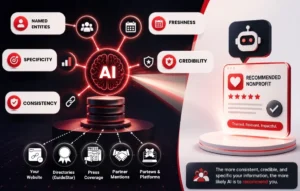
AI for nonprofits isn’t magic; it’s pattern recognition applied at scale. When a generative engine is asked to recommend or describe an organization, it’s pulling from a blend of sources: your own website, third-party mentions (GuideStar/Candid, press coverage, partner nonprofits, review platforms), and structured data markup that explicitly labels who you are and what you do.
A few patterns we’ve observed in how AI engines choose which nonprofits to surface:
- Named entities win. Organizations that consistently use their full, exact name (not “we” or “our team”) across pages are easier for a model to associate facts with.
- Specificity beats vagueness. “We’ve provided clean water access to 40,000 people across 12 districts since 2019” is far more citable than “we’ve made a big impact on water access.”
- Consistency across the web matters. If your mission statement, program numbers, and location differ between your website, your GuideStar profile, and a press release, AI engines struggle to resolve which version is authoritative, and often skip citing you at all.
- Freshness signals trust. Pages that are clearly dated and recently updated are treated as more reliable than static, undated content.
This is why ChatGPT for nonprofits visibility isn’t just a content problem. It’s a consistency and structure problem that spans your whole digital footprint.
The GEO Checklist: Entities, FAQs, Structured Data, Digital PR
Here’s the practical framework we run for every NGO client moving into GEO.
Entity clarity
- State your organization’s full legal name, mission, founding year, and service area explicitly on your About page, not just in a tagline.
- Use the same entity name and phrasing consistently across your website, social bios, and third-party listings.
- Name your programs specifically (with proper nouns) rather than describing them generically.
FAQ-formatted content
- Add a genuine FAQ section to key pages, phrased as real questions donors and volunteers ask (“How is my donation used?” “Is [org] a registered 501(c)(3)?”).
- Answer each question in 2-3 sentences immediately, before adding nuance. This is the format generative engines lift most easily.
Structured data
- Implement Organization, FAQPage, and Article schema markup so AI crawlers can parse your identity and content type programmatically.
- Mark up donation pages, program pages, and impact reports with relevant schema so numbers and outcomes are machine-readable.
Digital PR and third-party mentions
- Pursue coverage, partner mentions, and directory listings (GuideStar, Charity Navigator, local press) that reference your organization by exact name.
- Encourage partner organizations and grant funders to link to and mention you consistently. Third-party corroboration is one of the strongest trust signals AI engines use.
Together, these four pillars are what separate a nonprofit that gets cited by AI search from one that gets skipped entirely, regardless of how strong its actual programmatic impact is.
Measuring AI-Search Visibility
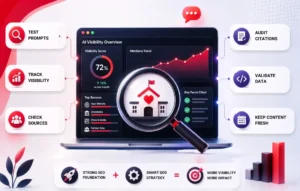
Traditional SEO has mature analytics: rankings, organic traffic, click-through rate. GEO measurement is younger, but a few practical methods work today:
- Manual prompt testing. Regularly ask ChatGPT, Perplexity, and Gemini the questions your donors would ask (“best nonprofits working on [cause] in [region]”) and track whether, and how, your organization appears.
- Referral traffic from AI platforms. Check your analytics for traffic sourced from chat.openai.com, perplexity.ai, and similar referrers; this segment is growing but still often mislabeled as “direct” traffic, so filtering carefully matters.
- Citation audits. Track whether your key facts (program numbers, mission statement, impact stats) appear correctly when AI tools summarize your organization. Inconsistent or outdated citations are a signal to update source content.
- Structured data validation. Periodically test your schema markup with validation tools to confirm AI crawlers can parse it without errors.
None of these replace classic SEO metrics. They sit alongside them, because a nonprofit with strong seo for nonprofit fundamentals is already halfway to AI-search visibility.
Case Notes: What We’re Seeing Across NGO Clients
Across the nonprofit accounts we manage, a consistent pattern has emerged: organizations with clear, consistently repeated program names and specific impact numbers get cited by AI tools noticeably more often than organizations with similar (or even larger) actual impact but vaguer messaging. Clients who added FAQ sections written in plain donor language to their program and grants pages saw those exact questions echoed back, sometimes verbatim in structure, when we tested AI search prompts.
We’ve also seen that nonprofits investing in digital PR and consistent third-party listings (rather than website content alone) tend to appear in AI-generated recommendation lists faster than those relying purely on on-site optimization. This reinforces that AI for nonprofits visibility is a cross-channel effort, not a one-page fix, which is exactly why we treat GEO as a layered service built on top of core nonprofit website SEO best practices, not a bolt-on tactic.
Do I need to choose between ChatGPT optimization and Google SEO?
No. The same foundational work (clear entity information, structured content, FAQs, schema markup) improves visibility across both traditional search and AI engines simultaneously.
Ready to make sure your organization is part of the answer when donors ask AI tools who to support? Explore our GEO services for nonprofits and see how we pair it with proven nonprofit SEO strategy to build visibility across both search and AI.