Getting the grant is the easy bit. Keeping it takes more work. Google can pause an account that slips on click-through rate, keyword quality, conversion tracking or basic activity, and the warning you get is often short.
This guide walks through the Google Ad Grants policy rules that matter in 2026, starting with the 5% CTR rule. It ends with a monthly checklist your team can run to stay compliant.
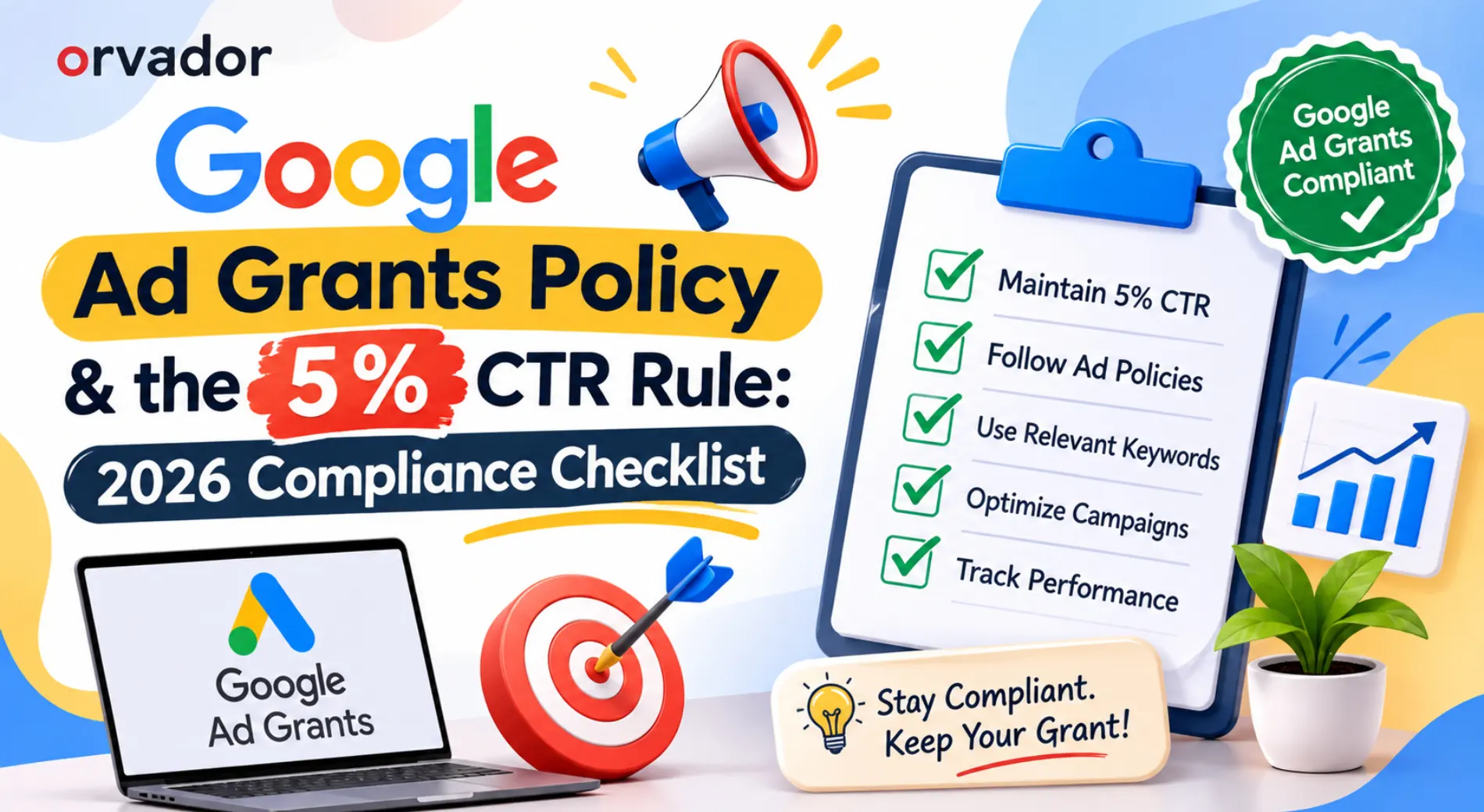
Quick answer: To stay compliant, a Google Ad Grants account needs to:
- Keep an account-wide CTR of at least 5% every month.
- Record at least one valid conversion each month.
- Avoid single-word and overly generic keywords.
- Remove any keyword with a Quality Score of 1 or 2.
- Run at least two ad groups per campaign and two ads per ad group.
- Use at least two sitelinks.
- Complete the annual programme survey.
If CTR stays under 5% for two months in a row, the account can be deactivated.
If keeping up with all this is stretching your team, our Google Ad Grants compliance management service checks every one of these points each month.
The 5% CTR rule explained
CTR is simply clicks divided by impressions. Your Google Ad Grants 5% CTR is measured across the whole account, for each calendar month. Fall short two months running and Google can deactivate the account.
Here’s how that looks in practice. 50 clicks on 1,000 impressions is a 5% CTR, so you’re fine. 40 clicks on the same 1,000 impressions is 4%, and that puts the grant at risk.
Why accounts slip below 5%
Most accounts drop below the line for the same handful of reasons:
- Broad keywords are matching searches that only loosely relate to your cause.
- Ads don’t echo what the person searched for, or don’t give them a clear next step.
- There aren’t enough negative keywords, so ads appear for searches that were never meant for you.
- The account leans on informational keywords from people who aren’t ready to act.
- Sitelinks and other assets are missing, which leaves ads smaller and easier to scroll past.
How to fix a low CTR
- Pause the weak keywords. Sort your keywords by CTR and pause the ones pulling the average down, until the account total is back above 5%.
- Tighten your match types. Move your important terms to phrase or exact match.
- Add negatives every week. The search terms report shows you exactly which irrelevant queries to block.
- Rewrite your ads. Put the keyword in the headline, name one specific benefit and end with a clear call to action.
- Use every asset available. Add sitelinks, callouts and structured snippets to each campaign.
- Look after your brand campaign. Branded searches usually get very high CTRs, which helps hold up the account average.
An unfixed CTR problem is the most common reason we see grants suspended. If yours has already been paused, our guide on getting a suspended Google Ad Grant reactivated covers what to do next.
Keyword, structure, conversion and bidding rules
| Policy area | The rule | What breaks it |
|---|---|---|
| Keyword quality | No keywords with a Quality Score of 1 or 2 | Leaving low-QS keywords active |
| Single-word keywords | Not allowed, except your own brand and a few Google-approved exceptions | Keywords like “donate” or “volunteer” on their own |
| Generic keywords | Overly broad terms are not allowed | “free videos”, “best ideas”, “news today” |
| Mission relevance | Every keyword and ad must relate to your mission and programmes | Targeting trending or unrelated topics for traffic |
| Account structure | At least 2 ad groups per campaign, 2 ads per ad group, 2 sitelink assets | One-ad-group campaigns, single ads |
| Geo-targeting | Target locations relevant to your work | Worldwide targeting with no clear reason |
| Conversion tracking | Valid conversion tracking with at least 1 conversion per month | No tracking, broken tags, or inflated “conversions” like page views |
| Bidding | Manual bids capped at $2 per click; Maximise Conversions bidding can bid above it | Manual bidding that can’t compete for valuable terms |
Conversion tracking: the quiet account killer
Google wants to see conversions that reflect real mission value. Think donations, volunteer sign-ups, newsletter subscriptions, event registrations, contact forms or meaningful downloads.
Counting page loads or every button click as a conversion makes your conversion rate look better than it is. An unusually high rate can trigger a review. Set conversions up properly in GA4 and Google Tag Manager, and audit them every quarter.
For a closer look at what belongs in your keyword list, see our Google Ad Grants keywords guide.
Account activity, annual survey and website policy
Keep the account active
Google expects someone to be looking after the grant. Log in regularly and make real improvements, like adding keywords, testing ads or building out negatives. An account left untouched for a long stretch is at risk of deactivation.
Don’t miss the annual programme survey
Once a year, Google sends a programme survey to the email address on your account. If it goes unanswered, your grant can be paused. Make sure the admin inbox is actually monitored and that one person owns this task.
Keep your website in line
Your site needs to sit on your own domain, load quickly, use HTTPS and stay focused on your mission. Commercial activity can’t be its main purpose. Your ads should also lead to pages that deliver on what the ad promised.
Google’s own Ad Grants programme policies are the final word, and the rules do change. Read through them at least twice a year.
Monthly Google Ad Grants compliance checklist
Run through this in the first week of each month.
Want us to run the checklist for you?
Orvador has managed Google Ad Grants for nonprofits since 2019. Every month we check CTR, keywords and conversions, and we fix problems before Google flags them. Get a free Google Ad Grants account audit.