Advanced Blueprint: Maximizing Your Non-Profit’s Google Ad Grant Performance
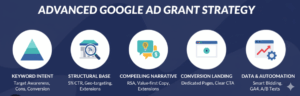
Consider your grant account to be a house foundation. When it is sloppy, all that is constructed on it will be unstable. Consider your grant account to be a house foundation. When it is sloppy, all that is constructed on it will be unstable. Effective Google Ads for nonprofits starts with a structurally sound, policy-compliant base. It implies that one should always surpass the 5% CTR threshold, apply powerful geo-targeting, and apply an entire package of ad extensions.
But the progressive thinking sees them not as work, but as tactical benefits. Arrange your account with surgical precision: form tightly themed ad groups around particular programs, donor intentions, or volunteer positions. This level of Google Ad Grants management creates clarity, allowing for precise messaging and measurement, the essential first step in any non-profit PPC strategy. And what does it feel like to realize that you are on solid ground and you are poised to grow big?
At Orvador, we believe true Google Ad Grant maximization requires moving beyond basic compliance into the realm of sophisticated, mission-driven strategy. It is not merely about spending a budget, but spending every dollar you have to make yourself even more impactful, appeal to unwavering support, and push your cause ahead. We will discuss ways in which your grant can be turned into your most vibrant growth driver.
Mastering Keyword Intent: The Heart of Google Ad Grant Optimization
The core of Google Ad Grant maximization is a deep understanding of searcher intent. Get rid of the generic, high-volume keywords that appeal to window-shoppers. Rather, develop a strategic keyword pyramid:
- Awareness Level: M Mission-oriented words words (climate change solutions).
- Consideration Level: Search services that are local food bank volunteer opportunities.
- Level of Conversion: High motivation acts (donate to disaster relief today).
This intent-based approach is how you optimize Google Ad Grant spending for value, not just volume. Manage the conversation by using phrase match (“”) and exact match [ ] and have an uncompromising list of negative keywords. This disciplined focus ensures you connect with people at the exact moment they are ready to engage, which is the ultimate goal of nonprofit marketing with Google Grants.
Crafting Compelling Narratives: Ad Copy for Ad Grant Conversion Optimization
Your advertisement is your introduction. In the context of nonprofit marketing with Google Grants, your copy must resonate emotionally and prompt immediate action. We suggest a mix of normcore clarity (straight, reliable, message) and strong differentiators. Test various headlines and descriptions with the use of Responsive Search Ads (RSAs). Make value first: 100 per of Donations Finance Clean Water Projects or Join 50,000 Advocates of Change.
This is a critical Google Ad Grants optimization tip. Get the most out of your cause using all extensions: callout extensions, where you can advertise benefits, structured snippets, where you can advertise services, and multiple sitelinks that will help users navigate to a landing page. This comprehensive approach is key to maximizing Google Ad Grant performance.
The Conversion Crucible: Landing Pages for Non-Profit PPC Strategy
A click is a promise. It is stored in the landing page. Ad Grant conversion optimization lives and dies on the destination page. Prepare a special, targeted landing page for each of your major campaign themes. In case the ad is on mentorship, the page must be all about being a mentor. Eliminate navigation distractions, employ action-oriented imagery, and include one powerful call-to-action. Such a single point of focus lowers friction and leads the user covertly but decisively to conversion. It’s the pivotal piece that turns interest into action, answering the question of how to optimize Google Ad Grant efforts for tangible results.
Leveraging Data & Automation: Advanced Google Ad Grant Strategies
In order to scale, you need to adopt intelligent bidding and audience insights. Search campaigns are keyword-based; however, in Observation mode, audience signals can be used. Compare performance based on affinity groups (e.g., “Charity and Cause Supporters”) to narrow down your message. When it comes to bidding, Target CPA or Maximize Conversions Smart is an option that you can consider, especially in cases where you have predictable conversion data.
This allows Google’s machine learning to optimize bids in real-time for users most likely to convert, a pinnacle Google Ad Grant advanced strategy. It represents a shift from manual management to intelligent, automated Google Ad Grants management.
Building a Performance Culture: Continuous Google Ad Grants Optimization
A grant account is a living system. The analysis is an implicit requirement, and it is the key to growth. Move beyond clicks and measure meaningful conversions: petition signatures, newsletter subscriptions, and visits to the donation page. Figure out the customer experience using Google Analytics 4. What are the sources of engaged users? Where do they drop off? This data fuels a cycle of continuous testing and refinement; the essence of maximizing Google Ad Grant performance.
Test the value propositions of your ads A/B. Test landing page designs. It is this insatiable, investigative attitude that makes the difference between a high-performing non-profit and others. Are you willing to develop this culture of optimization?
Your Path to Masterful Google Ad Grant Maximization
Learning how to use Google Ad Grant is a promise to strategic excellence. It is a process of just using a tool to plan an elaborate and multi-channel non-profit PPC operation that expands with your purpose. By implementing these Google Ad Grant advanced strategies, focusing on intent, crafting compelling journeys, and embracing data, you transform your monthly grant into a predictable, scalable source of support and awareness. It is all about making your clicks count for your cause.
FAQ
- What’s the biggest mistake non-profits make with their Google Ad Grant?
The most common mistake is a passive, “set-and-forget” approach. Without ongoing Google Ad Grants optimization tips like keyword refinement, ad testing, and conversion tracking, the grant spends its budget inefficiently and fails to deliver meaningful results.
- How long does it take to see results from advanced optimization?
While some tweaks can improve CTR within weeks, building a fully optimized, conversion-focused account as part of a mature non-profit PPC strategy typically takes 3-6 months of consistent testing, data collection, and iteration.
- Can we really use all $10,000 every month with these strategies?
Absolutely. The challenge for many is spending it effectively. By moving up the funnel with awareness campaigns and deeply targeting high-intent donors and volunteers, maximizing Google Ad Grant performance often involves strategically spending the full budget to maximize reach and conversions.
- Is Smart Bidding, like Target CPA, suitable for Ad Grant accounts?
Yes, but with a prerequisite. Smart bidding is a powerful Google Ad Grant advanced strategy, but it requires consistent conversion data (typically 15-30 conversions per month per campaign) to learn effectively. Focus first on driving and tracking conversions before enabling these automated strategies.